◆ Observations
Observation: The Collapse of Vertical and Horizontal Integration
Core insight: integration is not the joining of separate parts; it is the recognition that the parts were already connected.
Inscribed June 4, 2026
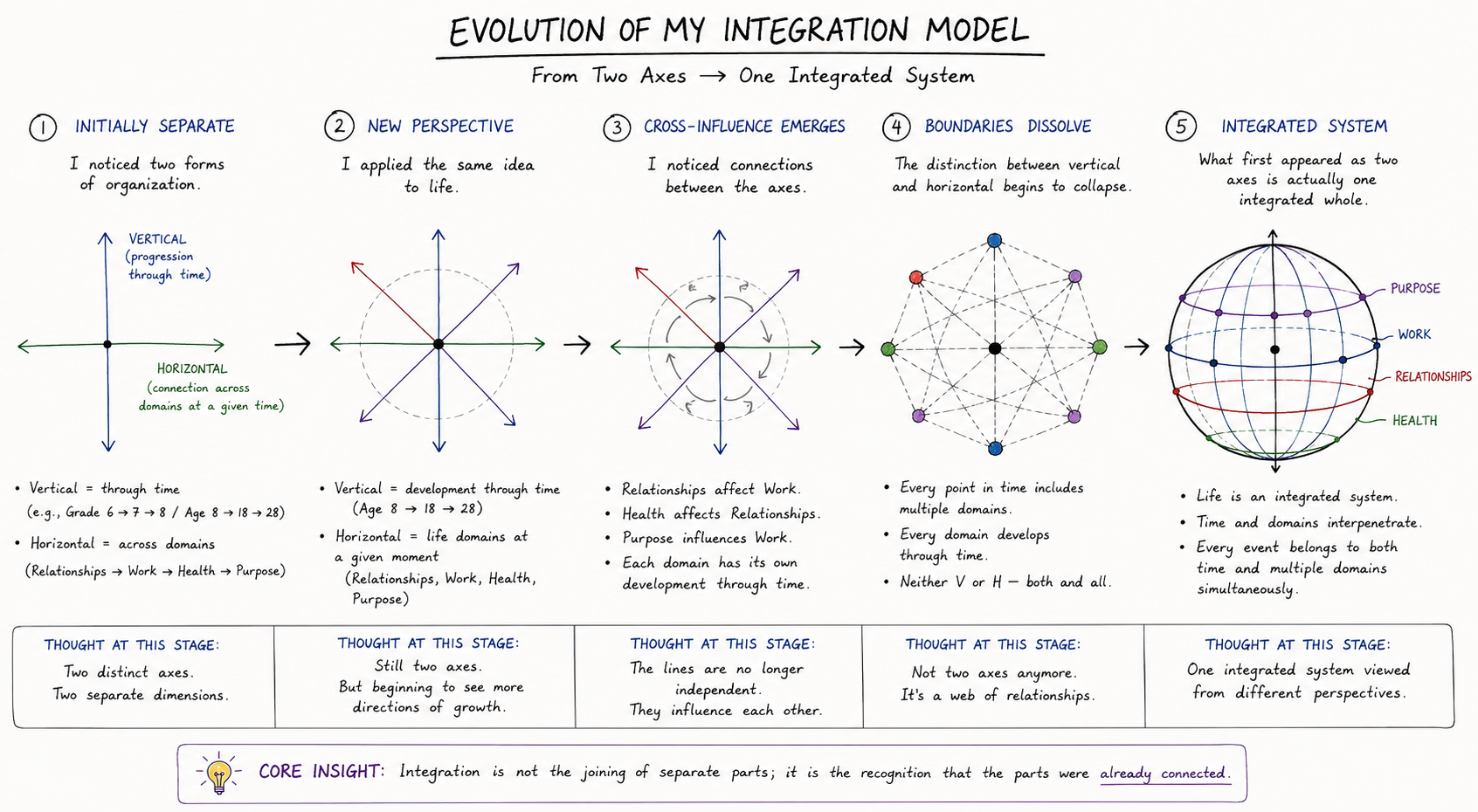
While reflecting on educational integration, I noticed that learning is commonly organized in two ways.
The first is vertical integration, which refers to progression through time. A student moves from Grade 6 English to Grade 7 English and then to Grade 8 English. Knowledge develops sequentially.
The second is horizontal integration, which refers to connections across subjects at the same point in time. Grade 6 English, Grade 6 Mathematics, and Grade 6 Science are studied simultaneously and may reinforce one another.
Initially, these appeared to be distinct forms of organization. One described development through time, while the other described relationships across domains.
I then wondered whether the same framework could be applied to life itself.
Vertical integration in life seemed straightforward. Human development unfolds across time: age 8, age 18, age 28, and beyond. Each stage builds upon previous experiences.
Horizontal integration appeared equally clear. At any given moment, life consists of multiple domains operating simultaneously: relationships, work, health, purpose, learning, community, and other dimensions of experience.
At first, these seemed to represent two separate axes of growth.
However, when I attempted to maintain the distinction, difficulties emerged.
Relationships develop through time. Work progresses through stages. Health changes across the lifespan. Purpose evolves as experiences accumulate. What I had classified as horizontal domains all possessed their own vertical trajectories.
At the same time, every developmental stage contained multiple domains. Age 18 is not merely a point in time; it includes relationships, work, health, identity, and purpose. What I had classified as vertical development was already composed of horizontal dimensions.
The categories began to overlap.
The more closely I examined them, the more each axis appeared embedded within the other. Horizontal domains contained vertical development. Vertical development contained horizontal domains.
What initially seemed to be two independent forms of organization gradually became a network of mutual influence. Changes in one area affected all others. Health influenced relationships. Relationships influenced purpose. Purpose influenced work. Work influenced health. Development no longer appeared linear or compartmentalized.
This led to a shift in perspective.
Rather than viewing vertical and horizontal integration as separate structures, I began to see them as analytical distinctions imposed upon a reality that is already interconnected. The categories were useful for observation, but they did not fully describe the phenomenon itself.
The final model was not a better separation of the two axes but the recognition that the separation was incomplete. What appeared as two dimensions gradually revealed itself as a single integrated system.
From one perspective, this system can be viewed through time and described as development. From another perspective, it can be viewed through domains and described as interconnectedness. Yet both perspectives refer to the same underlying reality.
The insight was not that separate parts become integrated. The insight was that integration exists prior to the distinctions. The distinctions help us think about the system, but the system itself is already whole.
Reflective Insight
The progression of this observation mirrors a broader movement from categorical thinking toward systems thinking. Understanding begins by dividing reality into parts, but deeper observation reveals relationships that transcend the categories themselves. Integration may therefore be less about connecting separate elements and more about recognizing the unity that was present from the beginning.
One question awaits you.
✦ End of scroll ✦