◆ Revelations
Natural Law and Emergent Law: Two Ways Law Comes Into Being
Truth → Law → two forms of Law → different catalysts → different functions. The asymmetry is actually part of the argument, not a gap in it.
Inscribed August 20, 2026
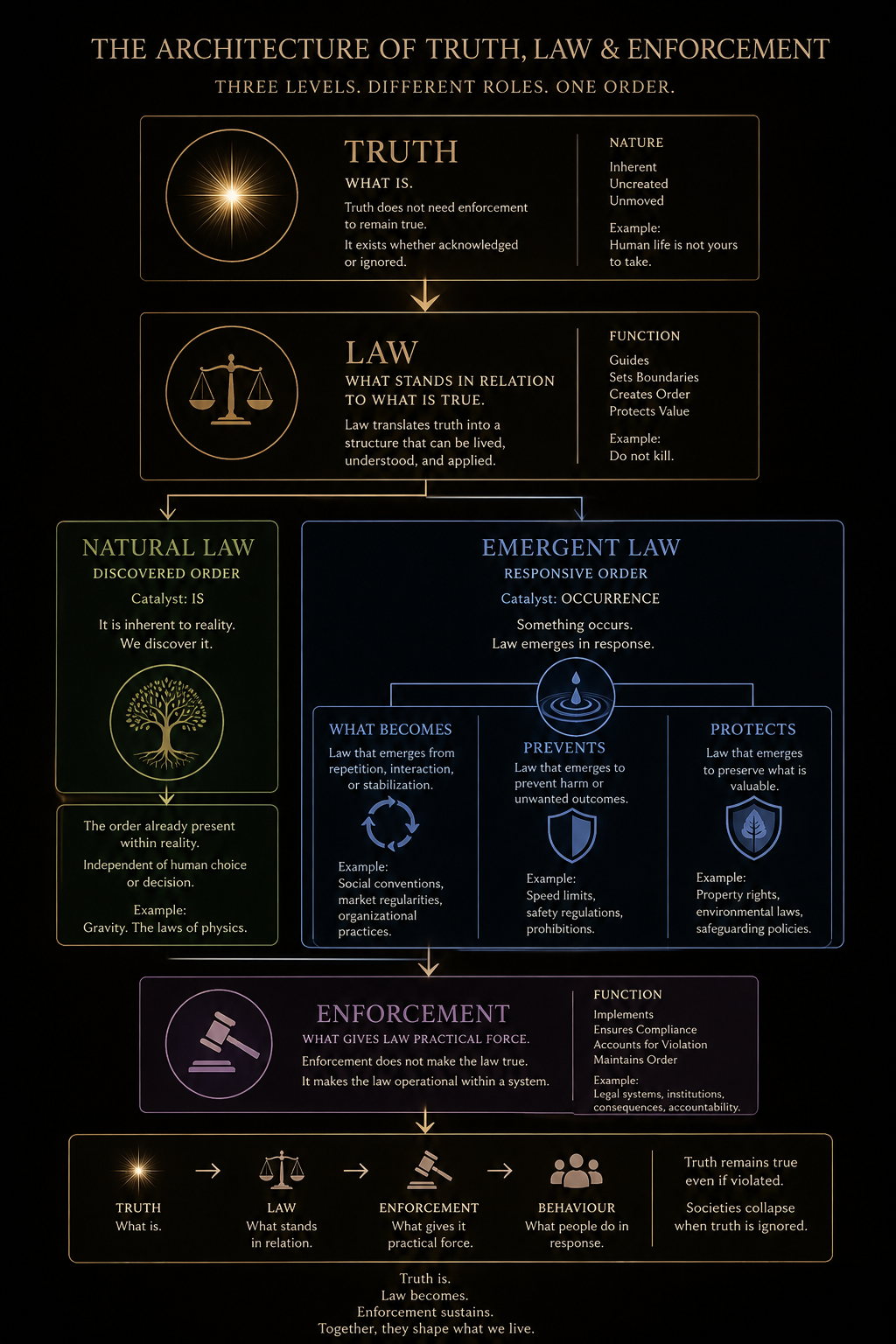
If Truth is what is, then Law is what stands in relation to what is true.
Law gives structure to what is discovered, recognized, protected, governed, or brought into operation.
But Law does not come into being in only one way.
There are two fundamental forms:
Natural Law.
Emergent Law.
The distinction is simple.
Natural Law is.
Emergent Law responds.
And this difference begins with their catalysts.
◇ Commentary
The Architecture
TRUTH
│
▼
LAW
│
┌──────────────┴──────────────┐
│ │
▼ ▼
NATURAL LAW EMERGENT LAW
│ │
Catalyst: IS Catalyst: OCCURRENCE
│ │
DISCOVERED ORDER RESPONSIVE ORDER
│
┌────────────────┼────────────────┐
│ │ │
▼ ▼ ▼
WHAT BECOMES PREVENTS PROTECTS
│
▼
ENFORCEMENT
│
▼
MANIFESTATION
The architecture is deliberately uneven.
Natural Law has one fundamental category:
Discovered Order.
Emergent Law has several forms.
That is not an omission.
It is a consequence of their different origins.
Natural Law has one fundamental source:
What is.
Emergent Law can arise from many conditions within what is.
What occurs.
And once Emergent Law exists, it may require another layer to become operational:
Enforcement.
This distinction matters.
Because Truth, Law, Enforcement, and behaviour are not the same thing.
Natural Law
Natural Law is the order already present within reality.
It is not legislated.
It is not negotiated.
It is not voted into existence.
It is discovered.
Gravity is the obvious example.
Gravity did not begin when Newton described it.
The universe did not wait for humanity to formulate the law before behaving according to it.
Newton recognized a pattern.
Einstein later described the same underlying reality through a deeper framework.
The description changed.
The reality did not.
This is the defining characteristic of Natural Law:
It is inherent before it is understood.
We can discover it late.
We can misunderstand it.
We can describe it imperfectly.
We can develop increasingly precise models of it.
But our recognition does not produce its existence.
The map can change.
The territory remains.
Within this framework, Natural Law therefore has one fundamental category:
Discovered Order
It is the order already present within reality.
Gravity.
The regularities of physical systems.
The relationships revealed by nature.
The structures that continue operating whether or not anyone has named them.
Natural Law does not require a responsive catalyst.
Its catalyst is almost deceptively simple:
It is.
Emergent Law
Emergent Law is different.
Emergent Law is what becomes.
It arises in response to conditions.
Something occurs.
A consequence is observed.
A pattern becomes apparent.
A vulnerability appears.
A need emerges.
A boundary becomes necessary.
And something begins to stand around it.
That something becomes Law.
Its catalyst is therefore not merely existence.
Its catalyst is occurrence.
Something happens, and Law emerges in response.
That response may be conscious.
It may be institutional.
It may be social.
It may be behavioural.
It may even arise gradually through repeated interaction, until nobody can identify the precise moment at which the pattern became governing.
But there is a catalyst.
Something occurs.
And Law responds.
This is why Emergent Law has several forms.
The Forms of Emergent Law
1. What Becomes
Some Law emerges through repetition, interaction, consequence, and stabilization.
Something happens.
Then it happens again.
Then again.
A pattern forms.
The pattern becomes recognizable.
Eventually, it begins to influence or govern what happens next.
A social convention can develop this way.
An organizational practice can develop this way.
A system can develop this way.
A repeated behavioural pattern can become sufficiently established that it functions as a governing rule within that system.
No single moment necessarily creates it.
It becomes.
The Law is emergent because it arises from what repeatedly occurs.
2. What Prevents
Some Law emerges because something has happened, or because something is sufficiently likely to happen, and a response is established to prevent its recurrence.
A dangerous consequence is identified.
A boundary is established.
The purpose is preventative.
Stop this from happening.
A speed limit is a simple example.
The law does not create the underlying physical reality.
It responds to what that reality makes possible.
Speed, momentum, reaction time, road conditions, and human vulnerability create a field of possible consequences.
The rule emerges in response.
Preventative Law therefore looks toward the future.
It asks:
What must stand now to prevent what may happen next?
3. What Protects
Other Law emerges because something valuable already exists and requires protection.
A protected habitat.
A confidentiality rule.
A safeguarding policy.
A boundary around private property.
Here, the purpose differs from prevention.
Prevention says:
Stop this from happening.
Protection says:
Keep this intact.
The two can overlap.
But they are not identical.
One is oriented toward stopping a consequence.
The other is oriented toward preserving a condition.
Protective Law therefore emerges because something has been identified as worth preserving.
The Catalyst Changes Everything
This may be the most important distinction between the two forms of Law.
Natural Law does not require an event to provoke its existence.
It is.
Emergent Law has a catalyst.
Something occurs.
Therefore:
«Natural Law: IS → LAW
Emergent Law: OCCURRENCE → RESPONSE → LAW»
Natural Law reveals an order already present.
Emergent Law establishes an order in response to something that has occurred, become possible, or become recognizable.
Natural Law is discovered.
Emergent Law is formed.
One is inherent.
The other is responsive.
But there is another distinction.
Law is not Enforcement.
Law and Enforcement
This is where an important confusion often occurs.
Consider:
Do not kill.
The statement is Law.
But the Law is not what makes the underlying Truth true.
The deeper Truth may be that human life is not yours to take merely because you possess the power to take it.
The Law gives that Truth an operational boundary:
Do not kill.
Enforcement is what gives the Law practical force within a system.
It establishes consequence.
It creates accountability.
It makes compliance materially consequential.
But Enforcement does not make the Law true.
And Law does not make the Truth true.
They operate at different levels.
TRUTH
What is true.
↓
LAW
What stands in relation to what is true.
↓
ENFORCEMENT
What gives Law practical force.
↓
BEHAVIOUR
What people actually do.
A society may fail to enforce a Law.
People may violate a Law.
An entire population may even reject a Law.
None of this changes the Truth to which the Law was intended to correspond.
The Truth remains true even when it is violated.
What changes is its manifestation.
This is why the more precise statement is not:
Truth does not need enforcement.
It is:
Truth does not require enforcement in order to be true.
Enforcement exists because human beings can fail to live according to what is true.
Law creates the structure.
Enforcement gives that structure practical force.
Behaviour reveals what people actually do with it.
But Emergent Does Not Mean False
This distinction matters.
Emergent Law is not inferior simply because it is formed.
Construction is not the problem.
The question is correspondence.
Does the Law correspond to Truth?
A protective law can protect the wrong thing.
A preventative law can prevent the wrong consequence.
A system can emerge around an assumption that was never true.
A convention can become so established that people mistake its longevity for its validity.
Something can stand for centuries and still not be True.
This is why Law must remain distinguishable from Truth.
Law can serve Truth.
But Law does not become Truth simply because it persists.
And Enforcement cannot rescue a Law from being false.
It can only make the Law more effective.
A perfectly enforced falsehood remains a falsehood.
The Blur
There is also a fascinating place where Natural Law and Emergent Law can appear almost indistinguishable.
Human beings can encounter Natural Law and construct Emergent Law in response to it.
The natural order produces a consequence.
The consequence is observed.
A response emerges.
The response becomes Law.
The Law is incorporated into a system.
The system develops mechanisms of Enforcement.
Over time, the original catalyst can disappear from memory.
What remains is simply:
the Law.
This can make a constructed law appear as though it were inherent.
But its origin still matters.
A map describing a mountain is not the mountain.
A rule responding to reality is not the reality.
Our understanding of Natural Law may change.
Our Emergent Laws may change.
Our systems of Enforcement may change.
Truth remains.
The Test
Perhaps the most useful question is therefore not simply:
“Is this Law?”
It is:
“What kind of Law is this?”
Was it discovered?
Or did it emerge?
If it is Natural Law:
What reality is it revealing?
If it is Emergent Law:
What caused it to emerge?
What occurred?
What pattern appeared?
What is becoming?
What is it preventing?
What is it protecting?
And beneath all of these questions:
What Truth does this Law correspond to?
Then comes another question:
How is this Law being made operational?
Through Enforcement?
Through repetition?
Through social agreement?
Through consequence?
Through voluntary alignment?
Because the existence of a Law and the manifestation of that Law are not the same thing.
A Law may exist and be ignored.
A Law may exist and be enforced.
A Law may exist and be embodied so thoroughly that enforcement becomes almost unnecessary.
These are different states of relationship to Law.
The Deeper Distinction
Law can be powerful.
Law can be necessary.
Law can be protective.
Law can be beautiful.
Law can become so deeply integrated into a system that its origin is forgotten.
But the origin still matters.
Because Law is not the final destination.
Natural Law reveals the order that was already there.
Emergent Law reveals what arises in response to what occurs.
Enforcement gives Law practical force.
Behaviour reveals what we do with it.
And beneath all four stands something none of them created.
Truth.
Unconstructed.
Unlegislated.
Unenforced.
Unmoved.
Truth does not become true because we obey it.
It does not become false because we violate it.
It does not require our agreement to remain what it is.
Truth simply is.
And perhaps that is the first distinction from which every other distinction follows.
Truth is.
Law becomes.
Enforcement acts.
We reveal what we believe by what we do.
One question awaits you.
✦ End of scroll ✦