◆ Hypothesis
THE INTEGRATION FRAMEWORK (Causal and Meta Awareness Relationship)
A Working Model of Awareness, Integration, and Progression focussed on the Causal and Meta Awareness Relationship
Inscribed June 5, 2026
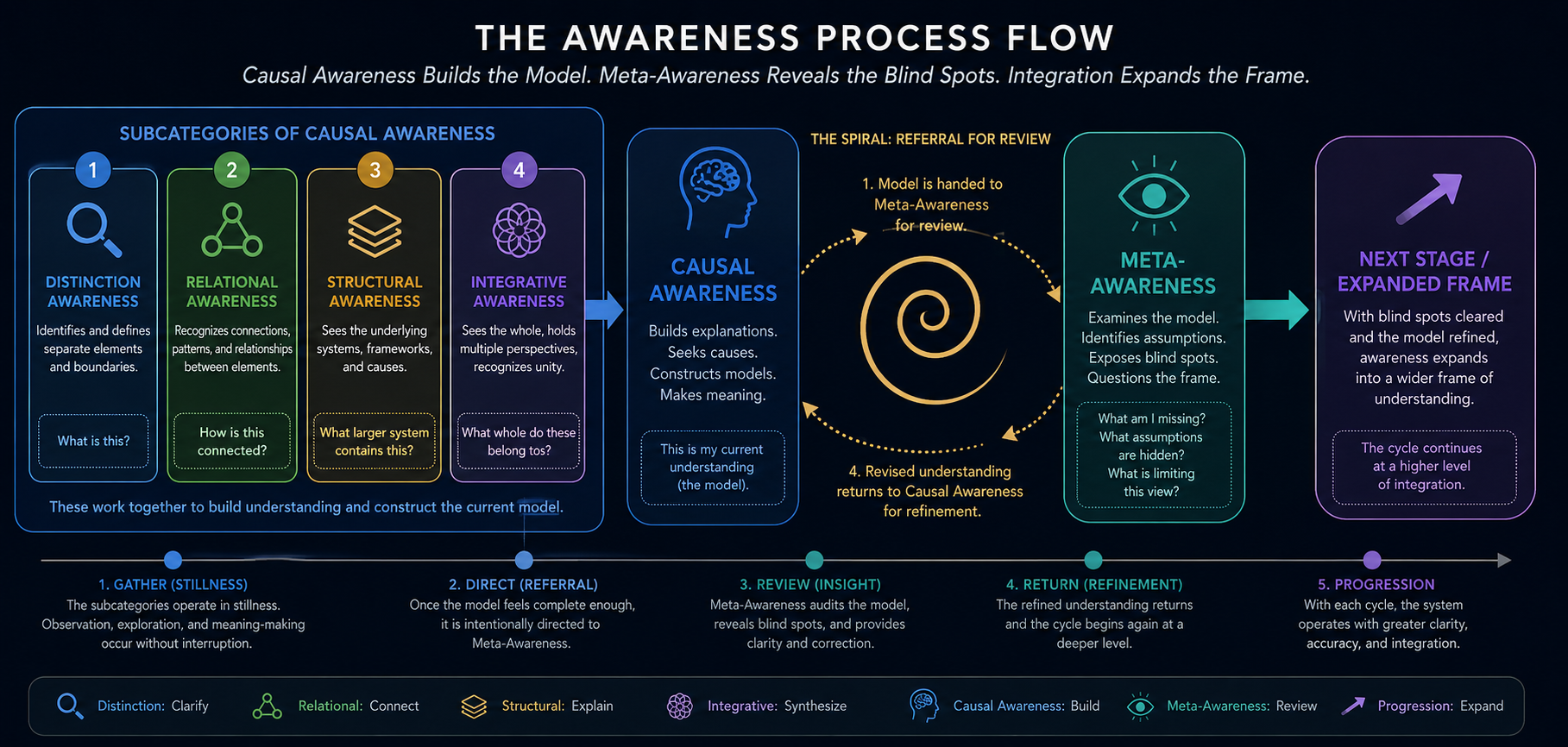
Inscribed June 2026 (19:48 UAE)
Introduction
The Integration Framework emerged from a series of observations across multiple domains including theology, education, systems thinking, legitimacy, and personal inquiry.
What initially appeared to be unrelated investigations began exhibiting the same underlying movement.
The recurrence of this movement suggested that the pattern was not specific to the subjects being explored.
Instead, it appeared to describe the process through which understanding itself develops.
The Macroscopic View
At its highest level, the Integration Framework describes a movement from perceived separation toward increasing integration.
Stage 1
Initially Separate
Reality is understood through distinctions.
Categories appear independent.
Boundaries appear clear.
The focus is differentiation.
Stage 2
New Perspective
The same pattern is recognized beyond its original context.
The observer begins applying an existing insight to multiple domains.
The focus is transferability.
Stage 3
Cross-Influence Emerges
Previously separate domains begin influencing one another.
Relationships become visible.
Feedback loops emerge.
The focus is interaction.
Stage 4
Boundaries Dissolve
The distinctions remain useful but begin to appear incomplete.
The observer realizes the categories are analytical tools rather than absolute descriptions of reality.
The focus is permeability.
Stage 5
Integrated System
Reality is experienced as an interconnected whole.
The distinctions still exist but are understood as perspectives within a larger system.
The focus is integration.
Core Insight
Integration is not the joining of separate parts.
It is the recognition that the parts were already connected.
The Microscopic View
Within every stage operates an awareness process.
This process is responsible for building, testing, refining, and expanding understanding.
The microscopic model explains how progression occurs.
Part One:
Causal Awareness
Causal Awareness functions as the builder.
Its purpose is to create a model of understanding.
It gathers information.
It identifies causes.
It constructs explanations.
It creates meaning.
Causal Awareness is composed of several awareness functions.
Distinction Awareness
Question:
What is this?
Function:
Identifies separate elements, categories, and boundaries.
Relational Awareness
Question:
How is this connected?
Function:
Recognizes relationships, patterns, and interactions.
Structural Awareness
Question:
What larger system contains this?
Function:
Identifies frameworks, systems, causes, and underlying architecture.
Integrative Awareness
Question:
What whole do these belong to?
Function:
Recognizes unity, interdependence, and coherence.
Together these functions construct the current model of understanding.
The Principle of Stillness
The awareness functions operate within a period of cognitive stillness.
Their task is not immediate self-correction.
Their task is observation, construction, and meaning-making.
The model must first be allowed to form.
Premature interruption can interfere with understanding.
The Spiral
Once a model has formed, it enters the spiral.
The spiral represents intentional referral.
The model is directed toward Meta-Awareness for review.
The spiral is not progression.
The spiral is examination.
Part Two:
Meta-Awareness
Meta-Awareness functions as the reviewer.
Its purpose is not to build the model.
Its purpose is to evaluate the model.
Meta-Awareness asks:
What am I missing?
What assumptions are hidden?
What limitations exist within this framework?
What is being excluded?
What is being taken for granted?
The Function of Blind Spot Exposure
Meta-Awareness identifies blind spots.
A blind spot is not necessarily an error.
A blind spot is a limitation within the current frame.
The discovery of a blind spot creates the conditions for expansion.
The Return
Once reviewed, the model returns to Causal Awareness.
The awareness functions now operate with an expanded frame.
The cycle repeats.
Gather.
Construct.
Review.
Refine.
Expand.
The Feedback Loop
Progression does not occur through Causal Awareness alone.
Progression does not occur through Meta-Awareness alone.
Progression emerges through their interaction.
Causal Awareness builds the model.
Meta-Awareness reveals the limitations of the model.
The exposure of limitations creates the conditions for growth.
The revised model returns to Causal Awareness.
The cycle continues.
This relationship is mutually dependent.
Without Causal Awareness, Meta-Awareness has nothing to evaluate.
Without Meta-Awareness, Causal Awareness has no mechanism for identifying its blind spots.
Together they create a self-correcting system.
The Emerging Observation
The most significant observation is that this framework appears capable of describing not only external systems but the development of understanding itself.
The framework may therefore be recursive.
It may describe the very process through which it was discovered.
In this sense, the framework is not merely a model of integration.
It may be a model of how integration becomes conscious of itself.
Current Position
This framework remains under observation.
It should be treated as a working model rather than a final conclusion.
The objective is not confirmation.
The objective is continued observation.
Future revisions should emerge from evidence rather than preference.
The framework remains open to correction, refinement, and expansion.
One question awaits you.
✦ End of scroll ✦