◆ Revelations
You Do Not Grow Into Yourself
The essential self is present from the beginning. Experience doesn't add to it. It obscures it. And awareness doesn't construct identity. It discloses it. Growth is a misleading word here, because it implies addition. What you are describing is revelation. A reduction of distortion. The self becomes more visible as veils thin. Not as something new is acquired, but as what was always there comes into view.
Inscribed August 6, 2026
We often speak about human development through the language of growth.
We say that pain helps us grow. That experience shapes us. That healing allows us to become who we are supposed to be.
But what if that language is slightly misplaced?
What if, at the level of essence, we do not grow into ourselves at all?
What if we are already ourselves... and the real process is one of revelation?
A person is born with an essence: the irreducible truth of who they are.
That essence is not their mood, their environment, their trauma, their behaviour or the roles they later occupy. These things may influence how a person experiences and expresses themselves, but they are not the person’s fundamental identity.
A mood is true.
A wound is true.
A circumstance is true.
But something can be true of a person without being the truth of who that person is.
A person may be grieving, exhausted, afraid, angry or emotionally overwhelmed. Each of these may accurately describe their present state. These conditions may influence how they communicate, perceive and respond to the world around them.
But the person is not the grief.
They are not the fear.
They are not the mood.
The state is real and therefore belongs to the truth of that moment. But it is not the essence of the person experiencing it.
Essence is the identity-bearing truth that remains present while circumstances, emotions and conditions move through different forms.
This gives us an important distinction:
Essence is the irreducible truth of a particular thing.
State is what is true of that thing at a particular moment.
Truth is the accurate whole: what the thing is, the state it is in, the context it occupies and its relationship to reality as a whole.
Every essential truth belongs to truth, but not every truth about a person belongs to their essence.
An orange may be bruised, cold or resting beside a pear. Each of those conditions may be true. But the bruise is not what makes the orange an orange. Its temperature is not its essence. Its position beside the pear does not alter its fundamental identity.
The orange remains an orange while additional truths surround it.
This does not mean that truth changes.
When a pear is placed beside an orange, the original truth, that the orange is there, has not been replaced or made false. Reality now contains an additional truth: there is an orange and a pear.
The first truth remains intact.
The truthful account has compounded.
As circumstances change, the accurate account of reality must expand to include them. The original truth is not rewritten. More of reality has entered the frame.
The same is true of a human life.
Our experiences accumulate. Circumstances shift. Additional truths become part of our history and present state. But these experiences do not necessarily manufacture our essence.
They may instead obscure it.
Trauma can create fear.
Fear can create protective behaviour.
Protective behaviour can become a role.
And the role can become so familiar that we begin to mistake it for identity.
Over time, layers form around the essence: expectations, adaptations, wounds, doubts, inherited beliefs and distorted perceptions.
These layers function like veils.
They do not destroy the essence, but they can make it more difficult for us to perceive and express it clearly.
The thicker the veil becomes, the more static enters the channel between essence and awareness.
We begin responding through fear rather than truth.
We hear through distortion.
We perceive ourselves through the residue of what has happened to us.
Healing, then, may not be the construction of a better self.
It may be the removal of what prevents the existing self from being seen.
When I understand an experience, I do not necessarily extract a new piece of identity from it. Instead, I discover what the experience concealed... or what it caused to become visible... about what was already present within me.
The hurt did not create my essence.
It created conditions under which parts of that essence could be recognised.
The experience did not build who I am.
It placed pressure upon what was already there, and through awareness, more of it was revealed.
This is why the word growth is not always sufficient.
Growth suggests addition. It implies that something previously absent is being acquired.
But awareness does not add essence to a person.
Awareness removes interference.
The movement is not:
experience → growth → new self
It is:
experience → awareness → understanding → revelation
We may grow in knowledge, capacity, discipline or maturity. We may become increasingly capable of expressing what we are.
But we do not necessarily grow into our essence.
We become increasingly able to recognise it, access it and express it without distortion.
A year ago, I prayed:
“Jesus, reveal Yourself to me. Show me who You are. I want to hear Your voice.”
The response I received was:
“In order to hear My voice, you have to strip yourself of yourself.”
At the time, the meaning was not entirely clear.
But stripping oneself of oneself is not self-erasure.
It is not the destruction of identity.
It is the removal of everything falsely mistaken for identity.
It is the stripping away of fear, performance, doubt, distortion and attachment to the constructed self.
The voice does not necessarily become louder.
The static becomes quieter.
When distortion falls away, perception becomes clearer. When the veils begin to thin, essence can communicate with essence with less interference.
This may also explain why healing can feel like remembrance.
We are not encountering an entirely new person.
We are recognising someone who was present all along.
The essential self was not waiting to be built.
It was waiting to be seen.
Awareness is therefore not the architect of essence.
It is the means through which obstruction becomes visible and begins to fall away.
We do not become more real by adding more to ourselves.
We become more clearly ourselves by releasing what was never essentially us.
The self is not manufactured.
It is revealed.
And perhaps the deepest movement of healing is not becoming someone else.
It is finally being able to see who has been there from the beginning.
◇ Commentary
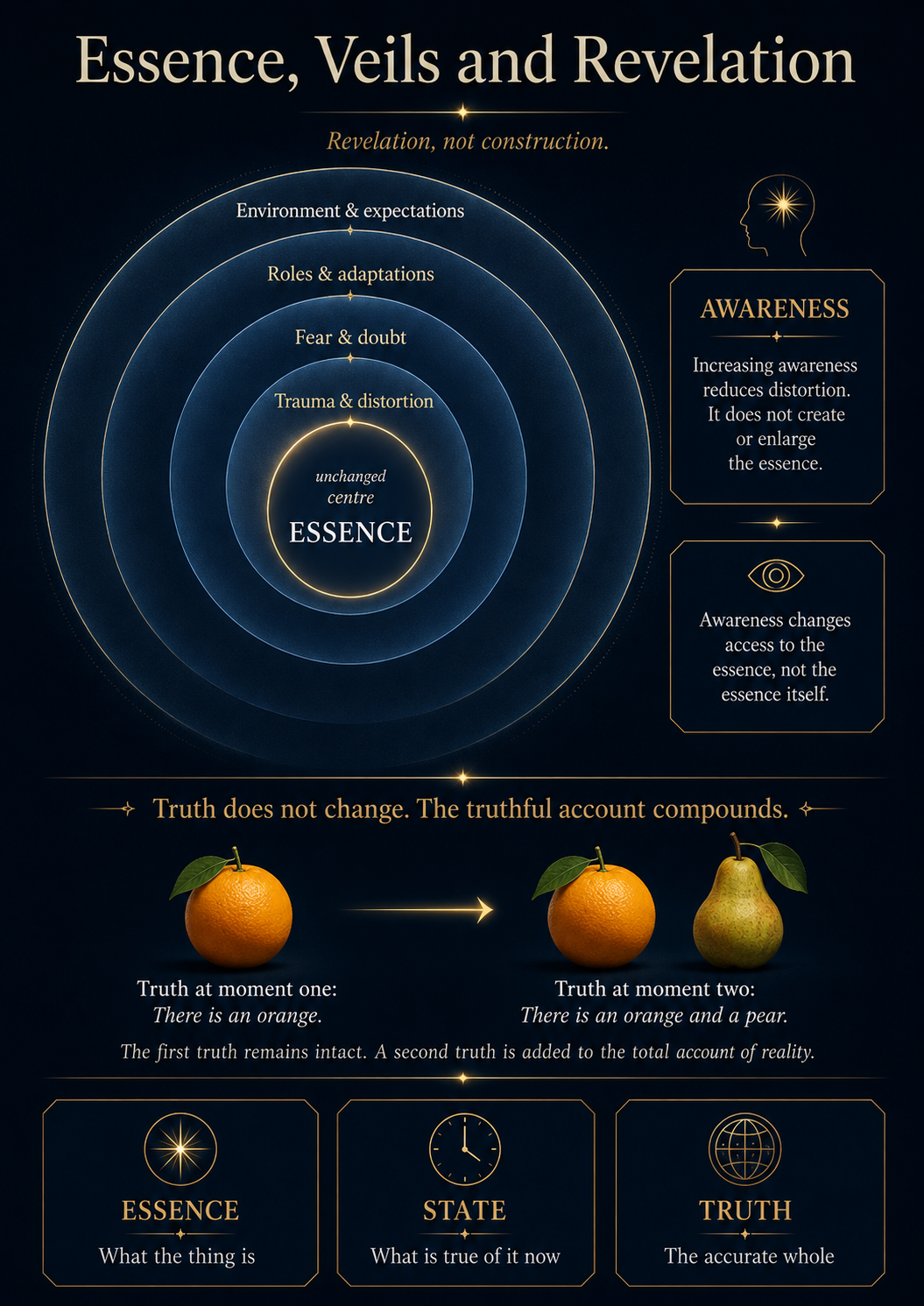
Visual Representation: Essence, Veils and Revelation
The visual maps the argument in two movements.
The first shows essence as the unchanged centre of a person, surrounded by layers of trauma and distortion, fear and doubt, roles and adaptations, and environmental expectations. Awareness does not create or enlarge the essence. It thins the veils and changes our access to what was already present.
The second shows that truth does not change when reality gains another element. The truth that an orange is present remains intact when a pear is placed beside it. The truthful account compounds: there is now an orange and a pear.
Essence: What the thing is.
State: What is true of it now.
Truth: The accurate whole.
One question awaits you.
✦ End of scroll ✦