◆ Revelations
Success
Success is not a thing. It is a label.
Inscribed July 15, 2026
Success.
It is one of the most pursued words in human history.
Yet surprisingly few people stop to ask what it actually is.
At first glance, success appears obvious.
We speak of successful businesses.
Successful relationships.
Successful leaders.
Successful students.
Successful lives.
But the more I observed it, the less substantial it became.
Eventually, I realized something.
Success is not the thing itself.
It is a label.
That distinction changes everything.
A label does not create reality.
It represents an evaluation of reality.
A business remains a business whether we call it successful or unsuccessful.
A person remains a person whether they are called a success or a failure.
The event exists first.
Only afterwards do we apply the label.
This immediately raises another question.
According to what?
What determines whether receives the label "success"?
The answer seems to be:
A metric.
Every declaration of success assumes a standard against which something has been measured.
Without a metric, success cannot exist.
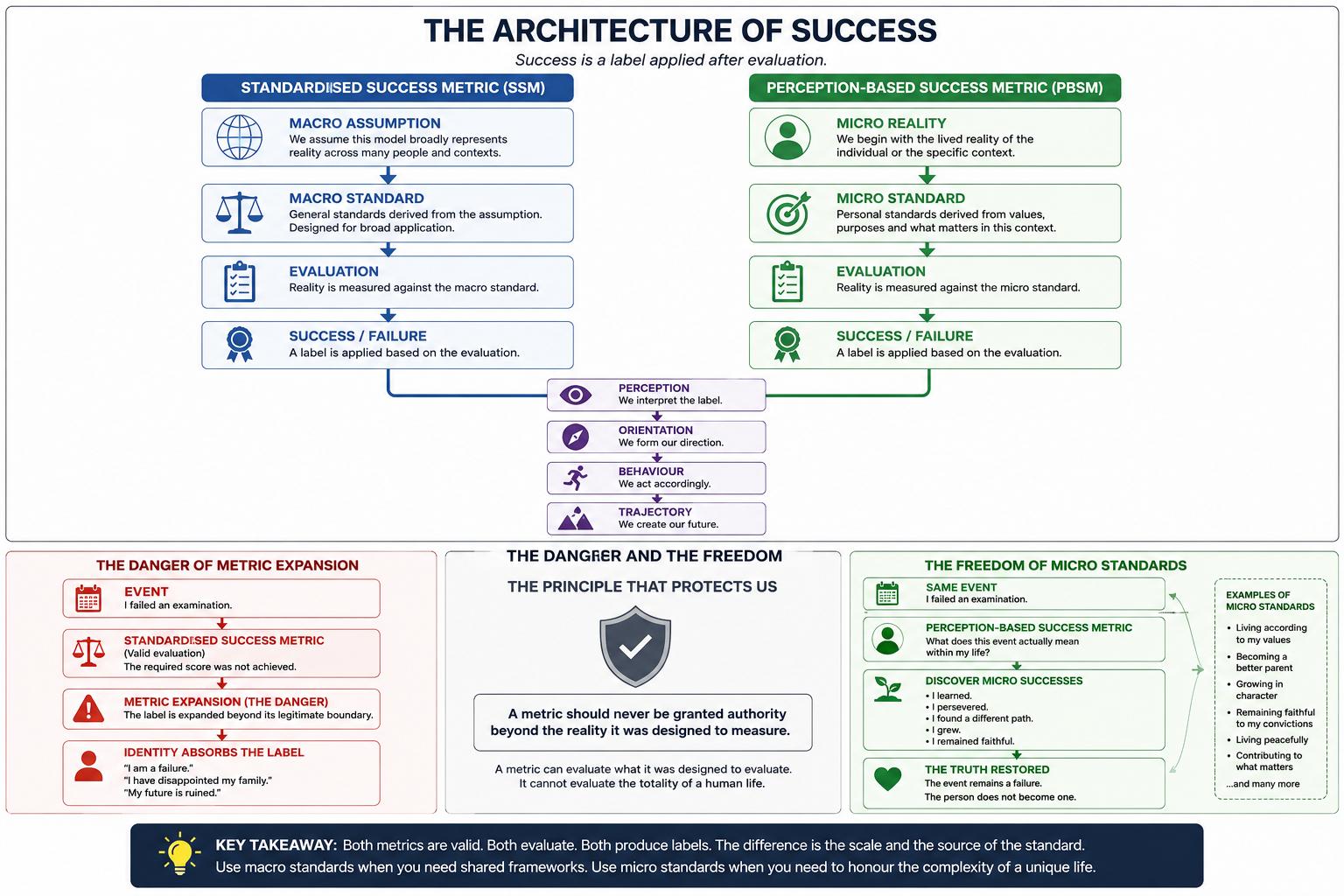
This led me to notice that success operates through two broad kinds of metrics.
The first is the standardized success metric.
These are built upon macro assumptions, which give rise to macro standards.
They attempt to create one framework that can be applied across many people and many situations.
Examinations.
Performance indicators.
Qualifications.
Competitions.
Professional standards.
They exist because societies require common measures.
The second is what I would call the perception-based success metric.
These are governed by micro standards.
Rather than asking, "What does everyone consider success?" they ask, "What does success genuinely mean within this particular reality?"
The distinction matters.
Because macro assumptions cannot account for every individual context.
Take an examination.
A student may fail.
According to the standardized metric, that conclusion is entirely legitimate.
The required score was not achieved.
The problem begins when the metric expands beyond the reality it was designed to measure.
"I failed the examination" quietly becomes, "I am a failure."
An evaluation of one event becomes a judgment upon an entire human life.
The examination never measured courage.
It never measured perseverance.
It never measured wisdom.
It never measured character.
It never measured love.
It certainly never measured the value of the person sitting in the room.
Yet we often grant standardized metrics authority they were never designed to possess.
This is where perception-based success becomes important.
The examination may have been a failure, but that does not mean the person failed.
Maybe they confronted a fear they had avoided for years.
Maybe they discovered a path that was never theirs to begin with.
In doing so, they learned something that will shape the rest of their lives.
To survive the disappointment without abandoning themselves was, in fact, the greatest success of all.
None of these truths invalidate the examination.
They simply recognize that not all success is measured by the same standard.
The danger, then, is not failure.
The danger is allowing one metric to become the governing authority over every other dimension of reality.
No metric should be granted authority beyond the reality it was designed to measure.
Perhaps that is why success causes so much confusion.
We mistake labels for reality.
We confuse evaluations with identity.
We assume that because something failed according to one standard, it has failed according to all standards.
But labels are not reality; they are interpretations of it.
Reality remains what it is.
Our labels merely influence how we relate to it.
Ultimately, success is not something we possess at all.
It is simply the name we give to reality after measuring it according to a chosen standard.
The deeper question, then, is no longer, "What is success?"
It is:
Who decided the metric?
One question awaits you.
✦ End of scroll ✦