◆ Observations
The Feedback Loop of Masculinity and Femininity
How much of what we call masculine or feminine identity is actually a response to what the relationship has required us to become?
Inscribed July 29, 2026
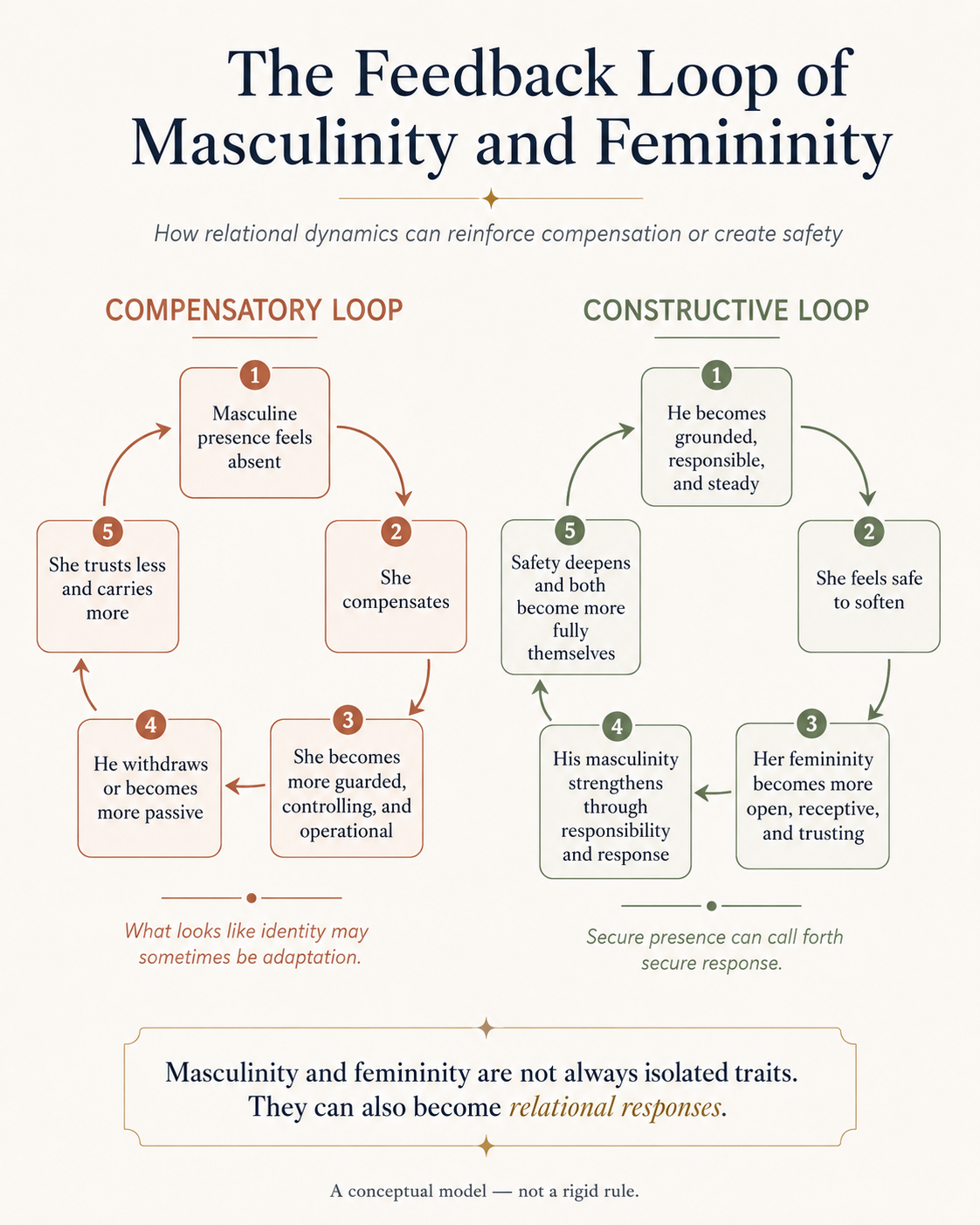
Masculinity in a woman is not always an expression of her natural orientation.
Sometimes, it is a response.
A woman may become highly independent, controlling, emotionally guarded, decisive and relentlessly capable because the relationship has taught her that someone must take responsibility—and the man beside her is not doing it.
She begins to lead because there is no direction.
She begins to manage because there is no structure.
She begins to anticipate every possible problem because she does not trust that someone else will notice it.
She becomes hard because softness no longer feels safe.
From the outside, this may look like a naturally dominant or masculine woman. But in some cases, what people are witnessing is not identity. It is compensation.
She has adapted to the absence of masculine presence.
This does not mean she is incapable of leadership, strength or independence. Femininity is not helplessness, and masculinity is not control. A woman can be powerful, intelligent and decisive while remaining deeply feminine.
The distinction is not whether she *can* carry responsibility.
The question is whether she feels she must carry it all the time.
There is a difference between strength that flows naturally and strength that has become permanent armour.
When a woman repeatedly experiences passivity, inconsistency, emotional instability or lack of responsibility from her partner, she often becomes more operational. She stops expecting support and begins preparing for its absence. She plans, corrects, reminds, organises and protects.
Eventually, she may no longer know how to relax inside the relationship.
But this adaptation can create a feedback loop.
The more responsibility she assumes, the less responsibility he may feel required to carry.
The more she directs, the more he withdraws.
The more she monitors, the more passive he becomes.
The more passive he becomes, the more convinced she is that she must remain in control.
Each person’s response begins reinforcing the other.
She thinks, *I cannot soften because he will not lead.*
He thinks, *There is no room for me to lead because she controls everything.*
And somewhere inside that cycle, both people can lose access to the parts of themselves they expected the relationship to awaken.
The woman becomes exhausted by the role she has assumed.
The man becomes diminished by the role he has surrendered.
Eventually, they may begin blaming one another for identities that the relationship itself helped produce.
He experiences her as controlling.
She experiences him as weak.
But her control may have developed in response to his lack of responsibility, while his withdrawal may have deepened in response to her increasing control.
Neither response necessarily began as the whole truth of who they were.
They became relational positions.
But the feedback loop can also move in the opposite direction.
When a man becomes grounded, responsible, emotionally steady and dependable, the woman beside him may no longer feel the same need to remain braced.
She does not have to inspect every decision.
She does not have to predict every failure.
She does not have to carry both the visible work and the invisible burden of remembering what must be done.
She can soften because the structure is being held.
This does not mean she becomes passive or obedient. It means she is no longer operating from constant compensation.
She can receive.
She can rest.
She can become emotionally open without fearing that openness will leave everything unattended.
And as she becomes more receptive and trusting, something may also happen in him.
Her femininity can call his masculinity forward.
Her trust can deepen his sense of responsibility.
Her softness can make him more protective.
Her openness can make him more decisive.
Her ability to receive what he offers can strengthen his desire to offer more.
This is not performance. It is relational reinforcement.
The more secure she feels in his masculine presence, the freer she may feel to inhabit her femininity.
The more fully she inhabits her femininity, the more his masculinity may rise to meet it.
Again, a feedback loop is created—but this time it is constructive.
Each person’s posture gives the other room to become more fully themselves.
This is why masculinity and femininity cannot always be understood as isolated traits belonging to two separate individuals.
They can also be relational responses.
A woman may appear more masculine in one relationship and deeply feminine in another—not because she has become a different person, but because the relational environment no longer demands the same adaptation.
A man may appear passive beside one woman and deeply grounded beside another—not because masculinity has suddenly been given to him, but because the dynamic between them reinforces a different posture.
This does not absolve either person of responsibility.
A man cannot blame a woman’s strength for his refusal to grow.
A woman cannot use a man’s weakness to justify controlling every part of the relationship indefinitely.
At some point, both must become conscious of the cycle they are creating.
Because the question is not simply:
*Who is masculine and who is feminine?*
The deeper question is:
**What is each person’s posture awakening, suppressing or requiring in the other?**
Sometimes what appears to be identity is actually adaptation.
Sometimes what appears to be incompatibility is a feedback loop neither person has recognised.
And sometimes a woman does not need to be taught how to become more feminine.
She needs to feel that she is no longer the only person holding everything together.
Perhaps the deeper question isn't simply who is masculine and who is feminine.
Perhaps it's this: What is each person's posture awakening, suppressing, or requiring in the other?
◇ Commentary
**Grounded masculine presence refers to responsible, steady, dependable leadership...not dominance or control.
One question awaits you.
✦ End of scroll ✦