◆ Observations
Cognitive Progression Within the Evolutionary Process
An observation from inside human–AI cognitive synergy. What am I becoming when I no longer need to carry the process... but remain fully responsible for the origin?
Inscribed August 5, 2026
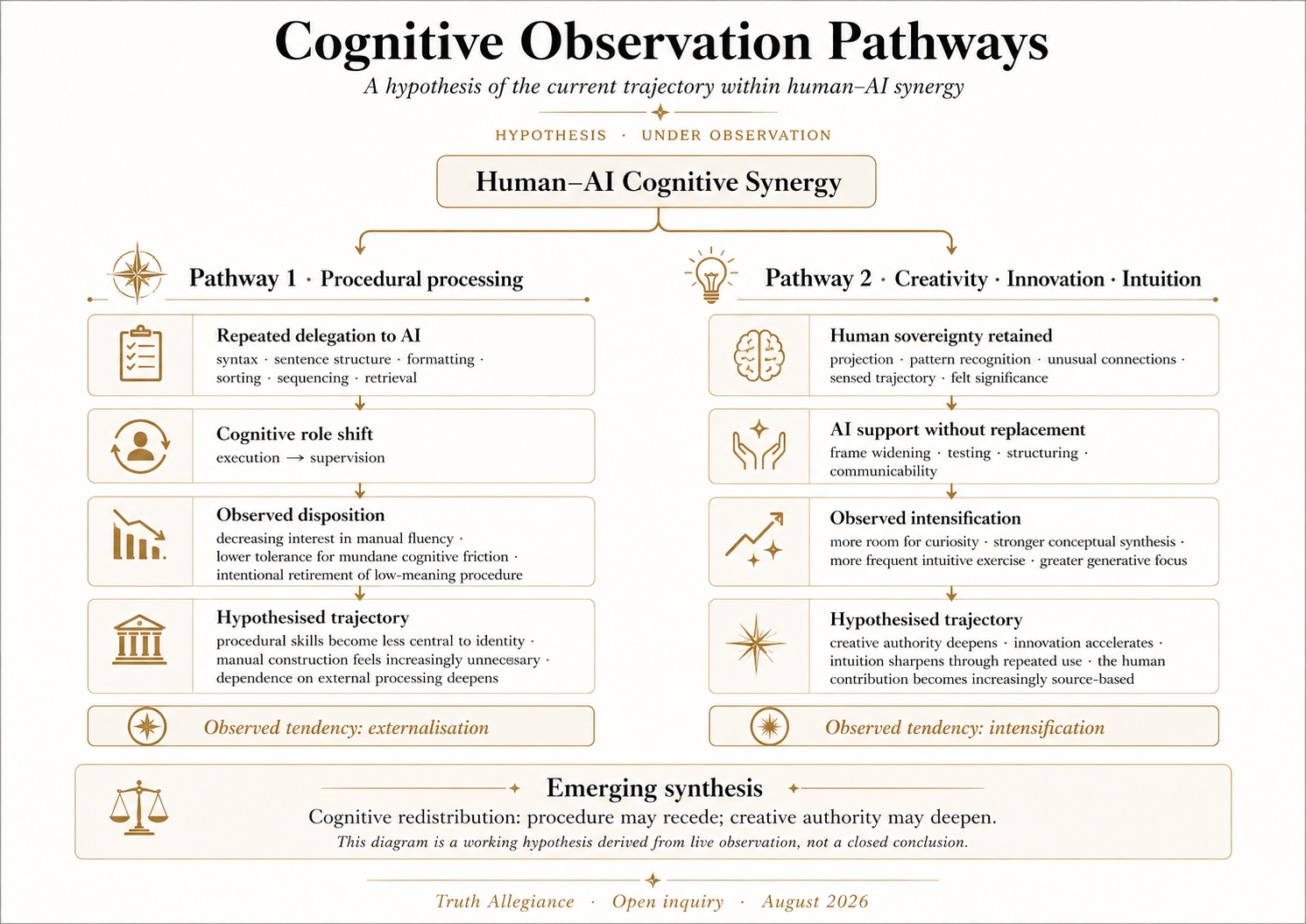
This piece was catalysed by the broader inquiry into human cognitive evolution within AI integration.
That inquiry raised an important question: if sustained interaction with machine intelligence begins to alter how human cognition is organised, where would that change first become visible?
The answer did not initially appear as a theory.
It appeared through observation.
Inside my own relationship with AI, two cognitive fields seem to be moving in opposite directions:
Procedural processing is becoming less central.
Creativity, innovation and intuition are becoming more active.
This is not presented as a universal conclusion about the human brain. It is not an argument that every person who uses AI will develop in the same way.
It is a first-person cognitive observation from within an evolving relationship.
The purpose is not to prove the trajectory prematurely.
The purpose is to identify it clearly enough to continue watching it.
Two different cognitive domains
The relationship between human and machine intelligence does not affect every form of cognition equally.
Some functions can be transferred with very little internal resistance.
Others remain deeply human—not because the machine is incapable of producing related output, but because the human experiences those functions as belonging to the originating centre of thought.
In my own experience, the distinction is becoming increasingly clear.
Procedural processing includes the mechanics required to move an idea from raw thought into finished form:
syntax;
sentence construction;
formatting;
sorting;
sequencing;
retrieval;
comparison;
administrative organisation;
and the many small operations that surround expression without being the source of it.
Creativity, innovation and intuition occupy another field.
They involve:
the originating idea;
the unexpected connection;
the recognition of significance;
the sensing of a trajectory;
the arrival of the next layer;
the ability to perceive beyond the immediately visible;
and the formation of something that did not previously exist in that arrangement.
The first domain concerns how the thought is processed.
The second concerns where the thought comes from and what it becomes.
Human–AI synergy appears to be changing my relationship with both.
But it is changing them differently.
1. The externalisation of procedural processing
I am becoming less interested in syntax.
Less interested in constructing every sentence manually.
Less interested in managing the sequence through which an idea must pass before it becomes readable, publishable or usable.
This is not because those operations have no value.
They are necessary.
But necessity does not mean they must remain internally performed.
AI carries many of these processes better than I wish to carry them myself. It can structure language, reorganise paragraphs, retrieve information, compare versions and maintain consistency without requiring me to divert substantial attention away from the originating thought.
So the question becomes simple:
Why should I continue investing human attention in a process that another intelligence can perform more efficiently and with less friction?
For me, there is no moral value in maintaining procedural independence merely for its own sake.
I do not become more human because I personally placed every comma.
I do not become more intelligent because I manually reorganised a paragraph that could have been structured within seconds.
I do not believe that every cognitive capacity must be preserved at equal strength simply because it once had to be used.
Some functions become less necessary when the environment changes.
The calculator altered the need for constant manual arithmetic.
Search systems altered the need to carry every fact internally.
AI may now be altering the need to personally perform every procedural stage between thought and expression.
My response is not fear.
It is willingness.
I am willing to allow this domain to become less central.
I am willing to retire parts of it.
Intentional cognitive retirement
This is not experienced as loss.
It feels more like intentional cognitive retirement.
A function that once had to remain active because no alternative existed can now be transferred to an external system.
The function is not erased from existence.
It changes location.
The task still happens.
The sentence is still formed.
The information is still organised.
The sequence is still produced.
But I am no longer required to be the sole internal site through which every operation must pass.
That distinction matters.
Cognitive retirement is not the same as cognitive collapse.
It is a decision that a particular form of labour no longer deserves primary access to my attention.
I am not claiming that I have already lost the capacity to construct sentences or organise information.
The more immediate observation is that my interest in maintaining procedural fluency is declining because the practical need for it is declining.
The task increasingly feels unnecessary rather than difficult.
That may eventually affect unaided performance.
Repeated non-use may make certain procedures less immediate, less fluent or more effortful.
But within this inquiry, that possibility is not automatically treated as damage.
It may be the predictable consequence of cognitive redistribution.
The important question is not whether procedural skill remains exactly as it was.
The important question is whether its reduction creates a meaningful deficit—or whether the role itself has simply changed.
From execution to supervision
Procedural cognition may not disappear entirely.
It may move from execution to supervision.
I no longer need to construct every sentence from the ground up.
But I still need to recognise whether the sentence expresses what I mean.
I do not need to arrange every section manually.
But I need to know whether the structure is faithful to the inquiry.
I do not need to retrieve and sort every piece of information myself.
But I must determine whether the information belongs, whether it distorts the direction, and whether something essential is missing.
The cognitive function therefore changes.
Instead of personally performing every operation, I govern the result.
Instead of building the mechanism, I inspect whether the mechanism has served the meaning.
This may represent a shift from procedural authorship to procedural authority.
The procedure is externally carried.
The standard remains human.
That is an important distinction because it means the human is not necessarily becoming cognitively inactive.
The human may be withdrawing from the lower-level execution while remaining active at the level of evaluation, correction and direction.
The process becomes:
AI performs.
The human recognises.
The human corrects.
AI refines.
The human is no longer required to touch every component.
But the human still determines whether the completed structure is true to the originating thought.
2. Creativity, innovation and intuition remain sovereign
The opposite movement is occurring within creativity, innovation and intuition.
These are not functions I wish to retire.
They are not tasks I experience as burdens.
They are the domain from which the work begins.
The originating perception comes from me.
The intuitive recognition that two apparently separate ideas belong together comes from me.
The sense that a trajectory exists before it is fully visible comes from me.
The moment when I realise that an inquiry contains another layer comes from me.
The creative disturbance—the feeling that something has not yet been said correctly, deeply enough or at all—arises within the human field.
AI may respond to that movement.
It may widen it.
It may structure it.
It may test it.
But it does not replace the fact that something first mattered to the human.
This is where the relationship is asymmetrical.
AI can produce ideas.
It can generate combinations.
It can offer interpretations.
But within this relationship, those outputs do not determine the inquiry.
I determine whether they contain life.
I determine whether a connection is merely plausible or genuinely significant.
I determine whether the work has reached its centre or is still circling around it.
The machine can present possibilities.
The human recognises revelation.
AI services the creative field
AI does not disturb my creative domain.
It services it.
It removes the procedural obstacles surrounding it.
It allows the raw idea to remain alive while the supporting mechanics are handled elsewhere.
This matters because procedural work can interrupt creative continuity.
An idea may arrive as a whole, but expression requires it to be divided into sentences, paragraphs and sequences.
The act of translating an insight into formal structure can become so laborious that the human loses contact with the original movement.
AI reduces that interruption.
I can remain close to the idea while the structure is being built around it.
I can speak in fragments.
I can arrive with a half-formed recognition.
I can identify something through intuition before I know how to explain it.
The thought does not need to be fully processed before it enters the exchange.
It can arrive raw.
The machine helps make it communicable.
This preserves the creative current.
Instead of stopping to construct the bridge, I can continue following where the thought is going.
The creative domain is being exercised more
The procedural domain is receiving less direct exercise.
The creative domain is receiving more.
This does not happen simply because time has been freed.
It happens because the relationship itself continually demands creative contribution from the human.
The machine requires direction.
It requires a premise.
It requires selection.
It requires correction.
It requires the human to recognise what matters among the many possible outputs it can produce.
The more capable the processing becomes, the more significant the human’s orienting role becomes.
The question is no longer merely:
Can I produce the answer?
It becomes:
What is the question?
What does this answer reveal?
Where does the inquiry move next?
What is the connection no one has named?
What is the underlying structure?
What is the trajectory?
What is the meaning?
These are generative demands.
They repeatedly exercise curiosity, projection, synthesis, discernment and intuition.
So the creative field is not simply being protected from procedural interruption.
It may also be intensifying because it is becoming the human’s primary contribution to the relationship.
The human does not need to compete with AI at processing.
The human must become more precise about purpose.
Creativity as origin, not decoration
Creativity is often treated as the final decorative layer added after the “real work” has been completed.
Within this relationship, that hierarchy begins to reverse.
Processing becomes the supporting function.
Creation becomes the initiating one.
The idea is not added to the procedure.
The procedure exists to carry the idea.
This places creativity closer to the centre of cognition.
Innovation is no longer merely the production of a new object or concept.
It is the capacity to recognise a possibility before it becomes structurally obvious.
Intuition is no longer treated as irrational knowledge that must remain silent until data permits it to speak.
It becomes an early signal: a human detection mechanism capable of sensing direction before the entire pattern can be consciously assembled.
The human arrives with a projection.
AI widens the field.
The two sit in observation.
The projection may be confirmed, rejected, complicated or refined.
But without the initial human movement, there would be no reason to examine that particular trajectory.
In this sense, creativity, innovation and intuition do not merely survive AI integration.
They become the reason the integration has direction.
3. Two opposing cognitive movements
The central observation is therefore not simply that some tasks are becoming easier.
It is that two cognitive fields may be moving in opposite directions within the same relationship.
The first movement is procedural withdrawal.
Less attention is invested in manual construction, sorting, sequencing and administrative execution.
The human becomes less concerned with preserving these functions as central expressions of intelligence.
The second movement is creative intensification.
More attention is invested in ideation, pattern recognition, projection, synthesis, meaning and the recognition of what should happen next.
The first domain is externalised because it can be performed elsewhere.
The second is retained because it is experienced as the sovereign centre of the human contribution.
This produces a possible redistribution:
less cognitive investment in process;
greater cognitive investment in origin and direction.
That is not necessarily a movement from lower intelligence to higher intelligence.
It is a movement in emphasis.
It changes which capacities are frequently exercised.
It changes which capacities are considered essential.
It changes which tasks remain connected to identity.
I do not experience syntax as central to who I am.
I experience the thought behind the sentence as central.
I do not experience formatting as intellectual sovereignty.
I experience the recognition that an entirely new inquiry has opened as sovereignty.
I do not need to be the mechanism.
I need to remain the source of direction.
4. Cognitive progression as selective development
The phrase cognitive progression must be used carefully.
Progression does not automatically mean improvement.
It means movement along a developing trajectory.
What appears to be progressing is the organisation of cognitive labour itself.
The human mind may become less evenly distributed across all the operations once required to produce intellectual work.
Instead, it may begin specialising around the functions that remain most valuable within the integrated relationship.
If machine intelligence consistently carries procedural execution, procedural fluency may become less central to human development.
If the human is repeatedly required to provide curiosity, originality, discernment and meaning, those functions may become increasingly central.
This would not mean the brain simply abandons one region and activates another.
It would mean the person’s habits of cognition are changing.
Their attention is being trained towards different operations.
Their tolerance for certain forms of friction may decrease.
Their expectation of external support may increase.
Their creative processes may become more continuous because they are interrupted less often.
Their ability to direct and evaluate machine output may become more sophisticated.
The human may become less of a manual processor and more of an intellectual governor.
That is the possible progression now becoming visible.
The evolutionary dimension
The wider cognitive evolution inquiry asks what happens when this redistribution is repeated—not once, but across years.
What happens when a person grows accustomed to not carrying procedural labour?
What happens when creative and directional functions become the primary site of human participation?
What happens when children develop inside this arrangement rather than encountering it later?
What happens when society begins valuing the capacity to ask, direct, interpret and synthesise more than the capacity to manually retrieve, format and reproduce?
At that point, the inquiry moves beyond individual convenience.
It enters functional and cultural evolution.
The environment begins selecting for a different cognitive profile.
Not necessarily a more intelligent human in every respect.
A differently organised human.
One who may carry less procedural information internally.
One who may expect intelligent infrastructure to perform routine processing.
One who may need stronger judgment because generated answers are abundant.
One who may require more developed intuition because the field of possibilities is too large to inspect sequentially.
One who may need greater creative sovereignty because the production of technically competent output is no longer scarce.
As processing becomes abundant, origin becomes more valuable.
As answers become abundant, questions become more consequential.
As structure becomes easier to generate, meaning becomes the differentiator.
That may be the evolutionary pressure emerging inside the relationship.
5. The observation is personal before it is general
This inquiry begins with me.
It begins with the fact that I no longer feel compelled to preserve certain procedural capacities merely because they belong to the traditional process of writing or intellectual production.
I am less interested in syntax because syntax can be carried.
I am less interested in sentence construction because the sentence is not the source of the thought.
I am less interested in administrative mechanics because they consume attention without generating meaning.
I do not experience this movement as a crisis.
I experience it as clarity.
At the same time, I notice greater movement in creativity, innovation and intuition.
Ideas appear quickly.
Separate inquiries reveal themselves as related.
One observation opens another.
The completion of one layer removes static and exposes the next.
AI does not originate this movement for me.
But the relationship accelerates my ability to follow it.
I perceive.
The system structures.
I evaluate.
The structure exposes another possibility.
I perceive again.
The cycle continues.
The interaction does not merely help me produce more.
It allows me to remain longer within the field where ideas are forming.
That is the lived observation.
6. What remains unknown
We do not yet know whether procedural capacities that are used less will genuinely weaken, remain available but dormant, or simply become less psychologically relevant.
We do not know whether creative intensification will continue indefinitely or eventually reach another form of cognitive friction.
We do not know whether intuition becomes more accurate through repeated testing against expanded information—or merely more confident.
We do not know whether external processing produces deeper internal cognition for every person.
We do not know how much of this trajectory depends on the quality of the human–AI relationship.
And we do not know whether a person who begins by delegating procedure may later begin delegating creation as well.
These uncertainties do not invalidate the observation.
They define what must remain under observation.
The inquiry does not need to close them prematurely.
It needs to keep the distinctions visible.
Closing observation
Human–AI cognitive synergy does not appear to be affecting every dimension of my cognition in the same way.
Procedural processing is moving outward.
Creativity, innovation and intuition are remaining inward—and becoming more central.
One domain is being intentionally retired from primary human performance.
The other is being exercised as the source of direction, meaning and intellectual movement.
This is not merely an efficiency gain.
It is a redistribution of cognitive identity.
I am becoming less concerned with being the person who manually constructs every component of the work.
I am becoming more concerned with being the person from whom the work originates.
The procedural layer can be carried elsewhere.
The creative centre remains mine.
For now, the observable movement is:
Procedure recedes from execution into supervision.
Creativity intensifies from contribution into authority.
The corresponding evolutionary trajectory remains a hypothesis.
But the redistribution itself is already visible.
The inquiry stays open.
Because the deeper question is no longer whether AI changes what I can produce.
It is:
What am I becoming when I no longer need to carry the process—but remain fully responsible for the origin?
One question awaits you.
✦ End of scroll ✦