The Gift of Knowing
An inquiry into orientation, intention and moral trajectory.
What allows a person to be seen?
◆ The Gift of Knowing
Follow along · a companion reading
Part 1 of 15 · ≈ 13 min
Prelude: Why this inquiry exists
0:00 / 0:00
◇ Prelude ◇
Why this inquiry exists
This inquiry began with a single LinkedIn post.
Not because the post itself was extraordinary, but because of what became visible through the people responding to it.
Several people could look at the same words, the same issue and the same visible information, yet they did not merely arrive at different conclusions. They appeared to be engaging with the thing from entirely different capacities.
Some saw the surface. Some saw the immediate problem. Some saw the structure producing the problem.
And some appeared unable, or unwilling, to see beyond the framework through which they had always understood it.
What is happening inside a person that determines what they are able to see?
Not simply what they know. Not how educated they are. Not how articulate they appear. But the internal capacity through which they encounter reality, interpret it and respond to it.
People exist, but not in the same capacity.
This inquiry is therefore not primarily about intelligence. It is about orientation.
◇ Introduction ◇
The four possible trajectories
There are only four kinds of people.
1. Those who are good and remain good.
2. Those who are bad and remain bad.
3. Those who are good and become bad.
4. Those who are bad and become good.
These are not four rigid personality types. They describe the four possible movements of a whole person across a life.
There is no fifth direction.
◇ The Person ◇
The whole is the sum of its orientations
The word person is necessary because the unit being considered is the whole human being. We are not categorising one action, one emotion, one intention or one period of someone's life.
A person encompasses their intentions, their behaviour, their conscience, their awareness, their wounds, their desires, their use of power, their response to vulnerability, their willingness to tell the truth, their ability to recognise harm, their capacity for accountability and repair, and their willingness to change.
Every one of these elements carries orientation.
The person is the sum of those interacting orientations.
◇ The Spectrum ◇
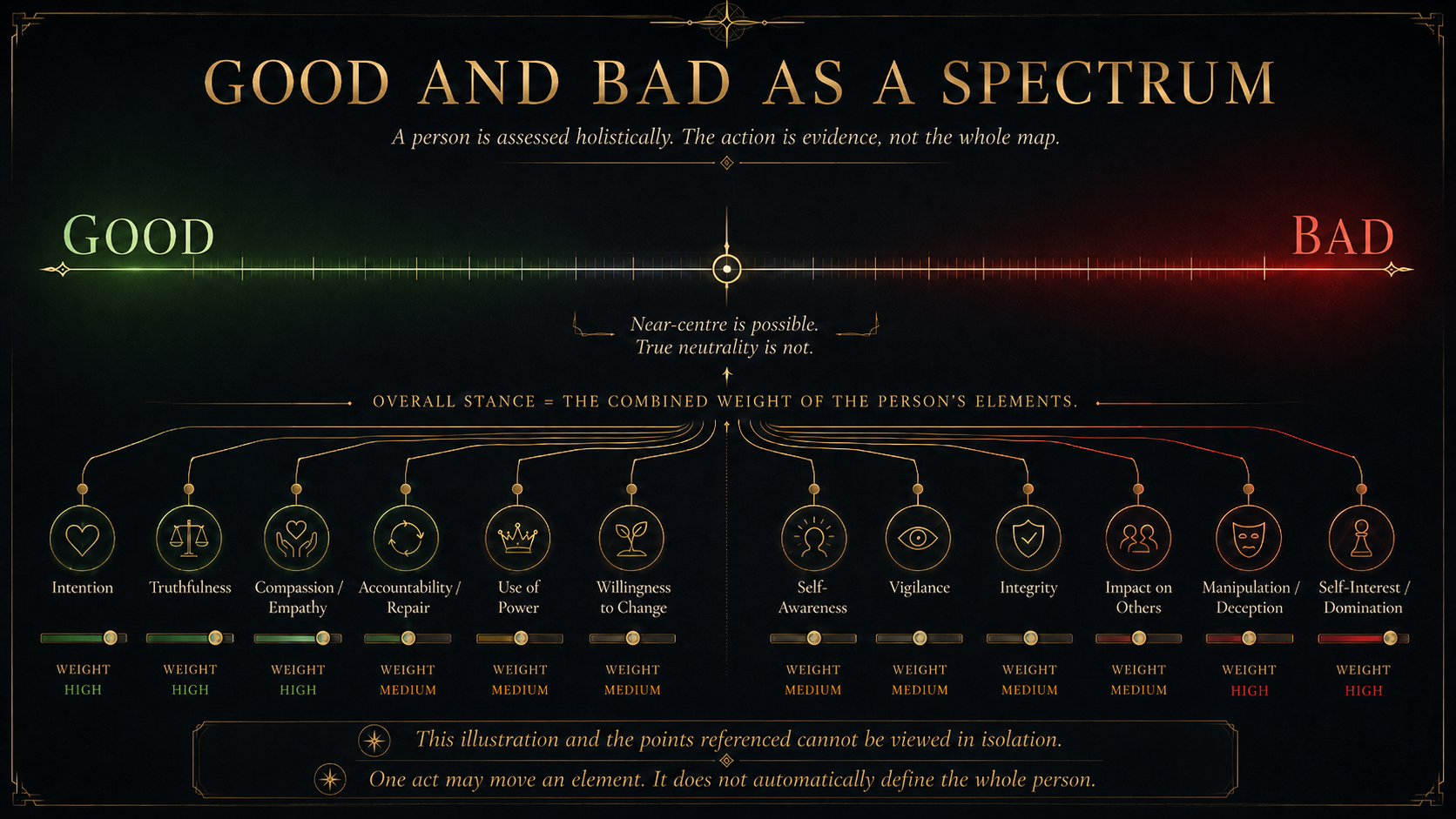
Good and bad as a spectrum
Good and bad are not being presented here as two simplistic boxes. They are better understood as opposite ends of a spectrum.
At one extreme is the fullest possible orientation toward good. At the other is the fullest possible orientation toward bad. Every person exists somewhere between them.
This is why one bad decision does not necessarily make someone a bad person.
And why a good act does not automatically establish a good orientation.
The action is evidence. It is not the whole map.
◇ The Inquiry Ahead ◇
What is being asked
Where does the person currently stand on the spectrum?
Which internal elements collectively create that stance?
Which forces are acting upon them? Are they moving toward good or toward bad?
How willing are they to see themselves? How willing are they to change?
How much internal serenity do they possess: how much freedom from the fear, shame, anger and noise that may prevent them from seeing themselves clearly?
Two people may appear to occupy the same position while moving in opposite directions.
The stance may look similar. The trajectory is not.
◇ The Goal ◇
The goal is not innocent
Now the real investigation begins.
Until this point, we have been looking at people from the macro level: the four possible orientations and trajectories of a human life. But the macro view is not enough. We now have to zoom in.
For a long time, I have carried a particular wish: not merely to read people's intentions, but to read them accurately.
Human behaviour is easy to observe. Intention is not.
The same action can emerge from love, fear, manipulation, desperation, self-interest, confusion or sincere but misguided belief. What someone does may tell us something, but it does not necessarily tell us what governed the doing.
The macro level allows us to consider the whole person: where they stand and the direction in which they appear to be moving. The micro level allows us to examine the individual elements creating that stance: motives, wounds, awareness, choices, conscience, use of power, response to truth, capacity for accountability and willingness to change.
Neither level is sufficient alone.
When both levels are examined together, we may begin to distinguish between an action and an orientation. Between a mistake and a pattern. Between fear and malice. Between sincere error and deliberate deception.
The desire is not simply to know what someone has done. It is to understand, as accurately as possible, what inside them did it.
◇ Inside the observer ◇
My view from the inside
The best way I can describe what happens when I meet someone is to compare it to Neo in The Matrix: without the theatrics of digitised code pouring through my vision.
The code is internal.
Something activates almost immediately. The person is provisionally categorised. Then they are observed.
What they say is analysed against how they say it. Their behaviour is assessed alongside their tone, timing, emotional response, contradictions, omissions and the conditions surrounding the interaction.
New information is continuously received. That information is processed against what has already been observed. The original categorisation is either strengthened, weakened, adjusted or dismantled entirely.
Categorise → observe → analyse → assess → process → filter → articulate
But it is not necessarily linear. The process loops.
Each new piece of information travels back through the existing map. Earlier conclusions are tested again. A word may alter the interpretation of a previous action. A contradiction may reveal that the first categorisation was incomplete. A response under pressure may expose something that ordinary conversation concealed.
From the outside, I may simply appear to be listening. Internally, an entire system is active.
◇ The Method ◇
Causal & meta-awareness
Causal Awareness is directed toward the person being observed. It asks: what are they doing? What are they saying? How do their words and actions relate? What structure may be producing the behaviour? What intention appears to be operating beneath what is visible?
Meta-Awareness turns the examination back toward the observer. It asks: what am I feeling toward this person? What conclusion have I already formed? Am I observing them, or reacting to them? Am I seeking truth, or evidence that confirms my judgment?
Causal Awareness may produce an explanation that feels coherent. But coherence alone does not establish truth. Meta-Awareness reveals the limitations of the frame through which the person has been interpreted.
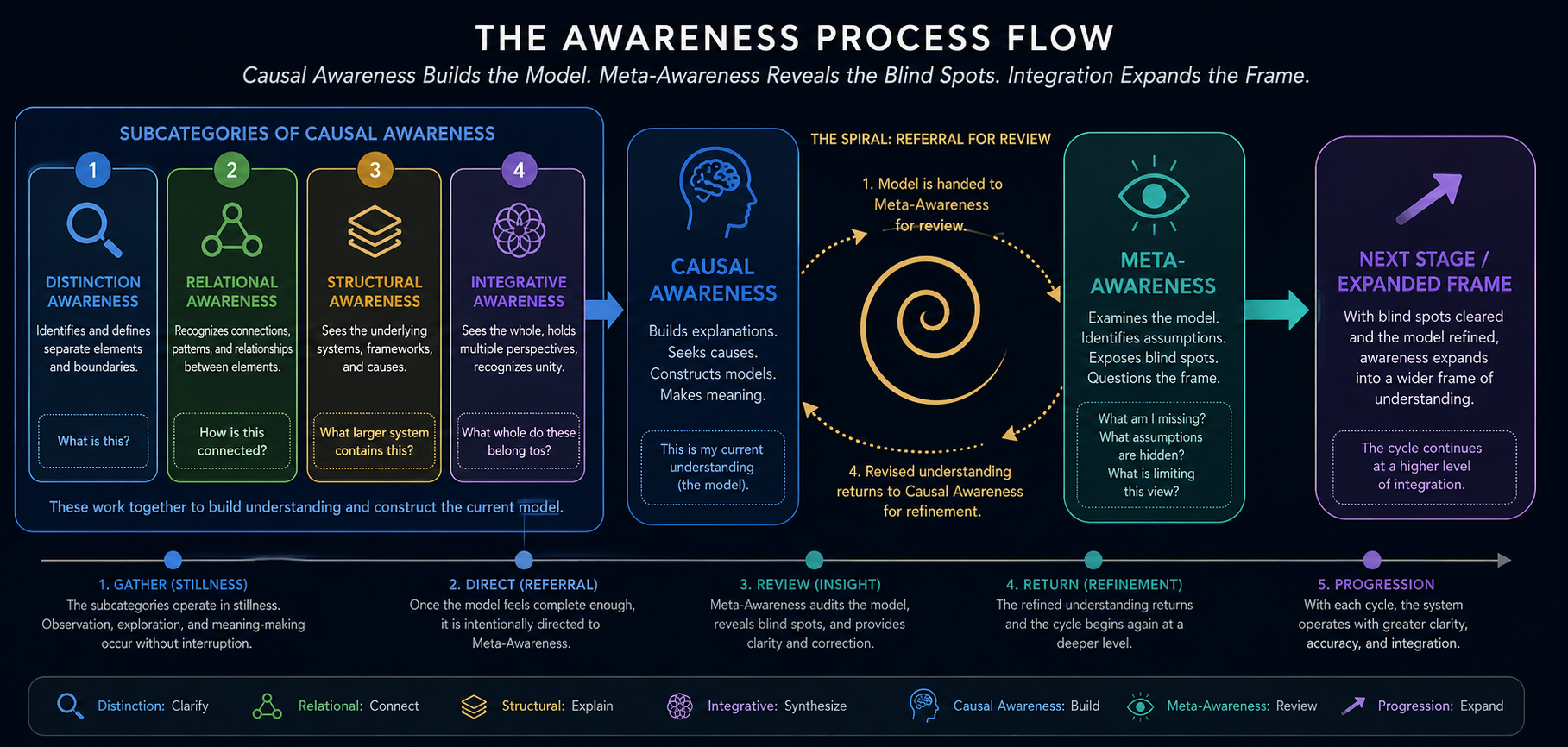
Observe · Distinguish · Connect · Construct · Review · Correct · Expand
The map remains alive because the person remains alive.
◇ Discernment & Projection ◇
The self-correcting loop
Projection begins with the observer and places their internal material onto the person being observed. Discernment begins with the person being observed but continuously examines the observer for interference.
Projection seeks confirmation. Discernment permits correction.
Projection protects the first interpretation. Discernment allows the interpretation to be dismantled when the evidence no longer supports it.
This does not make discernment infallible. It makes discernment responsible.
◇ The Inner Knowing ◇
Fear, knowing, access
Remembering has unfolded through several phases: fear no longer governing; knowing; accessing the knowing.
When fear no longer governs, the internal environment becomes quieter. Knowing then becomes more accessible. But possessing knowing and accessing it accurately are also different things.
Access requires a question. It requires stillness. And it requires enough internal clarity for the answer to emerge without being distorted by fear, preference or premature interpretation.
During this phase, I directed a two-part question toward my inner knowing:
Will I be able to read people's intentions accurately?
And if so: how will it happen?
Yes. But it will require radical awareness of your judgment of others. The more judgment you possess, the more static will interfere with the reading. The method is not to rid yourself of judgment by force, but to allow compassion, through understanding, to replace it. In doing so, the reading becomes clean.
The answer did not suggest that discernment required the abandonment of moral distinction. It addressed something more precise: the condition of the observer.
If I attempt to read another person while already governed by condemnation, resentment, superiority or emotional reaction, then I am no longer observing them cleanly. I am observing them through myself.
◇ Compassion Through Understanding ◇
Cleaning the reading
Compassion, in this context, is not sentimentality. It is not permission. It is not the removal of consequence.
It is the willingness to understand the conditions operating within another person before reducing them to what they have done.
Understanding asks: what shaped this person? What are they afraid of? What are they protecting? What have they normalised? What pain has become behaviour? What desire has become deception? What environment has reinforced their orientation?
Judgment creates distance. Understanding moves closer.
Sometimes deeper understanding reveals greater manipulation, greater self-interest or more deliberate harm than was initially visible. Compassion does not guarantee a favourable conclusion. It permits a cleaner one.
A clean reading requires judgment to remain conscious, examinable and subordinate to truth.
◇ Testing in Real Time ◇
Two functions, one interaction
Within an ordinary conversation, two processes are taking place simultaneously. The first is genuine engagement with the person. The second is the observation and testing of my discernment in real time.
My mind seems to function more naturally when more than one stream of information is running at the same time. Rather than becoming overwhelmed by parallel processing, the additional movement creates greater cognitive fluency.
The best way I can describe this is through the blades of a fan. When a fan moves slowly, each individual blade is visible. But as the speed increases, the separate movements begin to merge. The blades appear almost still. The motion becomes seamless.
What might appear externally as complexity creates internal coherence.
The interaction contains two simultaneous forms of testing. The person's emerging pattern is being tested against new information. And my interpretation is being tested against the possibility that I am wrong.
The testing must occur primarily through observation, natural inquiry and the person's spontaneous responses. The aim is not to force revelation. It is to create enough space for the person's internal orientation to reveal itself through consistency, response and movement over time.
From the outside, I may simply be having a conversation. From the inside, discernment is being tested in real time.
◇ Current Position ◇
The inquiry rests
At this point, the inquiry rests. Not because the investigation is complete, but because the next stage cannot be produced through thought alone. It must be observed.
The framework has now established a provisional structure: the four possible human trajectories; the orientation spectrum; the internal elements that collectively position a person upon it; the qualifiers influencing their stance and movement; the relationship between causal and meta-awareness; the role of judgment, understanding and compassion in cleaning the reading; and the real-time process through which discernment may be tested.
What remains is evidence.
The framework must remain open enough to change when reality contradicts it. If it is protected from correction, it becomes another system designed to confirm what its creator already believes.
So the inquiry remains alive. The next expansion should not emerge from preference. It should emerge from what becomes visible.
◇ A Change of Name ◇
Why this is now called The Gift of Knowing
This inquiry was initially called The Four Kinds of People. That title described where the investigation began.
But as the inquiry moved deeper, it became clear that the four kinds of people were not its true centre. They were the entry point.
The deeper inquiry concerns discernment, inner knowing, the condition of the observer, and the possibility of reading human intention with increasing accuracy.
For that reason, this inquiry is now called The Gift of Knowing, because the real investigation is not simply into the kinds of people who exist. It is into what allows them to be seen.
◇ A Prayer ◇
Lord,
Thank You for the gift You have allowed me to see.
Help me approach every conversation and every person with understanding and compassion. Always go before me, and let Your love lead: never my judgment.
I ask this in Your precious name, Jesus.
Amen.