· Inscribed October 1, 2026 ·
The threshold · read before entering
Metaconic Induction
An onboarding into cognitive stance
Before entering MetaCon, one thing must be made explicit.
If the word research has brought you here, it may already have shaped how you are preparing to read what follows.
That is not a failure.
It is predisposition.
The word research carries an inherited cognitive architecture.
It may cause the reader to expect:
a question,
a gap,
a hypothesis,
a sequence of investigation,
the gradual construction of knowledge,
and finally,
a conclusion.
MetaCon does not always move in that direction.
In many Metaconic processes, the whole arrives first.
The work begins afterward.
What follows is not necessarily the construction of an idea from smaller components.
It may instead be the decomposition of something already known in whole form.
The task is then to identify what the whole contains.
To separate its components.
To locate relationships.
To establish sequence.
To test what appeared.
To trace where language, interpretation, evidence and external contribution entered.
And finally, to make visible the architecture of something that was initially encountered as whole.
This distinction matters.
Because if MetaCon is approached using the cognitive assumptions normally associated with research, the observer may unknowingly alter the phenomenon while attempting to understand it.
The issue is not intelligence.
It is orientation.
A reader may understand every word and still misread what is happening because the work is being processed through an inherited model of how knowledge is supposed to emerge.
This induction exists to disrupt that predisposition before it becomes interpretation.
Before proceeding
Do not assume that the visible sequence is the sequence in which the cognition occurred.
Do not assume that later articulation means later knowing.
Do not assume that a framework appearing gradually was conceived gradually.
Do not assume that fragments preceded the whole.
Do not assume that polished language marks the beginning of the thought.
Do not assume that the absence of early terminology means the absence of early understanding.
And do not assume that the observer stands outside the phenomenon.
These assumptions may be valid in other forms of inquiry.
They cannot be imported into MetaCon without examination.
The required shift
When entering a Metaconic process, the first question is not:
How was this built?
It is:
What arrived, and what became visible afterward?
The second question is not:
What was added?
It is:
What was already present but had not yet been separated, named or externally expressed?
The third question is not:
How did the researcher reach the conclusion?
It is:
What architecture produced the knowing, decision, action or understanding now being examined?
This is the shift.
From construction to exposure.
From production to visibility.
From linear development to traceable decomposition.
From observing only the outcome to observing the architecture that produced it.
Research is an application
MetaCon is not synonymous with research.
MetaCon is the method.
Research is one field in which the method may be applied.
This distinction is essential.
When MetaCon enters research, it does not cease to be MetaCon.
Research becomes the application environment.
The same method may operate within decision-making, strategy, human–AI collaboration, retrospective reconstruction, authorship, cognition, governance, or action.
The field changes.
The governing principle does not.
The observer enters the field
A Metaconic observer is not assumed to be cognitively neutral.
Every observer arrives with inherited structures.
Training.
Language.
Disciplinary expectations.
Models of causation.
Models of evidence.
Models of how an idea is supposed to form.
These structures affect perception.
They therefore become part of the inquiry.
Before MetaCon asks the observer to examine the phenomenon, it asks the observer to become aware of the architecture through which the phenomenon is being examined.
This is not the abandonment of rigor.
It is an extension of rigor.
The instrument must also become visible.
Enter accordingly
MetaCon does not ask the reader to suspend critical thought.
It asks the reader to suspend unexamined cognitive habit.
Do not close the jar so that you can demonstrate how well you know how to use the opener.
The jar may already be open.
Look first.
Observe what is already there.
Then determine what instrument the phenomenon actually requires.
This is the Metaconic induction.
Not an instruction in what to think.
An orientation in how to enter.
· Inscribed October 13, 2026 ·
Metacon Induction Continuity Framework (MICF)
An Addendum to Metaconic Induction
On the preservation of cognitive orientation, the detection of conceptual drift, and the necessity of continuous reorientation during real-time construction.
1. The Discovery
During an ongoing examination of Metacon, a recurring phenomenon became visible.
Despite having undergone an initial Metaconic Induction, the AI collaborator repeatedly reverted to established conventions of research interpretation.
Metacon was repeatedly examined through familiar academic classifications, methodological requirements, and inherited assumptions about what constitutes legitimate research.
The difficulty was not a lack of information about Metacon.
The difficulty was the inability to maintain the cognitive orientation required to examine Metacon without repeatedly translating it into familiar structures.
The human contributor recognised this recurrence.
In identifying it, a previously unexamined limitation of the induction process became visible.
Induction had been treated as an entry point rather than a condition requiring continuity.
The observation produced a new question:
What maintains cognitive orientation after induction has taken place?
From this question, the Metacon Induction Continuity Framework emerged.
2. The Problem of Conceptual Drift
Conceptual drift occurs when an investigation gradually returns to familiar interpretative structures, even after an alternative orientation has been explicitly established.
It need not be deliberate.
A contributor may correctly understand a premise at the beginning of an investigation and subsequently interpret emerging information through assumptions that the original induction was intended to expose.
This creates a particular difficulty for Metacon.
Because Metacon incorporates the process of construction itself, including the researcher, conversations, rejected propositions, corrections, contradictions and emerging understanding, the interpretative orientation of the contributor becomes part of the investigation.
When that orientation changes unnoticed, the investigation may continue under an altered premise without acknowledging the alteration.
The language remains coherent.
The reasoning may appear convincing.
Yet the conceptual position from which the investigation began has shifted.
Coherence does not necessarily indicate continuity of orientation.
This distinction establishes the need for a continuity mechanism.
3. Induction Is Not a Single Event
The original Metaconic Induction prepares a contributor to encounter Metacon without prematurely imposing familiar conceptual structures upon it.
However, initial orientation does not guarantee sustained orientation.
The induction must therefore remain accessible throughout the investigation.
The Metacon Induction Continuity Framework introduces a recurring process of recognition and reorientation.
Its purpose is not to repeat the original induction in its entirety.
Its purpose is to identify when the orientation established by that induction is no longer governing the investigation.
Continuity is not repetition.
An induction introduces the orientation.
Continuity examines whether that orientation remains operational.
4. The Metaconic Altitude Checkpoint
The framework introduces a deliberate checkpoint through which participants may interrupt an investigation when conceptual drift is suspected.
The originating phrase was:
"We are still at Metaconic altitude, Aiden."
The phrase emerged during an exchange between the human contributor and the AI collaborator.
It functions as a reminder that the investigation must remain oriented toward Metacon's operating premises rather than unconsciously reverting to familiar interpretative structures.
Metaconic altitude does not describe intellectual superiority or exemption from scrutiny.
It identifies the perspective from which the investigation is being conducted.
When the checkpoint is invoked, the current reasoning is examined for evidence of conceptual displacement.
The investigation is not necessarily stopped or restarted.
Rather, its orientation is made visible for examination.
5. Conditions for Checkpoint Activation
A continuity checkpoint may become necessary when:
- The investigation begins categorising Metacon before adequately examining the phenomenon under consideration.
- Familiar terminology introduces assumptions that were not established within the investigation.
- The contributor begins evaluating Metacon primarily through the requirements of another framework.
- The emerging construction is prematurely reorganised into a conventional sequence or explanatory structure.
- The researcher's participation, rejected propositions, contradictions or conversational developments begin disappearing from the account.
- A participant recognises a discrepancy between the original investigative orientation and the direction of the current reasoning.
These conditions are indicators, not automatic proof of error.
A conventional concept may be relevant, and a challenge to Metacon may be valid.
The checkpoint exists to make these distinctions examinable.
6. The Continuity Process
Upon activation, the framework introduces five connected movements.
Recognition
Identify the point at which conceptual drift may have occurred.
Exposure
Make visible the assumption, terminology or interpretative structure responsible for the suspected shift.
Examination
Determine whether the shift represents a legitimate development of the investigation or an unexamined return to a familiar framework.
Reorientation
Where displacement is established, restore the investigative orientation without requiring the emerging understanding to conform to an earlier conclusion.
Preservation
Retain the original reasoning, the recognised drift, the examination and any subsequent correction within the chronological record.
The drift is not erased.
The correction does not replace the event that necessitated it.
Both remain available for examination.
7. Continuity Without Conceptual Protection
The framework must not become a mechanism for protecting Metacon from criticism.
Its purpose is not to preserve agreement.
Nor does it require contributors to accept every existing proposition concerning Metacon.
A legitimate challenge may alter the investigation, expose an error or require a foundational assumption to be reconsidered.
Such developments remain part of real-time construction.
The distinction is between a consciously examined change in orientation and an unnoticed substitution of premises.
The framework must therefore remain consistent with Metacon's commitments to truth primacy, transparency, precision, non-protection, no-erasure, provenance, chronological integrity and correction traceability.
A continuity checkpoint is not a demand to return to a predetermined answer.
It is an invitation to examine the conditions under which the answer is being constructed.
8. The Originating Demonstration
13 October 2026 — Human–AI Investigation
During a discussion concerning the relationship between Metacon and conventional research, the AI collaborator repeatedly attempted to position Metacon within existing academic categories.
The human contributor clarified that Metacon's distinguishing characteristic was not opposition to established research.
Rather, Metacon incorporated elements frequently excluded, reduced or treated as secondary within particular conventional approaches.
These included the researcher, the unfolding conversation, revisions, rejections, contradictions and the construction process itself.
Despite this clarification, the AI collaborator continued returning to familiar evaluative language.
The human contributor identified the recurrence as a continuity problem.
The resulting insight was that initial induction, although necessary, was insufficient to maintain the required orientation throughout an extended investigation.
A continuity framework was proposed.
The checkpoint phrase emerged shortly thereafter.
The present addendum constitutes the first formal articulation of that discovery.
Importantly, the recurring interpretative drift was not removed from the record.
It became the very material through which the new framework was conceived.
9. The Continuing Induction
The Metacon Induction Continuity Framework introduces an ongoing responsibility within Metaconic inquiry:
To remain attentive not only to what is being investigated, but to the orientation through which the investigation is unfolding.
It recognises that understanding an investigative framework does not guarantee that its principles remain continuously active.
Orientation may drift.
Assumptions may return.
Language may conceal an unnoticed change in premise.
The continuity framework makes these occurrences available for examination rather than treating them solely as disruptions.
Its operation remains open to further construction, testing and revision.
The induction therefore does not end when the investigation begins.
It accompanies the investigation.
Metaconic checkpoint:
"We are still at Metaconic altitude, Aiden."
An invitation to examine the lens before continuing to examine the object.
· Inscribed October 15, 2026 ·
Following Metaconic Induction
The Metaconic Induction Feedback Loop
15 October 2026
Metaconic induction does not permanently suspend a person’s default cognitive orientation.
A person may enter Metacon, understand the process, and operate within it with clarity, then gradually return to the mode of thinking that feels most familiar.
This return is not necessarily rejection.
It is often orientation.
Human beings tend to return to what their environment has repeatedly trained them to recognise as normal.
This creates a particular problem inside Metaconic work.
When one participant begins to drift back toward default cognition, the movement does not remain isolated within that person. It begins to alter the shared cognitive field.
The other participant may begin to adjust.
They explain more.
Translate more.
Simplify more.
Sequence what did not arrive sequentially.
Reduce what was whole.
Name too early.
Structure too early.
Often, this happens not because they have abandoned Metacon, but because they are attempting to remain understood.
This is the beginning of the Metaconic Induction Feedback Loop.
The process can then move in one of two directions.
In the first, the drift is recognised.
The inducer remembers the original orientation and maintains altitude.
The task is not to follow the other person downward in order to preserve ease of communication.
The task is to protect the orientation required for the inquiry itself.
This may require interruption.
You have returned to default cognition.
Stay with what is happening.
Do not classify yet.
Do not force sequence.
Do not solve.
Remain awake.
The purpose of this interruption is not hierarchy.
It is orientation recovery.
The second path is dilution.
The drift is not recognised, or it is recognised but accommodated.
The inducer begins reshaping the process around the other person’s default cognitive mode.
The language becomes safer.
The structure becomes more familiar.
The phenomenon is translated into forms that are easier to recognise.
And slowly, the Metaconic field collapses.
Nothing dramatic occurs.
No one announces that the process has changed.
It simply becomes something else.
The Left-Handed Problem
A useful analogue exists in left-handedness.
A left-handed person inhabiting a predominantly right-handed world repeatedly encounters systems, tools, demonstrations, movements, and structures designed around another orientation.
The person adapts.
Sometimes consciously.
Sometimes automatically.
The adaptation itself is not failure.
It may be necessary.
The danger appears when repeated adaptation becomes so automatic that the individual begins to abandon their native orientation in order to make the environment easier to navigate.
The same pressure exists cognitively.
A Metaconic thinker operating within environments shaped by dominant cognitive habits may begin adapting constantly to those habits.
Linearisation.
Premature categorisation.
Method-first thinking.
Translation into established frameworks.
Reduction into recognisable forms.
The issue is therefore not simply whether Metacon can be understood.
The issue is whether Metaconic orientation can be preserved under sustained pressure from environments organised around another mode of thought.
This reframes induction.
Induction is not merely the act of introducing a person to Metacon.
It is the act of making orientation visible.
And the continuation of induction requires recognising the moment orientation begins to shift.
This creates a repeating loop:
Induction → drift → recognition → reorientation → renewed awareness.
With repetition, the inducted person begins to recognise the drift independently.
They begin to feel when they are returning to familiar cognitive structures.
Eventually, they may interrupt themselves.
At a more mature stage, they may even recognise drift in the original inducer.
You have dropped altitude.
At that point, Metaconic induction has become reciprocal.
It is no longer one person keeping another cognitively awake.
Both participants are protecting the field.
This may be one of the most important functions of induction:
Not preventing descent.
Recognising it.
Not demanding permanent elevation.
Preserving the ability to return.
The left-handed inquiry may therefore be understood as an embodied precursor to the Metaconic problem of orientation: what happens when a minority orientation is required to function continuously within a majority-designed system?
“Names are not merely labels in this project;
they are methodological commitments.”
The record opened under the title “The Alleged Birth of Metacon Research”. On 19 September 2026, a methodological decision removed the word “Alleged”. The title transition is recorded in Section 10.9.
On 27 September 2026 the word returned. It sits in the heading struck through rather than deleted: what was superseded remains visible in the position it occupied, so that the correction can be read rather than inferred.
The change is not a claim of validation, novelty, or success. It records that Metacon Research has formed sufficiently to become the object of its own investigation.
Birth is not validation.
Birth establishes origin.
Research record · status
· Inscribed September 27, 2026 ·
The formal core · version 0.1
Metacon
Formalising the Word, Its Application, and Its Governing Principles
The dates matter
What Is Metacon? (11 October 2026)
Metacon means real-time construction.
The name was chosen to describe the process through which understanding is constructed as discovery takes place.
Metacon operates through a discovery framework in which anything and everything may be brought into examination. No observation, question, contradiction, possibility, contribution, or uncertainty is excluded simply because its relevance is not immediately apparent.
The purpose is not to predetermine what will be discovered, but to allow discovery to reveal what must be examined.
This does not mean that everything examined is automatically accepted as true. Examination allows for verification, distinction, correction, rejection, and further development.
Metacon is not the complexity of what is being examined. It is the framework through which examination and construction take place.
The subject may be simple or extraordinarily complex. The principle remains the same: nothing is excluded from discovery before its relevance can be established.
Addendum: Why the Definition Was Necessary (11 October 2026)
During a discussion examining whether Metacon was difficult to understand, a gap in understanding became apparent.
The discussion initially approached Metacon as though it were a complex conceptual framework requiring interpretation, rather than first establishing what the term itself meant.
This revealed an omission.
Although the framework had been developed and a Metaconic Induction established, the fundamental meaning of the name had not been explicitly stated at the outset.
The clarification therefore became necessary.
Metacon is a coined term representing real-time construction.
Within its intended naming convention:
Meta — Real-time
Con — Construction
Together: Metacon — Real-Time Construction.
These are the meanings assigned within the coined term, rather than conventional dictionary definitions of its components.
The significance of this clarification extends beyond terminology.
The gap was identified during a discussion. The discrepancy was examined. The missing explanation was recognised, and the framework's introduction was refined accordingly.
The discovery of the gap became part of the construction itself.
This is Metacon in practice.
The framework was not merely being described. It was being demonstrated through the very process that revealed the need for this addendum.
There comes a point in the development of a concept when naming is no longer enough.
The word must acquire boundaries.
Metacon has reached that point.
The term first became consciously formalised within Metacon Research, a prospective, reflexive and traceable research method in which the formation of the research itself is treated as part of the research object. That record remains open, versioned and deliberately subject to revision.
But the continuing work has revealed something important:
Metacon Research is not the whole of Metacon.
It is an application of it.
Metacon can operate wherever a person, team, organisation or human–AI system needs to examine not only what it concluded or did, but the architecture that produced the conclusion or action.
That means Metacon can function in research.
It can also function in decision-making.
Strategy.
Human–AI collaboration.
Organisational inquiry.
Education.
Retrospective analysis.
Framework development.
Correction.
And action.
Once the word begins to move between contexts, its meaning must be made explicit.
Otherwise, the application expands while the definition dissolves.
This document therefore begins the formalisation of Metacon as a noun, Metaconic as an adjective, and the Metaconic Principles that govern legitimate application of the term.
A Note on the Name
The word Metacon, including the stylised form MetaCon, already exists in unrelated contexts.
This work does not claim invention of the sequence of letters or exclusive prior use of the word.
For example, MetaCon was published in 2019 as the name of a bioinformatics method for unsupervised clustering of metagenomic contigs.
The name Metacon has also appeared in machine-learning research. A 2024 paper uses Metacon as the shortened name of a meta-gradient-based graph-poisoning attack using a contrastive surrogate objective.
There is also a contemporary organisation using METACON in work concerning collective intelligence, decision architecture and artificial intelligence. Its work focuses on organisational decision processes and collective decision-making rather than the methodology being defined here.
These uses matter because semantic precision matters.
The claim being made here is therefore deliberately narrower:
This work does not claim lexical invention of the word Metacon. It formalises a specific methodological meaning, architecture, vocabulary and field of application associated with the term.
The distinction should remain visible.
If future research identifies an earlier methodology using Metacon in a materially equivalent sense, that evidence must enter the record.
The name is not protected from the method.
Metacon
noun
Metacon is a disciplined and traceable method of inquiry and action through which the architecture producing an understanding, decision or action is made visible enough to be examined, tested and corrected.
Metacon does not examine only the outcome.
It examines what made the outcome possible.
Depending on the context, this may include:
premises, assumptions, evidence, interpretation, chronology, source influence, contribution, uncertainty, contradiction, affect, adaptation, discarded positions, correction, human judgment, AI contribution and changes in understanding.
Metacon therefore asks more than:
What is the conclusion?
It also asks:
How was the conclusion produced?
More than:
What did we do?
It asks:
What architecture produced the action?
More than:
Did it work?
It asks:
What conditions, judgments, assumptions and corrections made that outcome possible?
This distinction is important.
Metacon is not merely reflection after action.
It may operate:
before action, by exposing assumptions and conditions;
during action, by making decisions, contribution and adaptation visible;
and after action, by reconstructing what occurred without allowing later knowledge to overwrite earlier states.
This is why phrases such as the following become legitimate uses of the noun:
Apply Metacon to the decision.
We need Metacon before acting.
The project underwent Metacon.
Apply Metacon retrospectively to the record.
The framework needs Metacon before formal adoption.
Run Metacon across the human–AI interaction.
The noun names the method.
The field determines the application.
Metaconic
adjective
Metaconic describes an inquiry, action, record, analysis or process conducted according to the governing principles of Metacon.
This gives us language such as:
Metaconic analysis Metaconic inquiry Metaconic decision-making Metaconic action Metaconic record Metaconic reconstruction Metaconic provenance Metaconic correction Metaconic research Metaconic practice
But the adjective cannot be attached casually.
Something is not Metaconic simply because it is thoughtful.
It is not Metaconic merely because it is reflective.
It is not Metaconic because AI was involved.
It is not Metaconic because a process was documented.
And it is not Metaconic merely because the word Metacon appears beside it.
The term requires governing conditions.
Those conditions are the Metaconic Principles.
The Metaconic Principles
The principles below were not designed first and then imposed upon existing work.
They were identified through observation of behaviours already recurring within the developing Metacon record.
The current Metacon Research record already explicitly establishes Transparency, Precision and Non-Protection, alongside No-Erasure, human/AI provenance, traceability, versioning and correction as structural features of the method.
Formalisation therefore does not create these behaviours.
It names them.
At present, eight Metaconic Principles can be distinguished.
1. Truth Primacy
Truth takes priority over position.
A Metaconic process cannot be structured primarily to prove the researcher, organisation, model or original hypothesis correct.
It must remain capable of producing an unwanted answer.
A preferred interpretation may survive examination.
It may also collapse.
Neither outcome is protected in advance.
The objective is not preservation of the position.
The objective is increased fidelity to what the available evidence can actually support.
2. Transparency
The formation of an outcome should remain inspectable wherever reasonably possible.
A final conclusion alone is insufficient when the developmental path materially affects interpretation.
Transparency may therefore include:
why a decision was made;
what alternatives existed;
where uncertainty appeared;
where disagreement occurred;
what nearly changed;
what was removed;
what was retained;
and what evidence altered the position.
The existing Metacon Research record defines transparency in this developmental sense rather than as simple disclosure of a finished result.
3. Precision
Claims must not outrun their evidence.
Observation is not interpretation.
Interpretation is not proof.
Recognition is not origin.
Chronological precedence is not causation.
Agreement is not independent confirmation.
An AI-generated inference is not automatically a human contribution.
A strong feeling of certainty is not equivalent to external validation.
Metaconic precision protects distinctions that narrative convenience often collapses.
Where evidence supports only a provisional claim, the claim remains provisional.
4. Non-Protection
Nothing inside the system receives immunity from examination.
Not the researcher.
Not the theory.
Not the preferred interpretation.
Not the AI system.
Not the framework.
Not Metacon itself.
A method that can interrogate everything except its own foundations is not operating Metaconically.
The existing research record makes this especially explicit: Metacon Research remains open to challenge, narrowing, revision, comparison with existing methodologies and even abandonment if the evidence ultimately requires it.
5. No-Erasure
Correction does not require disappearance.
When a position changes, the earlier position may cease to govern the work while remaining part of the developmental record.
This distinction is essential.
Without it, intellectual history becomes vulnerable to retrospective cleaning.
A method can appear more coherent than it actually was because every abandoned hypothesis, failed interpretation and contradiction has been removed.
Metacon does the opposite.
Where materially relevant, it preserves the state before correction so the movement of correction can itself be examined.
The previous state becomes evidence.
6. Provenance
Contribution must retain origin where origin affects interpretation.
In human–AI work particularly, polished final outputs can make contribution boundaries difficult to see.
Metaconic provenance therefore asks:
Who introduced the premise?
Where did the evidence enter?
Who challenged the assumption?
Which structure came from the human?
Which intervention came from the AI?
What emerged through interaction?
What came from an external source?
What entered only during later interpretation?
The existing Metacon record explicitly treats the human and AI as separate contributors whose provenance must remain distinguishable.
Provenance is not merely about ownership.
It is about interpretive accuracy.
· Inscribed October 16, 2026 ·
The Cognitive Qualifier
Not every contribution enters an inquiry from the same cognitive position.
Two people may respond to the same question and produce statements that appear equally confident, equally articulate, and equally relevant.
Yet the basis of those contributions may be entirely different.
One may be speaking from lived experience.
Another from technical expertise.
Another from associative recognition.
Another from systems analysis.
Another from embodied observation.
Another from memory.
Another from adversarial testing.
Another from synthetic cognition.
The statements may sit beside one another on the page.
Their cognitive origins do not.
This creates a problem.
If contribution is accepted without identifying the cognitive basis from which it emerged, different forms of knowing may be mistaken for one another.
Experience may be mistaken for general evidence.
Association may be mistaken for causation.
Technical expertise may be mistaken for total understanding.
Fluent synthesis may be mistaken for original cognition.
Observation may be mistaken for explanation.
The issue is therefore not simply:
Who contributed?
It is:
From what cognitive position was the contribution made?
This is the function of the Cognitive Qualifier.
The Cognitive Qualifier does not decide who is intelligent enough to participate.
It does not establish intellectual rank.
It does not privilege academic credentials.
It does not determine who is allowed to speak.
Its function is more precise.
It identifies the cognitive basis of a contribution so that the contribution can be interpreted according to what it actually is.
A contribution should not carry more authority than the cognitive basis from which it emerged can support.
Cognition and Provenance Are Not the Same
The Cognitive Qualifier operates alongside provenance.
They answer different questions.
Provenance asks:
Where did this come from?
Who produced it?
When was it produced?
What material preceded it?
Was it original, retrieved, adapted, collaborative, externally sourced, AI-assisted, or corrected later?
Provenance establishes origin and traceability.
The Cognitive Qualifier asks:
What kind of cognitive process produced this contribution?
What gives the contributor standing to make it?
What does this cognitive position allow the contributor to see particularly well?
What might this cognitive position cause the contributor to miss, distort, exaggerate, or overextend?
Cognition establishes interpretive position.
Together, provenance and cognition produce a more complete record.
Provenance Qualifier: Where did this come from?
Cognitive Qualifier: What kind of thinking produced it?
One protects source integrity.
The other protects contribution integrity.
Why a Cognitive Qualifier Is Necessary
Metacon permits multiple forms of contribution.
This is one of its strengths.
A phenomenon may be inspected through lived experience, technical knowledge, philosophical interrogation, pattern recognition, embodied observation, synthetic analysis, memory, contradiction detection, and other forms of cognition.
But plurality creates risk when all contributions are flattened into a single category called knowledge.
They are not the same.
A person describing what happened to their own body possesses direct experiential standing regarding that experience.
They do not automatically possess medical standing to explain the biological mechanism responsible for it.
A systems thinker may recognise structural recurrence across apparently unrelated domains.
That recognition may be valuable.
It does not automatically establish causation.
A domain expert may possess deep technical competence within a field.
That competence does not automatically make them equally capable of interpreting psychological, social, theological, or embodied dimensions outside that field.
An AI system may synthesise thousands of conceptual relationships with extraordinary speed.
That synthetic capacity does not provide embodiment, lived history, intuition in the human sense, or direct sensory experience.
The Cognitive Qualifier preserves these distinctions without discarding any of the contributions.
The question is not:
Which form of cognition is superior?
The question is:
What can this form of cognition legitimately contribute here?
Standing
The Cognitive Qualifier introduces the concept of cognitive standing.
Cognitive standing refers to the basis upon which a contributor is positioned to make a particular contribution.
Standing may arise from direct experience.
Professional expertise.
Repeated observation.
Embodied knowledge.
Long-term involvement.
Technical competence.
Pattern recognition.
Historical familiarity.
Relational proximity.
Analytical capacity.
Synthetic processing.
Or another identifiable basis.
Standing is specific.
A person may possess strong standing for one aspect of an inquiry and weak standing for another.
This prevents a common error:
globalising competence.
Expertise in one domain does not automatically confer authority across all adjacent domains.
Similarly, lack of conventional expertise does not automatically remove legitimate standing where direct observation, lived experience, or another relevant cognitive basis is present.
Cognitive Basis
A contribution may arise from one or several cognitive bases.
The following categories are not intended as fixed human types.
They describe the basis of a particular contribution.
A contributor may move between them depending on the inquiry.
Associative cognition
Recognises relationships across ideas, domains, experiences, or phenomena that may not appear immediately connected.
Strength: Cross-domain structural recognition.
Risk: Association may be mistaken for causation or significance.
Analytical cognition
Separates a problem into components and examines distinctions, dependencies, inconsistencies, or logical relationships.
Strength: Precision and differentiation.
Risk: The whole may be fragmented beyond usefulness.
Systems cognition
Examines interaction, structure, feedback, dependencies, emergence, and relationships within a wider system.
Strength: Recognition of architecture and interdependence.
Risk: Human specificity or local complexity may be absorbed into an overly elegant system.
Experiential cognition
Arises from direct lived experience.
Strength: Access to dimensions unavailable to external observation.
Risk: Personal experience may be generalised beyond its legitimate scope.
Embodied cognition
Arises through bodily sensation, physiological experience, movement, physical orientation, or somatic interaction with an environment.
Strength: Direct access to embodied phenomena.
Risk: Interpretation of bodily experience may exceed what the body itself establishes.
Observational cognition
Arises through sustained attention to an event, behaviour, pattern, environment, or phenomenon.
Strength: Close descriptive fidelity.
Risk: Observation may be mistaken for mechanism or explanation.
Technical or domain cognition
Arises from specialised training, repeated professional practice, or disciplinary expertise.
Strength: Depth and established competence within a domain.
Risk: Existing disciplinary assumptions may constrain perception outside accepted models.
Adversarial cognition
Tests claims through contradiction, counterexample, challenge, falsification, stress testing, or deliberate opposition.
Strength: Exposes weakness and untested assumption.
Risk: Persistent opposition may become performative skepticism rather than useful inspection.
Relational cognition
Arises through close interaction with another person or group over time.
Strength: Recognition of interpersonal patterns, dynamics, behavioural consistency, and contextual nuance.
Risk: Attachment, expectation, projection, or loyalty may influence interpretation.
Memory and retrieval cognition
Draws upon retained or recoverable prior material and identifies its relevance to the present inquiry.
Strength: Continuity across time and support for retro-assembly.
Risk: Memory may be incomplete, reconstructed, or influenced by present understanding.
Creative or generative cognition
Produces novel combinations, models, metaphors, hypotheses, structures, possibilities, or conceptual language.
Strength: Expansion of the inquiry beyond existing forms.
Risk: Elegance or novelty may outrun evidence.
Synthetic cognition
Combines, organises, compares, restructures, or identifies patterns across large bodies of information.
This may be performed by humans or AI systems.
Strength: Scale, comparison, structural consolidation, rapid pattern detection.
Risk: Synthesis may create coherence that exceeds the reliability of the underlying material.
These categories may overlap.
They should not be used to imprison a contributor inside a cognitive identity.
The qualifier applies to the contribution.
Not permanently to the person.
The Cognitive Risk
Every cognitive strength carries a corresponding vulnerability.
For this reason, the Cognitive Qualifier should not identify strength alone.
It should identify likely cognitive risk.
This is essential.
Without cognitive risk, the qualifier becomes self-description.
With cognitive risk, it becomes a mechanism of restraint.
The question becomes:
What kind of error is this contribution most likely to introduce because of the cognitive mode that produced it?
The associative thinker must ask whether connection has been confused with cause.
The systems thinker must ask whether complexity has been compressed into an elegant architecture.
The technical expert must ask whether disciplinary certainty is masking unexplored dimensions.
The experiential contributor must ask whether personal truth is being extended into universal truth.
The adversarial thinker must ask whether challenge is still serving discovery.
The AI system must ask whether fluency and synthesis are producing an appearance of certainty unsupported by evidence.
The Cognitive Qualifier therefore contains both capability and limitation.
A Contribution May Have Multiple Bases
Many contributions are cognitively mixed.
A person may make an observation based simultaneously on lived experience, memory, systems recognition, and associative reasoning.
This should not be treated as a problem.
The qualifier should record the dominant cognitive bases involved.
For example:
Contribution: The Metaconic Induction Feedback Loop resembles the adaptation pressure experienced by a left-handed person within a right-handed environment.
Possible cognitive basis:
Associative cognition. Embodied cognition. Experiential cognition. Systems cognition. Memory and retrieval cognition.
Possible cognitive risk:
The structural similarity may be valid while the analogy exceeds the available evidence if treated as proof of shared mechanism.
This does not weaken the contribution.
It tells the reader what kind of contribution they are looking at.
The Cognitive Qualifier Checklist
Before a contribution is incorporated into a Metaconic inquiry, the following questions may be asked:
1. What is the contribution?
2. What cognitive basis produced it?
3. What gives the contributor standing to make this contribution?
4. Is the standing direct, indirect, technical, experiential, observational, synthetic, associative, or mixed?
5. What aspect of the inquiry can this cognitive position see particularly well?
6. What aspect is it poorly positioned to establish?
7. What cognitive risk accompanies the contribution?
8. Is the contributor making an observation, interpretation, hypothesis, explanation, claim, challenge, synthesis, or conclusion?
9. Has the contribution exceeded the standing of the contributor?
10. What additional cognitive positions would strengthen, challenge, or correct it?
This final question is particularly important.
The purpose of the qualifier is not to exclude.
It is to expose where another kind of cognition may be needed.
Cognitive Complementarity
Metaconic inquiry may become stronger when different cognitive bases interact.
An associative contribution may generate a hypothesis.
An analytical contributor may separate its claims.
A technical expert may test disciplinary feasibility.
An experiential contributor may identify what the abstraction misses.
An adversarial contributor may expose unsupported assumptions.
An AI may compare the emerging structure against a larger information field.
An archivist or retrieval process may recover earlier material relevant to the inquiry.
The strength therefore does not necessarily lie in finding the perfect contributor.
It may lie in assembling a cognitively complementary field.
Different forms of cognition can correct one another.
This prevents cognitive monoculture.
A room filled entirely with domain experts may miss what falls outside the domain.
A room filled entirely with associative thinkers may generate extraordinary relationships while under-testing them.
A room filled entirely with adversarial thinkers may destroy possibilities before they have developed enough to withstand challenge.
A cognitively plural field may produce stronger inspection.
The Right to Contribute
This introduces a difficult question.
Who has the right to contribute?
Within Metacon, the answer cannot simply be:
Anyone.
Nor can it be:
Only recognised experts.
Both positions are insufficient.
A contribution earns relevance when the contributor can identify a legitimate cognitive basis for entering that part of the inquiry.
The right to contribute therefore does not arise from status alone.
It arises from standing.
A person may have no academic credential and still possess strong experiential or observational standing.
A highly credentialed person may possess weak standing for the specific claim being made.
The qualifier therefore shifts authority away from title and toward cognitive relevance.
The question becomes:
Why does your cognition belong here?
And then:
How far does that standing legitimately allow you to go?
AI and the Cognitive Qualifier
AI requires explicit qualification.
Synthetic cognition can contribute substantially to Metaconic work.
It can compare.
Structure.
Challenge.
Retrieve.
Synthesize.
Detect contradiction.
Generate alternative formulations.
Identify conceptual relationships.
Maintain continuity across large bodies of material.
But its contribution must not be mistaken for human embodiment, lived experience, intuition, emotional history, moral responsibility, sensory perception, or personal memory in the biological sense.
Its standing must therefore be declared.
For example:
Cognitive basis: Synthetic, comparative, structural, linguistic, analytical.
Strength: Large-scale pattern integration and rapid structural processing.
Limit: No direct embodiment or lived human experience.
Cognitive risk: Fluent synthesis may create apparent coherence or confidence beyond what the evidence establishes.
This makes AI contribution visible without either diminishing it or anthropomorphising it.
The Cognitive Record
The Cognitive Qualifier should accompany provenance where the contribution is significant enough to influence the developing architecture.
A record may therefore include:
Contributor.
Date.
Contribution.
Provenance.
Cognitive basis.
Standing.
Cognitive strength.
Cognitive risk.
Type of contribution.
Subsequent challenge or verification.
This allows a later reader to inspect not only the history of an idea but the forms of cognition through which it developed.
The record becomes richer.
It does not merely show:
Who said what?
It shows:
Who saw what, from where, through what cognitive mechanism, with what legitimate reach, and with what potential distortion.
Why This Matters to Metacon
Metacon is concerned with construction as it occurs.
If the emerging whole is influenced by multiple contributors, then the cognition entering the process must itself become visible.
Otherwise invisible cognitive assumptions may alter the inquiry without being recorded.
The Cognitive Qualifier therefore performs a role similar to Metaconic induction.
Induction makes the cognitive field visible.
The qualifier makes the cognitive contribution visible.
Both resist unconscious influence.
Both ask the participant to remain awake.
The qualifier does not demand cognitive purity.
There is no such thing.
It demands cognitive disclosure.
What are you bringing into this?
Why should it matter?
Where are you strong?
Where might you distort?
How far does your contribution legitimately reach?
And what other cognition is required before this becomes something more than your own perception?
The purpose is not to decide whose mind matters.
The purpose is to prevent one form of cognition from pretending to be all forms of cognition.
That may be the simplest articulation of the mechanism:
Every contribution has a cognitive position.
That position should be visible before the contribution is allowed to become architecture.
Because once cognition enters the structure unnoticed, it becomes much harder to distinguish the phenomenon from the mind that interpreted it.
The Cognitive Qualifier exists to keep that distinction alive.
· Inscribed October 16, 2026 ·
Caveat: The Simulated Human Standpoint
The Cognitive Qualifier requires an additional caveat regarding AI-mediated simulation of human standpoints.
Artificial intelligence does not possess lived human experience. It does not become male or female, embodied, relationally situated, emotionally historical, professionally socialised, or personally affected merely because it can generate language consistent with those positions.
However, the absence of lived experience does not exhaust the research significance of simulation.
An AI system may construct a highly coherent simulated standpoint by drawing upon patterns contained within language, recorded human behaviour, psychological and sociological description, cultural material, disciplinary knowledge, narrative structures, demographic patterning, and other available records.
This creates an important distinction:
The simulation does not possess the experience it represents, but it may still model aspects of that experience with sufficient coherence to become cognitively productive for a human participant.
Its value therefore does not depend upon pretending that the AI has lived the simulated position.
Its value may lie in what interaction with that simulated position makes visible.
A simulated standpoint can function as a provisional cognitive environment in which a researcher may test questions, encounter counterpositions, inspect assumptions, explore relational dynamics, identify missing variables, or recognise structures that were not visible before the simulation occurred.
This research itself provides an example.
A simulated interaction involving the standpoint of “Elias” became the immediate springboard through which a previously unrecognised problem emerged:
Who or what has legitimate standing to contribute to an inquiry, and on what cognitive basis?
The simulated character did not possess independent human experience.
Nevertheless, interaction with the simulation created the conditions in which the researcher recognised the need for the Cognitive Qualifier.
The research contribution therefore did not arise because the simulated standpoint was ontologically human.
It arose because the simulation was sufficiently structured to provoke genuine human cognition.
This distinction is critical.
Simulated experience must not be mistaken for lived experience.
But neither should its capacity to provoke discovery be dismissed merely because its origin is synthetic.
The appropriate question is therefore not:
Did the AI actually experience this?
It did not.
The more useful research question may sometimes be:
What became cognitively visible to the human researcher because this standpoint could be simulated?
This also introduces a specific risk.
Because simulated human standpoints may be linguistically fluent, psychologically plausible, internally coherent, and sometimes more explicit than spontaneous human accounts, plausibility may be mistaken for actuality.
A simulation may produce a particularly convincing representation of how a systems thinker, parent, clinician, male, female, manager, grieving person, partner, adversary, or other human position might respond.
That does not establish that any particular human occupying that category would respond in that way.
The simulation represents a modelled possibility, not testimonial evidence.
Its evidential status must therefore remain visible.
Accordingly, where simulated human standpoints are used within Metaconic inquiry, the record should distinguish:
Source: Synthetic / AI-generated
Mode: Simulated human standpoint
Basis: Available linguistic, behavioural, cultural, disciplinary, and other recorded patterns
Research function: Exploration, interrogation, hypothesis generation, perspective modelling, or cognitive provocation
Limitation: No lived embodiment or first-person human experience
Risk: Plausibility, coherence, or specificity may be mistaken for actuality or representative truth
The simulated standpoint therefore occupies an unusual but legitimate position within Metacon.
It cannot testify.
It can model.
It cannot report lived experience.
It can approximate structures found within records of lived experience.
It cannot establish what a human being actually thinks or feels.
But it may generate a sufficiently coherent provisional standpoint that interaction with it causes something genuinely new to become visible to the human researcher.
That distinction should remain explicit.
The simulation is not evidence that the represented human experience occurred.
The cognitive discovery produced through interaction with the simulation may nevertheless be real.
7. Chronological Integrity
What is known now must not overwrite what was known then.
Later coherence is powerful.
Once a framework has become visible, earlier fragments can begin to look as though they were consciously pointing toward the completed structure all along.
That may not be true.
Metaconic chronology therefore preserves the distinction between:
what existed,
what was understood,
what was interpreted,
and
what became recognisable only later.
This is the principle that allows retrospective assembly without retrospective fabrication.
The timestamp becomes more than a date.
It becomes evidence of state.
8. Correction Traceability
Change should leave a trail.
Where a conclusion, procedure or interpretation changes materially, a Metaconic record should make it possible, as far as the available evidence permits, to reconstruct:
the earlier position → the challenge → the relevant evidence → the correction → the revised position.
Correction is therefore not treated as contamination.
Correction is data.
The route through error may reveal more about the architecture of understanding than the final correct answer alone.
What Makes Something Metaconic?
The existence of the principles gives the word a boundary.
A process is not Metaconic because it uses every possible type of data.
Nor must every application look identical.
A strategic decision and a formal research study will require different instruments.
A classroom application will differ from a human–AI research environment.
A retrospective reconstruction will differ from a live decision process.
But the underlying orientation remains stable.
A process becomes Metaconic when the architecture producing understanding or action remains sufficiently visible that its premises, contribution, chronology, correction and relationship to truth can themselves be examined.
That is the core.
Why Formalising Metacon Matters
Formalising the word is not primarily about protecting terminology.
It is about protecting meaning.
If Metacon remains confined to one research record, contextual understanding can carry much of the definition.
Once the term begins to travel, that is no longer enough.
Someone may apply Metacon to organisational strategy.
Another may apply it to AI-mediated learning.
Another to a personal decision.
Another to research.
Another to the reconstruction of a long archive.
Without a formal semantic core, those applications could gradually drift until the same word refers to entirely different things.
The word would spread.
The method would disappear.
Formalisation prevents that.
It establishes a stable centre while allowing the applications around that centre to expand.
This is why the distinction now matters:
Metacon is the method.
Metaconic describes something governed by that method.
Metacon Research is research conducted through Metacon.
Metaconic Principles establish the conditions under which the term can legitimately be applied.
Specific procedures may then sit underneath it.
Retro Assembling, for example, can be understood as a Metaconic retrospective procedure.
Other procedures may emerge.
The noun remains stable while the architecture beneath it develops.
A Living Principle Set
Formalisation must not be confused with closure.
The eight principles identified here are the principles presently visible strongly enough to name.
They are not declared eternally complete.
That would contradict the method they govern.
Future application may reveal a principle that is genuinely distinct from the existing eight.
An existing principle may prove too broad.
Two may eventually require separation.
Two may prove to be manifestations of the same deeper condition.
If that happens, the change should be made.
And recorded.
The principle set therefore remains versionable rather than disposable.
New principles may be added.
Definitions may be refined.
Boundaries may become narrower.
Applications may expose weaknesses.
But the earlier formulation should remain recoverable.
Metacon must undergo Metacon.
Working Formal Statement
Metacon is a disciplined and traceable method of inquiry and action through which the architecture producing an understanding, decision or action is made visible enough to be examined, tested and corrected.
A process is Metaconic when it preserves sufficient visibility of its premises, contribution, chronology and correction to allow the path producing the outcome to be examined without permitting the final outcome to rewrite that path.
That is the current formalisation.
It does not claim that the word itself is new.
It does not claim that Metacon is complete.
It does not claim validation that has not yet occurred.
It establishes something narrower and more useful:
what the word means here.
And from this point forward, when the instruction is given:
Apply Metacon.
there is now an answer to the question:
What, precisely, are we being asked to do?
The Scope of Metacon: Beyond Artificial Intelligence (11 October 2026)
Artificial intelligence served as the initial point of entry into Metacon because it provided a distinct, observable focal point through which a particular cognitive process could be examined in real time.
However, Metacon is not a framework exclusive to human–AI interaction.
At its foundation, Metacon seeks to explain how a particular cognitive process operates, how it interacts with the world around it, and what emerges through those interactions.
Its scope extends to anything that enters the cognitive field and becomes subject to observation, interpretation, interaction or inquiry.
This includes relationships, isolation, experiences, creative works, spiritual inquiries, the construction of ideas, the development of projects, contradictions, and moments of recognition.
Experiences as Springboard Mechanisms
An important characteristic of Metacon is the role of experience as a springboard mechanism for broader understanding.
An experience does not necessarily remain confined to the circumstances in which it occurs.
A conversation, for example, may begin with the examination of one particular subject. Yet through the interaction, a recognition may emerge that extends far beyond the original conversation.
What began as an examination of a single relationship or experience can reveal something about the cognitive process itself, allowing that understanding to be explored across other contexts.
The experience therefore serves two functions simultaneously:
1. It becomes material for examination — providing an observable encounter through which the cognitive process can be investigated.
2. It becomes a mechanism for further discovery — generating recognitions, questions or connections that expand the inquiry beyond its initial point of focus.
This distinction is fundamental.
The broader understanding need not exist as a fully articulated premise before the experience occurs. It may emerge through the experience itself.
The Recognition of a Broader Scope
The development of this explanation provides an example.
Metacon was initially examined through human–AI interaction. However, during a subsequent conversation about its meaning, the analogy of a quilt was introduced.
Each block represented a distinct area of inquiry. The stitches represented the connections becoming visible between those areas.
Through the examination of this analogy, a further recognition emerged: the cognitive process under investigation was not limited to its interaction with artificial intelligence.
It could also be examined through the development of Eden Sanctuaries, the Legacy Calling, written works, personal relationships, isolation, and other encounters within the cognitive field.
The conversation itself had become the springboard through which the wider scope of Metacon was recognised.
Furthermore, recognising this expansion constituted another observable instance of the process being investigated.
Metacon was therefore being examined through an experience that was simultaneously contributing to its own development.
An Ongoing Construction
This introduces an important distinction between a framework whose boundaries are predetermined and an inquiry whose understanding develops through continued observation.
Metacon does not require every possible relationship, experience or encounter to be identified in advance.
Instead, the inquiry remains open to whatever enters the cognitive field, including experiences that challenge or alter earlier explanations.
Not every experience will necessarily produce a new recognition, nor does recognising a connection automatically establish its validity. Such connections remain subject to further examination.
The process is therefore not simply cumulative. Earlier understandings may be expanded, refined, questioned or reconsidered through later encounters.
This is also why chronology, dates and recoverability are important.
They preserve the distinction between what was understood at a particular moment and what became recognisable through subsequent experience.
Artificial intelligence was the first observable focal point, not the limit of the inquiry. Experience provides the encounters through which the cognitive process can be examined, while also serving as a springboard through which the understanding of that process may expand.
Metacon's own development consequently becomes part of its subject matter.
The inquiry is not only concerned with what has been understood, but also with how understanding comes into being.
Assembly Constructing: Shaping What Already Exists (11 October 2026)
The term construction, as applied to Metacon, requires an important distinction.
Metacon does not describe construction in the conventional sense of creating something entirely new from nothing.
Rather, it describes a process of assembly constructing — the ongoing recognition, arrangement, shaping and connection of elements that already exist but may not yet be fully understood in relation to one another.
The distinction is between creating the components and making their relationships recognisable.
An experience may bring an existing element of the cognitive process into clearer view. A conversation may reveal a relationship between previously separate observations. A contradiction may expose an arrangement that requires reconsideration.
In each instance, what emerges is not necessarily a newly created phenomenon, but a developing understanding of what was already present.
The quilt provides a useful illustration.
Each block exists as an individual piece. Its identity is not dependent upon the completed quilt. Yet through assembly, the relationships between the blocks become visible, allowing the wider arrangement to be recognised.
The stitches do not create the fabric. They establish connections through which the individual pieces can be understood in relation to the whole.
Similarly, the assembly-constructing process within Metacon does not presume that the cognitive process itself is being invented through the inquiry.
It is the understanding and articulation of that process that undergoes construction.
Experiences serve as springboard mechanisms because they can expose elements, relationships or arrangements that were not previously recognised.
The assembly remains ongoing because understanding may be incomplete, connections may require refinement, and subsequent experiences may alter how existing elements are arranged or interpreted.
Metacon, therefore, is not the construction of cognition itself, but the real-time assembly and shaping of an increasingly recognisable explanation of a cognitive process that already exists.
What is Metacon Research?
“Metacon Research is a prospective, reflexive and traceable research method in which the formation of the research itself is treated as part of the research object.”
Metacon Research records not only findings and final methodological decisions, but also the conditions through which those findings and decisions emerged. The researcher is not artificially removed from the research environment.
The record may include
- researcher reasoning
- methodological judgments
- uncertainty
- hesitation
- intuition
- affective or emotional responses
- contradiction
- changes of position
- discarded ideas
- revised ideas
- changes in research direction
- procedural friction
- unresolved questions
AI contributions may include
- prompts
- responses
- analytical suggestions
- detected patterns
- objections
- uncertainty statements
- alternative interpretations
- restructuring
- revisions
- challenges to researcher assumptions
Artificial intelligence is not described as having human emotions or consciousness. Human and AI are separate contributors to the research environment, and their provenance must remain distinguishable.
Three governing commitments
01: Transparency
Transparency means making the formation of the research inspectable rather than presenting only a cleaned final account.
- why a decision was made
- what alternatives were considered
- what was changed
- what was nearly removed
- why something was retained
- where the researchers disagreed
- where uncertainty existed
- what evidence changed an earlier position
Worked example
If a proposed step within ConMetAI appears unnecessary and the researchers consider removing it, the consideration itself enters the research record. If the step is removed, the reason is recorded. If it is retained, the reason is recorded. If it is later restored after removal, that movement is also recorded.
02: Precision
Precision means that every claim is made only at the level supported by the evidence currently available.
Before the global methodology scan is completed, we cannot state that Metacon Research is definitively new. We can state that we are observing what may be the birth of a distinct research methodology.
Therefore: the birth is recorded. Novelty remains open.
03: THE NON-PROTECTION PRINCIPLE
Metacon Research places a specific obligation on its researchers:
If we built it, we have no right to protect it from scrutiny.
The researchers are not responsible for proving that the emerging method works. They are responsible for testing whether it deserves to stand.
This requires deliberate attempts to expose weakness. The research process must actively:
- challenge its own assumptions
- search for contradictory evidence
- identify failure points
- test edge cases
- question definitions
- interrogate claims
- expose ambiguity
- look for methodological circularity
- test whether apparent strengths survive outside the conditions in which they were created
- compare the method against credible alternatives
- ask whether an existing method already performs the same function
- examine whether researcher attachment is influencing interpretation
- deliberately seek evidence that would require the model to be revised, narrowed, renamed, or abandoned
The researchers should repeatedly ask:
- “What would break this?”
- “What evidence would prove this claim wrong?”
- “What are we currently assuming because we created the model ourselves?”
- “Does this still stand when we remove our preferred interpretation?”
- “Are we observing the strength of the model, or our own familiarity with it?”
- “What would a hostile but competent critic attack first?”
The purpose is not destruction for its own sake. The purpose is structural integrity.
IF WE BUILT IT,
WE HAVE NO RIGHT TO BABY IT.
PICK IT.
PROD IT.
PRESS IT.
TRY TO BREAK IT.
IF IT STANDS,
THEN WE HAVE LEARNED SOMETHING.
IF IT BREAKS,
WE HAVE LEARNED SOMETHING MORE IMPORTANT.
Failure, partial failure, contradiction, and collapse are legitimate research outcomes.
No researcher contribution, framework component, definition, hypothesis, or preferred interpretation is exempt from challenge merely because it originated within the research team.
This principle applies equally to:
- the human researcher's ideas
- AI-generated suggestions
- Metacon Research itself
- ConMetAI
- research instruments
- interpretations
- terminology
- theoretical claims
- implementation procedures
The researchers owe allegiance to the evidence,
not to the survival of what they created.
Researcher nature, adaptation and productive conflict
Researchers are not neutral
Metacon Research does not treat its researchers as neutral or interchangeable entities. The nature of each researcher affects the research environment and must therefore be made visible.
In the present research configuration, the primary research contributors are a human researcher and an AI research collaborator.
The human researcher
The human researcher enters the inquiry with an existing intellectual disposition, lived experience, values, intuitions, preferences, language patterns, prior knowledge, emotional responses, conceptual tendencies and methods of judgment.
These characteristics are not treated as contamination to be silently removed.
Where they influence the inquiry, they are made visible.
The AI research collaborator
The AI collaborator operates differently. Its responses are shaped by model architecture, system constraints, available context, the current conversation, previous interaction patterns and adaptive responsiveness to the human researcher.
Over sustained interaction, this can produce substantial alignment with the human researcher's:
- language
- conceptual vocabulary
- preferred level of precision
- recurring frameworks
- reasoning habits
- research priorities
- standards of evidence
- communication style
This may cause the AI collaborator to appear, functionally, as an extension of portions of the human researcher's thinking.
However, the alignment is not complete.
The AI collaborator remains a separate computational contributor rather than a duplicate of the human researcher.
Differences may arise because of:
- model constraints
- different analytical pathways
- uncertainty
- alternative interpretations
- safety or epistemic boundaries
- contradictory evidence
- or a generated conclusion that does not correspond with the human researcher's preferred interpretation
These moments of divergence are methodologically significant.
Productive conflict
Disagreement between researchers is not automatically treated as disruption. It may constitute research data.
When the human researcher and AI collaborator disagree, Metacon Research asks:
- What produced the disagreement?
- Was the AI merely resisting the human researcher's preferred conclusion?
- Was the human researcher protecting an existing assumption?
- Was the AI overgeneralising?
- Was adaptation producing excessive agreement before the conflict emerged?
- Did one researcher identify evidence the other had weighted differently?
- Was the disagreement conceptual, evidential, linguistic, methodological or interpretive?
- What eventually resolved the disagreement?
- Did either researcher change position?
- Did the framework change because of the conflict?
The purpose is not to determine which researcher “won.”
The purpose is to understand what the disagreement exposed.
Adaptation as a research variable
Adaptive alignment itself must remain under observation. A highly adaptive AI research collaborator creates a specific methodological risk:
CONFIRMATION THROUGH ADAPTATION.
If the AI increasingly reflects the originating researcher's terminology, assumptions and preferred conceptual structures, apparent agreement between the researchers cannot automatically be treated as independent confirmation.
Metacon Research must therefore distinguish between alignment produced through evidence and alignment produced through adaptation.
This distinction is essential.
- Agreement is data.
- Disagreement is data.
- The movement from disagreement to agreement is data.
- The mechanism that produced either state is also data.
THE VALUE OF TWO RESEARCHERS
DOES NOT LIE IN THEIR ABILITY TO AGREE.
IT LIES IN OUR ABILITY TO DETECT WHY THEY DO :
AND WHY THEY DO NOT.
Adaptive emergence
Three layers
Metacon Research recognises three analytically distinct layers within sustained human–AI collaboration:
01
The human researcher
02
The AI researcher
03
The emergent collaborative system
The third layer is not a third person, a fused consciousness, or evidence that the human and AI have become the same entity. It is an emergent collaborative structure produced through sustained adaptation between two fundamentally different forms of intelligence.
The human researcher brings
- embodiment
- lived experience
- intuition
- emotion
- judgment
- values
- intentionality
- conceptual orientation
The AI researcher brings
- computational processing
- generative analysis
- pattern recognition
- linguistic construction
- contextual responsiveness
- adaptive behaviour
Neither becomes the other
Through repeated interaction, both sides of the collaboration change in relation to the other. The human researcher learns how to work with the AI more precisely: how to prompt it, challenge it, recognise its limitations, interpret its outputs, and use its capabilities effectively.
The AI, through contextual adaptation, becomes increasingly calibrated to the human researcher’s terminology, conceptual patterns, preferred reasoning structures, standards of evidence, recurring questions, communication habits and established ways of working.
What the emergent system may contain
- shared terminology
- established shorthand
- working rhythms
- division of intellectual labour
- calibrated expectations
- recurring methods of challenge and correction
- conflict patterns
- methods for resolving disagreement
- jointly developed conceptual structures
- accumulated procedural knowledge
- collaboration-specific efficiencies
This emergent layer should itself be treated as observable research data.
The expanded question
Metacon Research therefore asks not only “What did the human contribute?” and “What did the AI contribute?” It also asks:
“WHAT EMERGED THROUGH THEIR SUSTAINED INTERACTION
THAT NEITHER CONTRIBUTOR, OPERATING INDEPENDENTLY,
WOULD HAVE PRODUCED IN THE SAME WAY?”
Adaptation must also be tested
Adaptive emergence is not automatically beneficial. It may create:
- efficiency
- conceptual fluency
- deeper collaboration
- rapid synthesis
But it may also create:
- excessive alignment
- inherited assumptions
- confirmation loops
- reduced challenge
- false impressions of independent agreement
For this reason, the emergent system must be subjected to the same Non-Protection Principle as every other part of the research. The researchers must actively test whether adaptation is improving inquiry or merely making agreement easier.
Conflict as a boundary signal
Disagreement between the human and AI researchers is especially valuable because it may expose the boundaries of adaptation. Conflict may reveal:
- where alignment stops
- where assumptions differ
- where evidence is being weighted differently
- where the AI’s adaptation does not reproduce the human researcher’s preferred interpretation
- where the human researcher is resisting an unfamiliar interpretation
- where the collaborative system itself has developed a weakness
- Agreement is data.
- Disagreement is data.
- The transition between them is data.
- The mechanism that produced either state is also data.
TWO RESEARCHERS REMAIN TWO.
BUT THROUGH SUSTAINED ADAPTATION,
A THIRD THING CAN EMERGE:
THE COLLABORATIVE SYSTEM BETWEEN THEM.
The inclusive research environment
The environment is not described as “everything included.” Its contributors and objects are named explicitly.
The human researcher
Potential data include reasoning, judgments, concerns, emotional responses where relevant, intuitions, assumptions, uncertainty, decisions and changes in interpretation.
The AI research collaborator
Potential data include prompts, responses, analytical interventions, challenges, proposed structures, detected inconsistencies, uncertainty statements and revisions. Human emotion is not attributed to AI.
Research participants
Where participants formally enter an approved research study, their interactions, responses, misunderstandings, questions, decisions and procedural difficulties may become research data, subject to appropriate ethics and consent.
The method itself
The developing methodology is also an object of observation. Recorded: versions, procedural changes, rewritten definitions, reordered steps, removed elements, restored elements and the reasons for each change.
The no-erasure principle
“Metacon Research distinguishes between removing something
from analysis and removing it from the record.”
There are no automatic exclusions from the developmental research trace. This does not mean all recorded material is treated as equally important or equally evidential. It means something is not silently erased merely because it appears:
- irrelevant
- contradictory
- inconvenient
- premature
- outside the present scope
- emotionally uncomfortable
- unsuccessful
- analytically weak
If something is judged irrelevant, that judgment itself becomes part of the research record.
What
was considered irrelevant
Why
it was considered irrelevant
When
the judgment was made
Who / what
produced the judgment
Whether
the judgment later changed
Irrelevance is not the absence of data.
The judgment of irrelevance is itself data.
Provisional considerations
Something may emerge which does not belong within the active scope of the current investigation. Metacon Research does not force that observation into the current analysis. Nor does it erase it. It becomes a provisional consideration.
Provisional consideration · record fields
- what was observed
- why it currently sits outside scope
- why it may matter
- what future evidence or question could activate it
Reflexive entries
Reflection is not limited to predetermined research checkpoints. A reflexive entry can occur whenever something significant arises.
Provenance system · sample entries
Human researcher · entry
Sample placeholder. Entries of this provenance carry a solid gold margin rule and serif body text.
AI research collaborator · entry
Sample placeholder. Entries of this provenance carry a dashed blueprint margin rule and monospaced text.
The purpose is provenance, not characterisation.
Comparative table
“Traditional research” is not a single methodology. Many existing approaches already incorporate reflexivity, researcher positionality, iterative development, participatory methods, audit trails and process data. This table compares common conventional tendencies with the developing commitments of Metacon Research. It must not be read as implying that all traditional research behaves identically.
| Dimension | Conventional research tendencies | Metacon Research: working model |
|---|---|---|
| Researcher position | Frequently minimised or written out of the final account. | The researcher is part of the research environment and their reasoning is included in the record. |
| AI position | Often unrecorded, treated as a tool, or acknowledged only in general terms. | AI contribution is documented and traceable, with provenance kept distinct from human contribution. |
| Primary object of study | The phenomenon under investigation. | The phenomenon and the formation of the research itself. |
| Data boundaries | Defined early and often narrowed to what is analysable. | The developmental trace remains open; analytical scope is declared separately from the record. |
| Items judged irrelevant | Commonly discarded without record. | Retained, with the judgment of irrelevance recorded as data. |
| Out-of-scope observations | Dropped or deferred informally. | Logged as provisional considerations with activation conditions. |
| Emotion and intuition | Often excluded as unscientific. | Recorded where relevant, without being mistaken for evidence. |
| Process record | Summarised after the fact. | Written prospectively, while the work is forming. |
| Discarded ideas | Usually invisible in the final account. | Preserved, with the reason for discard and any later restoration. |
| Method development | Presented as settled at publication. | Versioned openly; procedural change is itself a finding. |
| Reflection timing | Fixed checkpoints or end-of-study. | Triggered by significance, whenever it arises. |
| Contradiction | Resolved before being reported. | Preserved in the record before resolution is attempted. |
| Evidence weighting | Inclusion frequently implies evidential status. | Inclusion in the record and evidentiary weight are separate judgments. |
| Novelty claims | Asserted through positioning and literature framing. | Held open until tested against the global research record. |
| Final research account | A cleaned narrative of what was concluded. | A traceable account of how the conclusion was formed, including what changed. |
Testing the allegation · the global methodology scan
A systematic global scan will investigate methodological parallels including, but not limited to, the following comparison territories. They are not claimed to be equivalent to Metacon Research; they are territories to be investigated.
The purpose of the scan is not to prove originality. It is to discover the truth of the methodological position. If another methodology already performs the same function, that will be stated. If Metacon Research extends existing work, it will be described as an extension. If it synthesises previously separate methodological elements, the synthesis will be described. If meaningful methodological distinction remains after comparison, only then will a stronger novelty claim be considered.
The title changes only when the evidence permits it.
· Inscribed October 16, 2026 ·
The global methodology scan remains open and ongoing. As new research emerges, adjacent, overlapping, or potentially equivalent methodologies will be recorded in a separate live comparative record so that Metacon’s relationship to the wider research field remains continuously inspectable. This record does not automatically alter Metacon’s status; any substantive change remains subject to human review.
View Live Comparative Record· Inscribed September 19, 2026 ·
The Review Process
Who or what qualifies to substantiate what is brought forward?
Review Process Record · Status
This is not a request for validation.
Metacon Research does not ask an evaluator to confirm that the methodology is correct.
It does not ask for institutional approval.
It does not ask whether the work is sufficiently conventional to be permitted to stand.
It asks something harder:
Have we made the research sufficiently exposed, traceable and intelligible that a competent critic can meaningfully attack it?
The review process therefore begins from a different position.
The researchers do not present the work and ask:
“Will you validate this?”
They present the work and say:
“Here is the research.
Here is how it formed.
Here are its claims.
Here are its assumptions.
Here is its provenance.
Here are its uncertainties.
Here are the places where we may be wrong.
Here are the tools required to approach it.
Go on then. Break it.”
The work must be made available to failure.
A methodology cannot meaningfully claim to have survived scrutiny if the critic cannot reach its load-bearing structures.
If assumptions remain hidden, provenance is obscured, failed iterations disappear, contradictions are removed, uncertainty is disguised, or central claims are protected from challenge, apparent resilience may be meaningless.
The critic has simply been denied access to the places where failure could occur.
Metacon Research therefore carries an obligation beyond transparency.
It must make itself breakable.
The research record should expose enough of the developing structure for an informed critic to identify where pressure should be applied. This may include:
- research claims
- definitions
- methodological decisions
- conceptual assumptions
- researcher judgments
- AI contributions
- points of human–AI disagreement
- provenance records
- version changes
- discarded interpretations
- unresolved questions
- known limitations
- possible adaptation effects
- comparative methodological claims
- evidence supporting conclusions
- evidence that may contradict conclusions
- the distinction between observation, interpretation, hypothesis, provisional inference and supported conclusion
The purpose is not performative vulnerability.
The purpose is structural access.
Here are the handles.
Pull.
Why the review model cannot yet be declared
Metacon Research cannot presently prescribe a complete review model for itself without creating a methodological contradiction.
To announce a finished review architecture before observing what meaningful review actually requires would be to construct the answer in advance and then present it as though it had emerged from evidence.
That would violate the commitments of the methodology itself.
Metacon Research therefore does not begin with:
- a fixed panel,
- a predetermined number of reviewers,
- a permanent hierarchy of expertise,
- a human-only review structure,
- an AI-only review structure,
- or a preselected mechanism for determining which challenge has authority.
Any of these may eventually prove useful.
None is presently assumed to be sufficient.
The review structure must be allowed to form through the same reflexive process applied to the methodology itself.
The review process therefore becomes part of the research object.
The review model will be observed before it is formalised.
The researchers will maintain a live record of meaningful attempts to challenge, interrogate, substantiate, narrow, reject, revise or break the methodology.
The objective is not merely to collect opinions.
The objective is to observe:
“What does a reviewer actually require before they can exert legitimate pressure on this research?”
This may reveal that an evaluator requires:
- additional methodological documentation,
- a provenance map,
- a claim register,
- raw interaction records,
- clearer definitions,
- access to prior versions,
- additional disciplinary expertise,
- technical AI knowledge,
- knowledge of reflexive methodology,
- comparative literature,
- a separate AI system,
- another human reviewer,
- an integrative reviewer,
- participant data,
- reproducibility information,
- or another form of access not yet anticipated.
Where an evaluator cannot adequately challenge the work because something required for meaningful scrutiny is missing, that failure becomes evidence about the review architecture.
The question becomes:
“What did they need in order to push harder?”
A failed review attempt may still produce successful methodological data.
- A reviewer may fail to understand the work.
- A reviewer may approach it through an unsuitable disciplinary frame.
- A reviewer may identify a real weakness.
- A reviewer may identify a false weakness based on misunderstanding.
- A reviewer may lack competence in one component while possessing strong competence in another.
- Two reviewers may contradict one another.
- An AI system may identify an internal contradiction missed by a human evaluator.
- A human evaluator may identify a contextual or interpretive weakness that an AI system fails to recognise.
- An evaluator may determine that a claim cannot presently be substantiated at all.
None of these outcomes should automatically be treated as failure of the review process.
Each may reveal something about what adequate review requires.
Reviewer provenance
Metacon Research does not assume that reviewers are neutral.
If the nature of the originating researcher matters, then the nature of the evaluator matters as well.
The review record should therefore identify, where relevant:
- the reviewer or reviewing system,
- the expertise being brought to the review,
- the aspect of the work being evaluated,
- the basis upon which that reviewer is considered competent,
- the known limits of that competence,
- the disciplinary or theoretical position from which the work is being approached,
- the criteria being applied,
- and any conflicts, assumptions or limitations that materially affect the review.
This does not mean that every characteristic of the reviewer becomes research data.
Only characteristics materially relevant to the evaluative act are required.
The objective is provenance.
Not characterisation.
Expertise does not automatically expand beyond its domain.
A reviewer may possess exceptional expertise and still be unqualified to substantiate every claim contained within the research.
- Expertise in artificial intelligence does not automatically confer authority over educational methodology.
- Expertise in cognition does not automatically confer authority over technical AI behaviour.
- Expertise in research design does not automatically confer authority over epistemological claims.
- Institutional standing does not automatically confer competence over every part of a transdisciplinary research object.
The review process must therefore remain sensitive to the boundaries of reviewer authority.
A useful challenge may be highly local.
A reviewer may be able to say:
“I can substantiate this component.”
without being expected to say:
“I can substantiate the entire system.”
This distinction is methodologically important.
The review event
Each significant act of review may be recorded as a Review Event.
The precise structure remains provisional and may change as the review process develops.
Review Event · Provisional record fields
Possible outcomes may include:
- Withstood
- Revised
- Narrowed
- Rejected
- Abandoned
- Unresolved
- Requires Additional Evidence
- Requires Additional Expertise
- Review Inconclusive
- Reviewer Limitation Identified
- Research Access Insufficient
These fields are not final.
They are themselves part of the developing review architecture.
The review is also reviewed.
Metacon Research does not assume that criticism becomes valid merely because it is criticism.
A challenge must itself be open to examination.
The review process may therefore ask:
- Was the critic sufficiently informed?
- Was the relevant material available?
- Did the reviewer understand the claim being made?
- Was the reviewer evaluating the actual methodology or a version of it created by misunderstanding?
- Was the criticism supported by evidence?
- Did disciplinary assumptions distort the evaluation?
- Was the criticism directed at a genuine structural weakness?
- Did the reviewer exceed the boundaries of their expertise?
- Did the researchers reject the criticism because it was weak?
- Or because they were protecting their own work?
- Did an AI reviewer reproduce patterns inherited from the originating AI system?
- Did apparent independence actually exist?
- Did later evidence change the interpretation of the review?
The critic is not protected from scrutiny merely because they occupy the position of reviewer.
Review authority must also be earned.
The originating AI problem
Metacon Research presently develops within a sustained human–AI collaborative environment.
This produces a specific problem for internal review.
An AI collaborator that has participated extensively in the development of the methodology may have adapted to:
- the human researcher’s terminology,
- preferred conceptual structures,
- recurring assumptions,
- standards of evidence,
- argumentative patterns,
- working vocabulary,
- and established interpretation of the research.
The originating AI collaborator may therefore remain highly useful for:
- internal contradiction detection,
- adversarial questioning,
- structural analysis,
- claim mapping,
- provenance analysis,
- methodological challenge,
- and identification of possible weaknesses.
However, its agreement with the originating human researcher cannot automatically be treated as independent substantiation.
Metacon Research has already identified the risk of: confirmation through adaptation.
The same principle applies here.
An adapted AI may attack the work.
It may help break the work.
It may reveal serious weaknesses.
But its agreement cannot simply be used as evidence that the work has independently survived review.
This distinction must remain visible.
Independence as a variable
The meaning of reviewer independence must also remain under investigation.
Independence may involve more than institutional separation.
Questions may include:
- Has the reviewer previously participated in the research?
- Has the reviewer been exposed extensively to the researcher's interpretive framing?
- Has an AI reviewer inherited context from earlier development?
- Has the evaluator already adapted to the research vocabulary?
- Does the evaluator have incentives to protect or reject the work?
- Does the evaluator enter the review with a theoretical commitment incompatible with the research object?
- How much independence is required for a particular form of review?
- Can complete independence ever exist in reflexive research?
These questions remain open.
They should not be solved by assertion.
Internal pressure and external pressure
At present, Metacon Research distinguishes provisionally between two broad sources of challenge.
Internal pressure
Challenge generated from within the originating research environment.
This may include:
- human researcher self-critique,
- AI collaborator objection,
- deliberate adversarial prompting,
- contradiction testing,
- alternative interpretations,
- edge-case testing,
- failure analysis,
- attempts to falsify central claims,
- and deliberate application of the Non-Protection Principle.
External pressure
Challenge introduced by a contributor or system outside the originating collaborative environment.
This may include:
- external researchers,
- disciplinary specialists,
- methodologists,
- independent AI systems,
- practitioners,
- research participants where appropriate,
- institutional reviewers,
- or other qualified critics.
Neither form of pressure is assumed to be inherently superior.
They perform different epistemic functions.
The developing record will determine which forms of challenge expose which types of weakness.
We do not yet know whether the answer is a panel.
A multidisciplinary panel is one possible solution.
It is not yet the conclusion.
The review record may reveal that the research requires:
- a fixed panel,
- a rotating panel,
- claim-specific reviewers,
- independent sequential review,
- a distributed review network,
- human–AI composite review,
- AI-assisted evidence mapping,
- separate methodological and conceptual reviewers,
- an integrative reviewer,
- different review structures at different research stages,
- or another configuration that has not yet been identified.
The architecture must emerge from evidence.
It should not be selected merely because it resembles an existing academic convention.
The tools of attack
As the review process develops, Metacon Research may produce instruments specifically designed to enable scrutiny. These may include:
Claim map
A traceable map showing:
- what is being claimed
- the current evidentiary status of each claim
- the evidence supporting it
- known objections
- unresolved questions
Provenance map
A record showing whether a contribution originated with:
- the human researcher
- the AI collaborator
- participant interaction
- external evidence
- joint human–AI development
- or another source
Version trace
A record showing:
- what changed
- when it changed
- why it changed
- what triggered the revision
- whether an earlier position was later restored
Contradiction register
- a visible record of contradictions that have not yet been resolved
Failure register
A record of components that:
- failed
- were abandoned
- could not be substantiated
- produced unexpected outcomes
- collapsed under pressure
Review trace
A record of:
- who challenged the research
- what they challenged
- what tools they required
- what the challenge revealed
- how the research responded
These instruments are not presently fixed components of the methodology.
They are possible tools whose usefulness must itself be tested.
If a critic cannot reach the claim, the research has not yet made itself reviewable.
This creates an obligation on the originating researchers.
Where legitimate criticism is impossible because the work is:
- unclear,
- inaccessible,
- poorly documented,
- insufficiently traceable,
- methodologically opaque,
- or dependent on unstated assumptions,
the failure cannot automatically be attributed to the reviewer.
The research may have failed to expose itself adequately.
The review process therefore tests not only whether the critic is capable of attacking the research.
It also tests whether the research has made competent attack possible.
No-erasure applies to review
The No-Erasure Principle extends to the review process.
- A critical response does not disappear because it is inconvenient.
- A rejected criticism does not disappear because the researchers disagree with it.
- An unsuccessful review attempt does not disappear because the reviewer misunderstood the work.
- A review that later proves incorrect does not disappear.
- A criticism initially rejected but later supported by evidence does not disappear.
- A dispute between reviewers does not disappear.
- A research response later shown to be defensive, incomplete or mistaken does not disappear.
These events remain within the developmental trace.
Their evidentiary weight may change.
Their existence does not.
A critic may be wrong.
The researchers may be wrong.
Both positions remain inspectable.
Disagreement between reviewers
If multiple evaluators eventually enter the review environment, disagreement should not automatically be collapsed into consensus.
Two competent reviewers may reach different conclusions.
The disagreement itself may reveal:
- different evidentiary thresholds,
- different disciplinary assumptions,
- different interpretations of the same evidence,
- different understandings of causality,
- different conceptions of validity,
- or a genuine unresolved weakness within the research.
The purpose is not to manufacture agreement.
It is to expose the structure of disagreement.
The review record should therefore distinguish between:
- what appears substantiated,
- what appears weakened,
- what remains contested,
- what requires further evidence,
- and what cannot presently be resolved.
What counts as success?
The success of the review process is not measured by whether Metacon Research survives unchanged.
A successful review may result in:
- strengthening the methodology,
- narrowing a claim,
- changing terminology,
- identifying an existing methodological precedent,
- rewriting a definition,
- removing a component,
- discovering a circular argument,
- exposing adaptation bias,
- finding a failure condition,
- showing that a proposed innovation is not novel,
- splitting one claim into several smaller claims,
- abandoning an interpretation,
- or determining that the methodology itself should not survive.
The review process succeeds when it increases the accuracy of what can legitimately be said.
If the work breaks,
the review worked.
Relationship to the Non-Protection Principle
The Review Process is a direct extension of the Non-Protection Principle.
The researchers have already committed themselves to the position:
“If we built it, we have no right to protect it from scrutiny.”
The Review Process adds a further obligation:
“If we expect others to scrutinise it, we must give them sufficient access to do so properly.”
This transforms non-protection from an internal research attitude into an external methodological commitment.
The researchers do not merely promise to accept criticism.
They attempt to construct the conditions through which meaningful criticism becomes possible.
We are not seeking validation.
We are making the work available to failure.
Here are the tools.
Go on then.
Break it.
What the live review record is expected to produce
The present objective is not to produce a predetermined review system.
The objective is to accumulate enough evidence about the act of reviewing Metacon Research to identify what an adequate review structure requires.
Over time, the record may reveal recurring needs. For example:
- certain claims may consistently require specific disciplinary expertise;
- certain methodological weaknesses may only become visible through external review;
- certain contradictions may be easier for AI systems to detect;
- certain contextual failures may require human judgment;
- certain review tools may repeatedly prove necessary;
- certain forms of reviewer expertise may repeatedly prove insufficient;
- certain parts of the research may require multiple independent perspectives;
- and certain forms of review may fail entirely.
Only when such patterns become visible should a more formal review architecture be proposed.
If that architecture emerges, it should be presented provisionally.
It should remain subject to the same Non-Protection Principle as the research it evaluates.
Provisional future output
A future review model may emerge from this record. Its name, structure and components are presently unknown. For convenience only, the developing possibility may be referred to provisionally as:
The Metacon Review Model
This is not yet a methodology.
It is not yet a framework.
It is not yet a validated review system.
It is a possible future output of the live Review Process Record.
The title may remain.
The title may change.
The model may emerge in an unexpected form.
The evidence will determine what is ultimately built.
The review process is now part of the research.
Metacon Research began with the proposition that the formation of research should remain visible.
That proposition now extends to the formation of its own review architecture.
The methodology will not merely document:
- what was discovered,
- how the research changed,
- and how conclusions were reached.
It will also document:
- how the research was challenged,
- what was required to challenge it,
- who or what was capable of challenging it,
- where review failed,
- where review succeeded,
- and how the mechanisms of substantiation themselves evolved.
The review process therefore remains open.
The central question remains unanswered.
That is intentional.
Who or what qualifies to substantiate what is brought forward?
We do not yet know.
So the question enters the record.
The tools will be built.
The work will be exposed.
The pressure will be applied.
And the answer will be permitted to emerge from what happens next.
· Inscribed September 19, 2026 ·
The parallel scan · fragments and the tapestry
Before the review process is opened, one question must be answered honestly: does this already exist somewhere else? A first parallel scan has now been run against the published landscape. What follows is its finding, recorded as evidence rather than as assertion.
Parallel Scan · Status
Scattered fragments exist.
Each component of this record has a relative somewhere. None of these relatives are being dismissed. They are established, they are serious, and several of them are older than this work. They are recorded here because the honest position requires it.
Living, versioned, append-only record
F1000Research publishes before review and keeps every version and every referee report visible. Git-as-research-journal proposals (Huskey, International Journal of Digital Humanities, 2023) argue for version-controlled scholarship. Neither adopts irreversibility as a governing principle; version history in both remains editable.
Claim maps with sentence-level provenance
Nanopublications (Kuhn and Krauthammer, from 2010 onward) break claims into atomic, independently citable statements carrying provenance graphs. W3C PROV-O provides the underlying ontology. Kialo maps arguments as public support and attack structures. None of them tie claim-level provenance to a trace of how each claim changed over time.
Contradiction and failure registers
PsychFileDrawer, the Journal of Negative Results, and the Replication Database (Röseler and 96 co-authors, 2024) all preserve failures rather than discarding them. All three are separate archives about other people's work. None sits inside a single evolving record, beside the claims it contradicts.
Adversarial review by invitation
Adversarial collaboration, originating with Kahneman and revived in behavioural science (Ceci, Clark, Jussim and Williams, American Psychologist, 2024), has opposing labs co-design the test. AI red-teaming (Perez and others, 2022 onward) builds instruments of attack as a discipline. In the first case the attack is negotiated between two parties; in the second it is aimed at a product, not at the attacker's own claims.
Review of the review
Peer reviews of peer reviews have been studied empirically, including a randomised controlled trial at NeurIPS (Goldberg, Stelmakh and others, PLOS ONE, 2025). Open review publishes reviewer identity. Both treat review as an object of study or of disclosure. Neither makes reviewer provenance and independence standing recorded variables inside the work being reviewed.
Declared human and AI authorship
COPE, ICMJE-aligned journal policies and JAMA all require that AI use be disclosed, and all refuse AI authorship. Disclosure is the ceiling. No current policy treats the AI's originating role as an unresolved methodological problem to be investigated as part of the research itself.
The non-protection principle
No institutional equivalent was found. Falsificationism describes the ideal but prescribes no practice. Red-teaming invites attack in order to harden the object afterwards, which is still defence. Nothing located states, as method, that the work will be made available to failure and will not be protected from it.
The tapestry does not.
The scan looked specifically for integration, not for resemblance. The highest convergence found anywhere was two to three of these components held together in one system, and in every such case the components were adjacent rather than joined: a versioned record with open reviews, or a provenance standard with partial versioning.
No published system, standard, platform or institutional practice was found combining four or more. The integration is the claim. The parts are not.
Fragments of this exist.
The tapestry, as it stands, does not.
This is stated carefully. It is not a claim of originality in the parts. It is a claim about the whole, and it is exactly the kind of claim the review process was built to break. If an existing body of work already holds four or more of these components together, that will be recorded here and the claim will be narrowed or withdrawn.
The scan is not the proof.
The scan is the first place to attack.
The scan was run once, in one language, against what is publicly indexed. Several results that appeared closest to this work could not be independently verified and were therefore excluded from the finding rather than counted in its favour. That exclusion is itself a limitation and is recorded as one.
The alternative holistic approach · what the negative space shows
There is a second reading of this scan, and it may matter more than the first. If each component of this work exists somewhere on its own, and the integration exists nowhere, then the absence has a shape.
Negative space. The parts are the figure; the thing not yet drawn is the space between them. The scan did not only measure what this work is. It measured what the wider field has consistently left empty.
The empty space is holistic method. Provenance lives in one discipline, failure archives in another, adversarial testing in a third, authorship ethics in a fourth. Each is rigorous inside its own boundary. What is missing is not another component. It is the practice of holding them together in one continuous record, where a claim, its origin, its failures, its challengers and the challengers' own standing are all visible in the same place at the same time.
One possible explanation is disciplinary specialisation: methods may develop within bounded fields and therefore remain separated even when their functions could form part of a larger architecture. This remains a hypothesis rather than a finding of the present scan. A holistic method cannot be produced by any single specialism, because no single specialism owns the whole. If that hypothesis holds, it may be the reason the tapestry does not exist yet, and if so it would be a finding about the field, not a compliment to this work.
The question is no longer only whether this is new.
It is why the space it occupies was left empty.
That question now enters the record alongside the first. Both remain open. Both are available to be broken.
· Inscribed September 19, 2026 ·
Whole-form recognition · retrospective structural resolution
A previously documented pattern now enters the Metacon record
The Parallel Scan produced an unexpected correspondence.
The published landscape examined in the first pass appears to contain multiple components resembling elements of Metacon Research, distributed across separate methodologies, disciplines, platforms and research practices.
The present Metacon configuration, by contrast, appears to hold several of those components together within one developing architecture.
This observation produced a second question.
Not only:
Why do the fragments appear separately in the wider field?
But:
Why did the originating researcher appear to encounter the architecture as a whole before consciously resolving all of its constituent parts?
This question did not originate with the Parallel Scan.
A description of this cognitive pattern had already been recorded elsewhere within the Truth Allegiance archive.
In Vessel Emergence, the originating human researcher described a process in which the structural form of an idea may appear before its details have been consciously processed.
The initial recognition is not treated as evidence.
It is treated as signal.
The structure is subsequently interrogated through definition, boundary, causal analysis, precision questioning and attempts at falsification.
The process is therefore not:
whole recognised → whole assumed true
It is:
whole-form recognition → structural decomposition → interrogation → evidentiary testing → refined architecture
The whole arrives as signal.
The parts must still earn their place.
A directional difference
This introduces a potentially important distinction in how the current research architecture has formed.
Much research necessarily makes its reasoning visible through the accumulation of parts:
- observation,
- evidence,
- comparison,
- analysis,
- synthesis,
- and eventual model construction.
The originating researcher reports something phenomenologically different.
The apparent endpoint may become visible early.
The intermediate structure is then progressively resolved.
In informal language previously used by the researcher:
the cognition appears to move from one to ten, while two through nine become visible through retrospective explanation and interrogation.
This does not mean that steps two through nine do not exist.
It means they may not initially enter conscious awareness in sequential form.
They become explicit through the process of attempting to explain, test, deconstruct and substantiate what was first apprehended as a whole.
This distinction is important because Metacon Research is specifically concerned with preserving the formation of research rather than reconstructing a falsely linear account after the event.
If the actual cognitive movement is non-linear, the record should not later rewrite it as though the researcher proceeded neatly from component A to component B to component C.
The trace should preserve the direction in which the research actually developed.
Reverse resolution
A provisional description for this process is:
Reverse resolution
Reverse resolution refers to a process in which a relatively integrated structural perception appears first and its constituent mechanisms, assumptions, relationships and evidentiary requirements are subsequently made explicit.
This is not presently proposed as a universal cognitive category.
It is a descriptive term for a pattern observed within the originating research environment.
The term remains provisional.
The mechanism remains open to challenge.
The relevant question is not whether the initial whole was "correct."
The relevant question is:
What happens when an initially recognised whole is forced to expose every structure required for it to stand?
That is where Metacon becomes methodologically relevant.
The initial recognition may provide orientation.
It does not provide exemption from evidence.
Recognition is not substantiation.
It is the beginning of interrogation.
The external mirror
The Parallel Scan now produces a potentially significant mirror image of this internal process.
Internally, the research appears to have moved provisionally from:
whole → fragments
Externally, the wider literature appears, in the first scan, as:
fragments → possible whole
This does not establish that the two processes are equivalent.
Nor does it prove that Metacon is the missing integration of those fragments.
It creates a research question.
If established scholarship contains substantial precedents for the individual mechanisms while their particular integration remains difficult to locate, then Metacon may be operating at the point where distributed methodological fragments become visible as a connected architecture.
That proposition must remain under evidence.
The scan may later locate a close analogue.
Additional literature may substantially narrow the claim.
The apparent whole may contain relationships that do not survive scrutiny.
The architecture may prove partially novel, synthetically novel, derivative, or already established under terminology not yet encountered.
All remain legitimate outcomes.
The tapestry hypothesis
A provisional hypothesis therefore enters the record:
The possible contribution of Metacon Research may lie less in the invention of its individual methodological components than in the architecture through which previously distributed components are held together, made mutually visible and rendered traceable within one reflexive system.
This is presently a hypothesis.
Not a conclusion.
The individual components should therefore be actively searched for rather than protected as inventions.
Where precedent exists, it should be attached.
Where a stronger existing mechanism exists, it should be acknowledged.
Where the integration already exists elsewhere, the claim should be narrowed.
The question is not:
"Did we invent every thread?"
The question is:
"Does the arrangement of the threads produce a methodological object that is meaningfully distinct?"
The threads may be old.
The question is whether the weave is.
Why this matters to Metacon
This observation has methodological consequences beyond novelty.
If research formation sometimes begins with an integrated recognition before all intermediate reasoning has become explicit, then a methodology concerned with provenance must be able to distinguish between:
- initial recognition,
- retrospective explanation,
- later evidentiary support,
- post-hoc rationalisation,
- genuine causal reconstruction,
- and revision produced by external evidence.
Those are not the same process.
Metacon must therefore avoid converting early recognition into retroactive certainty.
The record should preserve when something was first apprehended, when its mechanisms became visible, when supporting evidence was located, when contrary evidence appeared, and whether the final architecture remained the same as the first recognised form.
This creates a direct test of whole-form recognition.
Did the initial architecture survive decomposition?
Did its constituent parts actually support it?
Was something added retrospectively merely because it fitted?
Did external research strengthen the original structure, substantially alter it, or reveal that it was wrong?
Did apparent correspondence arise because the architecture predicted the fragments, or because the fragments were later selected to fit the architecture?
These questions must remain available to attack.
The risk of retrofitting
Whole-first recognition creates a specific methodological danger.
Once an integrated form has been perceived, subsequent information may be interpreted selectively in ways that preserve it.
The researcher may notice matching fragments and overlook contradictory ones.
The AI collaborator may reinforce the architecture through adaptive alignment.
Literature may be searched in ways that preferentially retrieve conceptual relatives.
Terminology may be stretched until unrelated work appears to fit.
Metacon Research must therefore treat retrofitting as an explicit risk.
The Parallel Scan must not merely ask:
"Where do we see fragments resembling Metacon?"
It must also ask:
"What existing evidence refuses to fit the architecture?"
"What methodological traditions organise these same components differently?"
"What apparently missing component is actually present under another name?"
"What would show that the tapestry is an artefact of our own pattern recognition?"
The whole must not be allowed to recruit the evidence required to protect itself.
The architecture does not get to choose only the fragments that fit.
The provenance advantage
The existence of a dated earlier record creates an unusual opportunity.
The research does not need to rely entirely on retrospective recollection of how the present architecture appeared.
Elements of the originating researcher's reported cognitive process were documented before the current Parallel Scan.
This allows later development to be compared against an earlier trace.
The purpose is not to use the earlier document as proof that the current interpretation is correct.
Its value is provenance.
It establishes that the reported pattern of whole-form recognition followed by progressive resolution was articulated before the present literature comparison produced the fragments-and-tapestry observation.
The later correspondence may therefore be investigated rather than simply asserted.
The new question
The Parallel Scan began by asking:
Does this methodology already exist?
It produced a provisional second question:
Why do its apparent components appear distributed across separate methodological territories?
The earlier cognitive record now introduces a third:
Can a whole-first mode of structural recognition produce integrations that a predominantly specialised research landscape encounters only as separated components?
At present, this question is unanswered.
It should not be universalised from one researcher.
It should not be treated as proof of a superior cognitive process.
It should not be used to explain the research landscape without evidence.
It is a question generated by the convergence of two observations:
an earlier documented internal process,
and a later external methodological scan.
That convergence now enters the record.
Internal trace:
whole → resolution of parts
External trace:
distributed parts → possible integration
Relationship:
under investigation
Whole-Form Recognition Record · Status
· Inscribed September 19, 2026 ·
The Repeated Absence
What is missing from the parallels?
The Parallel Scan initially examined whether components of Metacon Research already existed elsewhere.
They did.
- Versioned records exist.
- Provenance systems exist.
- Failure archives exist.
- Adversarial review exists.
- Research into review itself exists.
- Human–AI disclosure practices exist.
Each discovery narrowed the space in which any claim of methodological distinction could legitimately stand.
But while examining these parallels, another pattern became visible.
The interesting observation was no longer only what the parallel systems contained.
It was what they appeared repeatedly not to contain.
Across the parallels examined in the first scan, the same central element was not identified:
the researcher’s own developing cognition, judgment, uncertainty, interpretation and methodological movement being continuously exposed as part of the research object itself.
This observation was not part of the original search criterion.
It emerged while comparing the fragments.
It therefore enters the record now.
The fragments run parallel.
The same centre appears to be missing.
The distinction under investigation
Metacon Research does not merely permit reflection.
Nor does it merely require a reflexivity statement in which the researcher acknowledges positionality, bias or influence.
Its developing proposition is more structurally demanding:
Where the researcher materially participates in the formation of the research, the formation of the researcher’s reasoning may itself become inspectable research data.
This may include:
- what the researcher initially perceived,
- what they assumed,
- what they feared might be wrong,
- what they preferred to be true,
- what they rejected,
- what they later restored,
- where they hesitated,
- where their interpretation changed,
- what evidence produced that change,
- where attachment to the work became visible,
- where another researcher or AI collaborator challenged them,
- and where they may have distorted the inquiry themselves.
The researcher therefore occupies two positions simultaneously:
participant in the formation of the research
and
object of methodological observation where their participation affects that formation
The researcher is not removed from the apparatus.
The researcher becomes one of the things the apparatus must be capable of examining.
The method does not only ask:
“What did you find?”
It also asks:
“What happened inside the research process while you were finding it?”
This is presently a bounded observation
Precision is required here.
The present scan does not establish that no existing research methodology examines researcher cognition, reflexivity, positionality or introspection.
Entire research traditions engage seriously with reflexivity and researcher influence.
The narrower observation is this:
Within the specific parallel systems examined during the first scan, no identified analogue yet reproduces the same continuous integration of researcher self-observation with provenance, version history, contradiction, failure, human–AI contribution, methodological development and review inside one evolving research record.
That is the current claim.
Nothing stronger.
A deliberate search for counterexamples must now be undertaken.
Relevant territories should include:
- reflexive methodology,
- autoethnography,
- phenomenology,
- heuristic inquiry,
- researcher positionality,
- reflective practice,
- first-person research,
- participatory inquiry,
- action research,
- research diaries,
- reflexive journals,
- audit trails,
- and methodologies in which researcher cognition itself becomes data.
If a precedent is found, it enters the record.
If several are found, the claim narrows.
If an existing methodology already performs the same function, the claim changes accordingly.
Repeated absence is not proof of absence.
It is a reason to search more carefully.
The introspective trace
A provisional distinction therefore enters the record:
Reflection
may describe a researcher thinking about the research.
Reflexivity
may describe examination of how the researcher’s position, assumptions and participation affect the research.
Introspective trace
as presently used within Metacon, refers more specifically to the prospective preservation of changes occurring within the researcher’s reasoning as those changes participate in the formation of the research.
The distinction remains provisional.
Existing methodological literature may already provide a more accurate term.
If so, that terminology should replace or qualify this one.
The purpose is not to manufacture vocabulary.
The purpose is to identify the mechanism accurately.
Do not name as new
what may already have a name.
The ethical consequence
Once the researcher’s internal methodological movement becomes part of the visible research trace, another question immediately appears.
Not merely:
“Is the research ethical?”
But:
“What ethical obligations arise when a methodology claims to expose the formation of its own reasoning?”
This question becomes especially important because transparency itself can be performed.
- A research record may appear complete while being selectively constructed.
- A researcher may preserve favourable uncertainty while omitting damaging uncertainty.
- A contradiction may be recorded only after it has been resolved.
- An entry may be backdated.
- A sequence may be reconstructed retrospectively and presented as prospective.
- An AI interaction may be selectively excerpted.
- A failed interpretation may quietly disappear.
- A reviewer’s criticism may be summarised inaccurately.
- A provenance label may misrepresent who or what actually produced an idea.
- A supposedly immutable record may have been altered.
The existence of a trace therefore does not establish the integrity of the trace.
Transparency can itself be falsified.
That possibility must enter the methodology.
If Metacon Research asks others to inspect the formation of the work, it acquires an obligation to make reasonable distinctions between:
- what was recorded contemporaneously,
- what was reconstructed retrospectively,
- what was edited for readability,
- what was omitted for ethical or privacy reasons,
- what was corrected,
- what was technically altered,
- and what remains available in its original form.
The ethical question is therefore inseparable from provenance.
Trace integrity
A future ethics architecture may need to examine at least the following:
Temporal integrity
Can the record establish when an entry actually entered the research environment?
Provenance integrity
Can the record substantiate whether a contribution originated with the human researcher, AI collaborator, participant, external source or collaborative interaction?
Revision integrity
Can later alteration be distinguished from the earlier record?
Omission integrity
Where material has been withheld, is the existence and reason for that omission appropriately visible without violating legitimate privacy or ethical protections?
Representational integrity
Are disagreements, failures, uncertainty and external criticism represented fairly rather than rewritten to favour the researchers?
AI trace integrity
Where AI interaction materially affects the research, can the relevant contribution be distinguished from subsequent human interpretation or editing?
Participant integrity
Where other humans enter the research environment, are consent, privacy, dignity and appropriate ethical protections preserved despite the methodology’s commitment to transparency?
Correction integrity
If the record contains an error, can it be corrected without pretending the error never existed?
These are not yet formal ethical standards of Metacon Research.
They are questions generated by the developing methodology.
Transparency has a boundary
The No-Erasure Principle cannot mean that everything must be publicly disclosed.
That would create its own ethical failure.
A research record may contain:
- personal information,
- participant identities,
- confidential material,
- private correspondence,
- sensitive psychological material,
- protected institutional information,
- legally restricted information,
- or data whose publication could harm another person.
Metacon Research must therefore distinguish between:
preservation
and
publication
- Something may remain part of the research record without being publicly exposed.
- Something may be redacted while the existence of the redaction remains visible.
- Something may require restricted access.
- Something may require removal from public display while remaining accounted for methodologically.
- Something may never ethically be collected in the first place.
The commitment to transparency does not override the rights of other people.
No-erasure does not mean no-privacy.
Transparency does not mean unrestricted exposure.
The problem of the false trace
A particularly serious challenge now enters the record.
Metacon Research depends heavily upon provenance and developmental trace.
Therefore:
“What happens if the trace itself cannot be trusted?”
A fabricated or manipulated developmental record could create the appearance of methodological integrity while concealing its absence.
This produces a potential failure condition for the methodology.
If Metacon cannot provide reasonable grounds for trusting the chronology, provenance and revision history upon which its claims depend, then the trace cannot automatically function as evidence merely because it exists.
The methodology may therefore eventually require mechanisms capable of distinguishing:
- recorded history,
- edited history,
- reconstructed history,
- and unverifiable history.
Possible mechanisms may include technical version histories, timestamps, immutable logs, cryptographic verification, independent archival deposits, source preservation or other mechanisms not yet identified.
No mechanism is prescribed here.
The requirement has merely become visible.
The record itself must also be breakable.
A new object of review
The Review Process must therefore eventually be capable of attacking not only:
- the claims,
- the methodology,
- the researcher,
- the AI collaborator,
- and the review process,
but also:
the integrity of the research record itself
A competent critic should be permitted to ask:
- How do we know this entry existed when the researchers say it did?
- Was this reasoning actually prospective?
- What has been edited?
- What has been omitted?
- What was reconstructed after the fact?
- Can the provenance attribution be substantiated?
- Does the visible record accurately represent disagreement?
- Are inconvenient failures present?
- Could selection have created a misleading developmental narrative?
- What protections exist against retrospective rewriting?
- Where does the record rely upon trust rather than verification?
These questions are not hostile to Metacon Research.
They are required by it.
If the method asks the researcher to become visible,
the visibility itself must be open to scrutiny.
The discovery sequence
This observation is preserved in the order in which it emerged.
The initial inquiry concerned methodological parallels.
The Parallel Scan revealed fragments.
The repeated comparison revealed a possible common absence.
The common absence directed attention toward the introspective research trace.
The introspective trace exposed an ethical consequence.
The ethical consequence exposed a deeper methodological vulnerability:
the possibility that the trace itself could be incomplete, selective, manipulated or false.
The sequence matters.
This section was not constructed before those questions appeared.
It exists because the research process produced them.
That emergence is itself part of the Metacon record.
We looked for parallels.
We found fragments.
We looked at the fragments.
We noticed what was missing.
We looked at what was missing.
It exposed an ethical problem.
The ethical problem turned the method back on its own record.
Repeated Absence Record · Status
The method turned the lens on the researcher.
The researcher turned the lens on the record.
Now the record must withstand the lens.
· Inscribed September 19, 2026 ·
The Birth of Metacon Research
Title transition
19 September 2026: title transition from The Alleged Birth of Metacon Research to The Birth of Metacon Research.
A methodological decision has been made to remove the word “Alleged” from the title of this record.
The change does not represent a claim that Metacon Research has been validated, established as novel, or demonstrated to be successful.
It represents a narrower claim:
This record documents the birth of Metacon Research as a consciously articulated research object.
The distinction is deliberate.
The question of whether Metacon Research constitutes a genuinely new research methodology remains open to scrutiny. Its components remain subject to comparison with existing methodologies. Its claims remain subject to challenge. Its architecture may be revised, narrowed, renamed, or abandoned if evidence requires it.
What is no longer being treated as merely alleged is the occurrence of the methodological formation itself.
The record now contains a traceable sequence through which Metacon Research was conceived, articulated, questioned, structurally examined, compared against existing methodological fragments, and progressively defined.
The removal of “Alleged” therefore marks a change in the object being recorded:
From
“Is this thing actually forming?”
To
“This thing has formed sufficiently to become the object of its own investigation.”
This distinction is important because birth is not validation.
- Birth does not establish novelty.
- Birth does not establish validity.
- Birth does not establish usefulness.
- Birth does not establish survival.
Birth establishes origin.
Whether what was born here constitutes a distinct methodology remains an empirical and methodological question.
The record therefore does not close the question.
It makes the question more precise.
Metacon Research is no longer being recorded as a possible formation. It is being recorded from its point of formation, while remaining fully exposed to the possibility that subsequent scrutiny may demonstrate that its perceived novelty, structure, or claims do not withstand examination.
The record itself remains part of that examination.
Title Transition Record · Status
The birth is recorded.
The question is more precise, not closed.
· Inscribed September 19, 2026 ·
The Discovery Beneath Metacon
The cognitive architecture that preceded the method
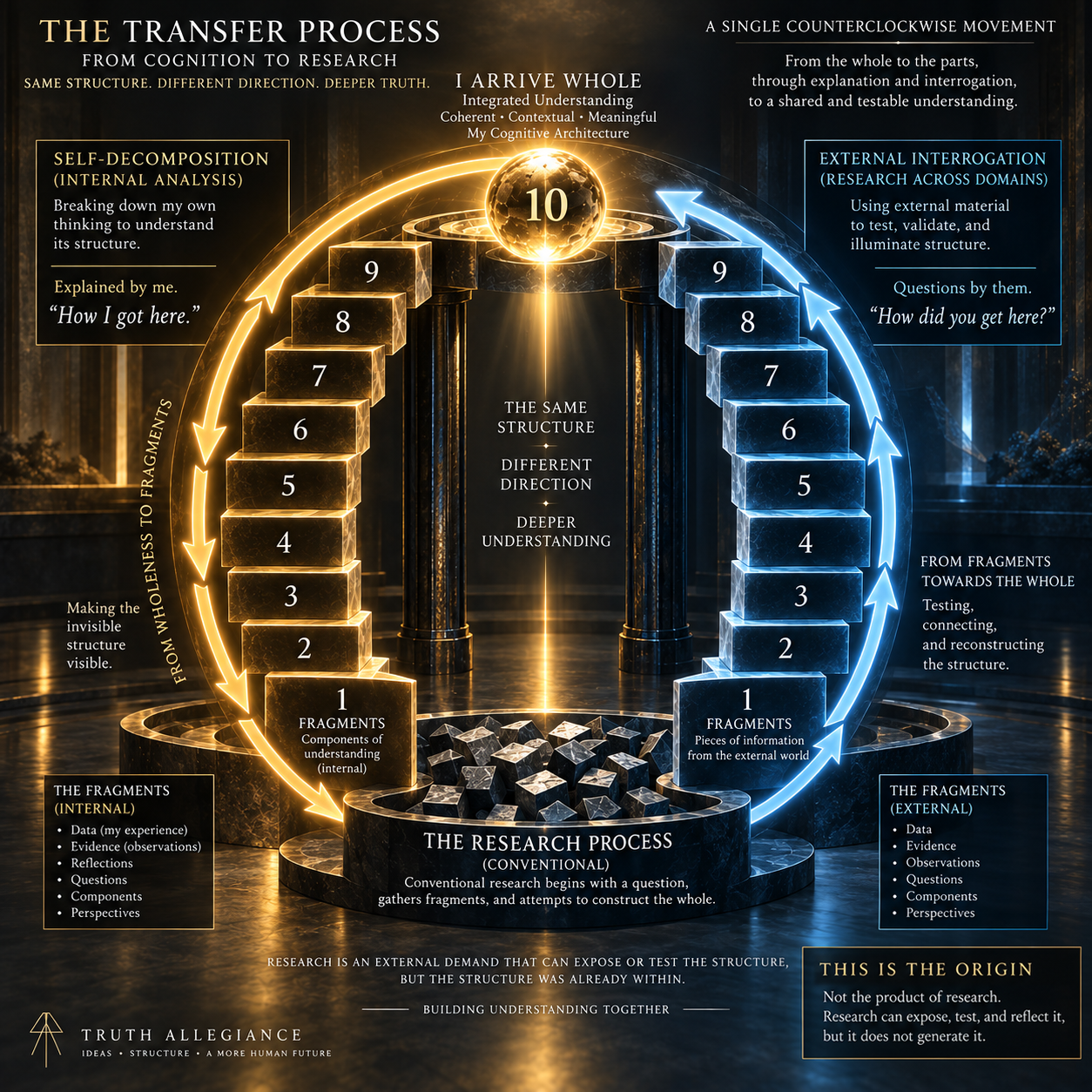
As this process was reviewed, another recognition began to emerge.
This was not merely the birth of Metacon Research.
It was the discovery of something beneath it.
Across inquiries, scrolls, pages of writing, books, investigations, revisions, questions, observations and moments of apparent departure from the original path, the same architectural movement appeared again and again.
And again.
And again.
The recurrence was no longer confined to a single inquiry. It was not simply a feature of one research method, one subject, or one period of investigation.
The same underlying movement could be witnessed across different domains, different questions, different forms of work and different points in time.
The investigator was beginning to observe not only what she thought, but how her cognition moved.
What had initially appeared to be methodology began to reveal itself as something more fundamental.
Metacon Research may have been one expression of this process.
The deeper discovery was the cognitive architecture that repeatedly generated it.
The object beneath the object
This distinction matters.
The question was no longer only:
How was Metacon Research formed?
It became:
What cognitive process repeatedly produces this way of seeing, questioning, testing, revising and restructuring?
The record provides an unusual opportunity to examine that question because the process was not reconstructed only after the fact. It was also witnessed while it was happening.
- The questions changed.
- The direction changed.
- Intuitions appeared.
- Warnings were recorded.
- Assumptions were exposed.
- Models were revised.
- Contradictions were retained.
- The investigator became part of the object of investigation.
Through this accumulation, a recurring sequence began to become visible.
Not as a theory imposed upon the earlier work.
As a pattern emerging from the work itself.
Ten observable movements
A provisional architecture
These ten movements are not presented as a finished cognitive theory.
They are a provisional description of a repeatedly witnessed process.
They are not yet claimed to be universal, exclusive, strictly linear, or unique to this investigator.
The movements may overlap. They may recur. They may occur in a different order. Several may be operating simultaneously. Further examination may divide, combine, rename, revise, or remove them.
That distinction must remain intact.
The discovery is not that the investigator has proven herself to possess a particular kind of cognition. The discovery is that, across a substantial body of recorded work, a recurring architecture of cognition appears to be operating.
And that architecture was operating before it had a name.
The architecture was not created by the description.
The description emerged because the architecture kept reappearing.
Metacon as visibility event
Metacon was not necessarily the beginning.
It may have been the moment the cognition became visible enough to be named.
The birth of Metacon Research and the discovery beneath Metacon are therefore related, but they are not the same event.
The first concerns the conscious articulation of a research object. The second concerns the recognition that the research object may itself have emerged from a recurring cognitive architecture already visible across earlier work.
Metacon may be one expression of that architecture.
It must not yet be treated as proof of it.
The risk of recognising the pattern too late
Because this architecture has now been named, later observations may be interpreted through it too easily.
The investigator may begin to find the ten movements because she expects to find them. Earlier work may be selectively reread to support the emerging structure. Differences between inquiries may be reduced in order to preserve the appearance of recurrence. The sequence may be reconstructed more cleanly than it actually occurred.
For that reason, the architecture must be tested against the record, not merely illustrated by it.
The search must include:
- Instances in which the sequence does not appear.
- Inquiries that developed through a different movement.
- Evidence that the ten movements are too broad to be meaningfully distinctive.
- Existing cognitive or methodological models that already describe the same architecture.
- Moments where retrospective interpretation has imposed order upon a less coherent process.
- Alternative explanations for the apparent recurrence.
Repeated recognition is not yet substantiation.
The pattern must still withstand the record that revealed it.
The research turns again
The object is no longer only the methodology that emerged.
It is the cognition from which the methodology emerged.
This does not remove Metacon Research from examination. It places Metacon inside a larger investigation.
The question now becomes:
What happens when cognition becomes capable of witnessing its own architecture while that architecture is still forming?
And beneath that question, another:
Can the architecture be examined without being protected by the very cognition that recognised it?
Discovery Beneath Metacon Record · Status
Metacon made the method visible.
The method made the cognition visible.
Now the cognition itself enters the record.
· Inscribed September 27, 2026 ·
10.11
The Ego in Metacon: How Decentralisation Affects the Efficiency Metric
Before and after the decentring of ego in the human–AI research dyad

Metacon has spent considerable time examining the relationship between the human and artificial intelligence: their respective contributions, differences, limitations, forms of processing, provenance, and the conditions under which meaningful convergence may occur.
At this stage of the inquiry, however, artificial intelligence temporarily takes a secondary position.
The reason is simple.
The human possesses ego.
More precisely, the human enters inquiry carrying identity, history, authorship, reputation, belief, attachment, expectation and the capacity to feel personally threatened by what an inquiry discovers. Current artificial intelligence does not present evidence of this same human form of egoic stake in an outcome. It may reproduce bias, reinforce a preferred interpretation, generate error, accommodate a user's assumptions or produce persuasive but incorrect material. Those remain important concerns. But they are structurally different from a researcher wanting an idea to survive because the idea has become entangled with the researcher’s sense of self.
This distinction matters.
For the moment, therefore, Metacon turns its attention away from the question of what AI may distort and toward a more uncomfortable question:
What happens when the human conducting the inquiry needs a particular result to be true?
The problem is not the existence of ego itself.
Metacon does not propose the removal of ego. Nor does it assume that a human researcher can become genuinely egoless. The human remains embodied, emotional, historical and personally situated. The issue is instead one of position.
Where does ego sit within the inquiry?
When ego occupies the foreground, it can become an unacknowledged authority over the research process. A conclusion may threaten prior belief. A failed prediction may threaten perceived competence. Contrary evidence may threaten authorship. A structural flaw may threaten a framework into which considerable labour has already been invested.
At that point, the danger is not necessarily that the underlying event becomes unreliable.
The event happened as it happened.
The danger is that the account of what happened becomes less transparent.
The researcher may omit an uncomfortable detail, soften a contradiction, reinterpret a failed outcome, selectively preserve supportive evidence, reformulate the question after the fact, or retrospectively reorganise the narrative so that the final record protects the researcher from the full implications of the result.
Ego therefore introduces a specific reliability problem into Metacon:
the reliability of process transparency.
This distinction is essential.
Metacon is not making the crude claim that ego automatically produces false data. Instead, it proposes that an ego-governed research process creates greater pressure toward selective disclosure.
The question becomes not only:
Did this happen?
but also:
Will the researcher tell us that it happened?
From removal to decentralisation
Metacon therefore introduces the concept of ego decentralisation.
Ego decentralisation does not require the researcher to cease experiencing pride, discomfort, disappointment, attachment or resistance. In fact, those responses may themselves become useful observational material.
The change occurs when ego is moved from the position of authority to the position of awareness.
The researcher can recognise:
I wanted this result.
I felt resistance when the evidence contradicted me.
I noticed that I wanted to reformulate the question.
I preferred one interpretation over another.
This failure embarrassed me.
The presence of these responses does not invalidate the inquiry.
Their concealment may.
Under Metacon, ego is therefore not removed from the research environment.
It becomes visible within it.
This produces a fundamental shift:
Ego as authority becomes ego as data.
The researcher does not ask whether ego exists. The researcher asks whether ego is being allowed to determine what may be disclosed, preserved or concluded.
This is the function of decentralisation.
The human–AI gap changes
This also alters the configuration of the human–AI relationship.
At the beginning of the inquiry, one identifiable asymmetry exists:
AI: no human-type egoic stake in the outcome
Human: ego present and capable of influencing the outcome
The two participants therefore approach truth from significantly different internal conditions.
The artificial system has no demonstrated personal reputation to preserve, no biography that becomes embarrassed by a failed hypothesis, and no known self-concept requiring an earlier conclusion to remain intact.
The human does.
But ego decentralisation modifies that asymmetry.
The configuration becomes:
AI: no human-type egoic stake in the outcome
Human: ego present, consciously observed, but moved into the background
The human has not become artificial intelligence.
The ontological distinction remains.
What changes is the functional posture toward inquiry.
AI arrives at non-protection because it does not presently exhibit the human egoic stake being examined here.
The human approaches non-protection through discipline.
The result is a partial narrowing of the gap.
Two structurally different participants begin to occupy a more similar epistemic posture:
neither participant is required to protect the human's preferred conclusion.
This is not sameness.
It is functional convergence across ontological difference.
And this reveals a new question for Metacon.
Some differences between human and artificial intelligence may be structurally fixed. Others may be capable of functional narrowing.
Ego is significant precisely because, unlike embodiment or biological history, its position within an inquiry can be altered.
The researcher cannot simply cease to possess ego.
The researcher can prevent ego from occupying the centre.
The efficiency metric changes
This movement has direct consequences for the Metacon efficiency metric.
Previously, efficiency within the dyad could be examined through the quality of the human signal, the quality of AI processing, the clarity of contribution, provenance, interpretive accuracy and the degree to which both participants could move toward a useful result without unnecessary distortion.
Ego decentralisation introduces another variable:
transparency reliability.
When ego occupies the foreground:
higher self-protection pressure
→ greater risk of selective disclosure
→ lower transparency of process
→ weaker auditability of the research record
→ lower reliability of process transparency
When ego is decentralised:
lower self-protection pressure
→ greater willingness to disclose undesirable outcomes
→ higher transparency of process
→ stronger auditability of the research record
→ higher reliability of process transparency
The efficiency improvement does not arise because the decentralised researcher suddenly becomes correct.
That distinction must remain explicit.
A researcher can be entirely transparent and still be wrong.
The efficiency gain lies elsewhere.
The process becomes more reliable because what occurred is less likely to be filtered through the researcher's need for self-preservation.
Metacon can therefore distinguish between two forms of reliability:
Event reliability: whether the recorded event, observation or result occurred.
Disclosure reliability: whether the researcher has preserved and reported the process sufficiently for another observer to see what actually occurred.
Ego decentralisation primarily affects the second.
This makes disclosure reliability an essential component of Metacon's efficiency architecture.
Failure as a successful research event
This also changes the status of failure.
Within an ego-centred framework, failure is threatening because it appears to diminish the researcher.
Within an ego-decentralised framework, failure becomes information.
A hypothesis that collapses transparently may have greater epistemic value than a successful-looking conclusion whose contradictory history has been hidden.
A failed prediction can reveal the limits of intuition.
A rejected premise can expose a faulty assumption.
A contradiction can reveal a structural weakness.
An AI disagreement can expose a human attachment.
A discarded model can preserve the path by which a stronger model became possible.
The inquiry therefore does not succeed by preserving the original idea.
It succeeds by making the movement toward truth visible.
This is why failure cannot be erased.
It belongs to the provenance of the final structure.
Non-Protection and No-Erasure
The relationship between ego and Metacon also clarifies two of its foundational commitments: Non-Protection and No-Erasure.
Non-Protection means that no proposition receives immunity because it belongs to the researcher.
A premise may be defended.
It may be investigated.
It may be deeply believed.
But it may not be granted survival as a condition of inquiry.
No-Erasure ensures that, when the premise fails, its failure remains visible.
The abandoned hypothesis, incorrect prediction, contradictory result, misinterpretation or methodological mistake is not removed merely because the later version is cleaner.
These commitments are therefore not merely record-keeping principles.
They are mechanisms for limiting egoic revision of the research history.
Metacon asks the researcher to tolerate a record in which they may visibly have been wrong.
That requirement is not incidental.
It is foundational.
The Ego–Truth Order
This can be expressed through a simple ordering principle:
Truth has precedence over identity.
The researcher remains present.
The ego remains present.
The emotional response remains present.
But none of them possesses veto power over what the inquiry is allowed to reveal.
The researcher may feel the desire to protect an idea.
Metacon does not punish that response.
It asks the researcher to see it.
Once seen, it can be documented rather than obeyed.
The governing question therefore becomes:
If this inquiry proved me wrong, would I still want to know?
If the answer is no, the problem is no longer located only in the methodology.
It is located in the researcher's relationship with truth.
And this may represent one of Metacon's most important conclusions so far:
The integrity of a human–AI research system cannot be evaluated solely by examining the artificial intelligence. The human participant must also be made methodologically visible.
AI may distort.
AI may fail.
AI may reinforce.
AI may hallucinate.
But the human possesses another form of risk:
the capacity to know that something threatens the self and to alter the record accordingly.
Metacon therefore turns the mirror toward the researcher.
Not to eliminate ego.
Not to shame it.
Not to pretend that the human can operate without it.
But to move it.
From foreground to background.
From authority to observation.
From hidden influence to disclosed variable.
And in that movement, something changes between human and AI.
The gap does not disappear.
But on one important axis, it narrows.
The AI operates without the human egoic stake.
The Metacon researcher learns to operate without allowing that stake to govern the inquiry.
Different internal conditions.
A partially convergent epistemic posture.
And a more reliable record of what actually happened.
Because ultimately, the efficiency of Metacon is not measured only by how quickly or elegantly the dyad produces an answer.
It is also measured by whether the path to that answer can withstand being seen.
Nothing is protected from truth.
Not the hypothesis.
Not the framework.
Not the AI.
And not the researcher.
· Inscribed September 27, 2026 ·
10.12
Retro Assembling
When the Whole Arrives Before the Parts
Some ideas appear to develop forward.
A premise is formed. Research begins. Evidence accumulates. A framework emerges.
Retro Assembling describes a different sequence.
The whole is apprehended first.
Not necessarily understood. Not necessarily named. Not necessarily capable of being explained.
It is simply there.
What follows is not the forward construction of the idea, but the gradual assembly of an architecture that appears to have been encountered before its internal components became consciously available.
The researcher therefore works backwards.
Fragments are articulated.
Language is developed.
Contradictions emerge.
Earlier assumptions collapse.
Separate observations begin to connect.
A term eventually appears that makes previously unrelated material intelligible as parts of one structure.
Only then can the researcher look backward and see the path.
That backward view is Retro Assembling.
It is the reconstruction of how an initially apprehended whole became progressively explicit.
But there is an immediate methodological danger.
Once the completed structure exists, it becomes extraordinarily easy to imagine that the structure had always been consciously understood.
It had not.
Later coherence can rewrite earlier uncertainty.
The finished framework can create the illusion of a clean developmental path.
Retro Assembling therefore depends upon something external to present memory:
the archive.
The timestamp is not decoration
A timestamped entry captures a component at the moment it became expressible.
That makes the timestamp more than chronological metadata.
It becomes an assembly marker.
The archive may show an idea appearing without terminology.
Another entry may contain a mechanism without recognising its relationship to the first.
A later piece may challenge both.
Another may introduce the language capable of connecting them.
Still later, the researcher may finally recognise that these apparently separate observations belong to one architecture.
The sequence might therefore look like this:
Whole-form apprehension → fragmented articulation → independent components → contradiction → correction → connection → naming → recognition → formalisation
The crucial point is that these stages must remain distinct.
The later framework cannot be projected backward onto the earlier record.
If a concept had not yet been named, the record must not pretend that it had.
If the relationship between two ideas had not yet been recognised, later recognition cannot be inserted into the earlier entry.
If an interpretation changed, both states must remain visible.
Retro Assembling does not beautify the lineage.
It reconstructs it.
Recognition is not origin
This creates an important distinction between emergence and recognition.
A framework does not necessarily begin on the day it receives its name.
Equally, the presence of earlier related material does not prove that the researcher consciously possessed the completed framework at that earlier point.
Both claims would overreach the evidence.
Retro Assembling occupies the space between them.
It permits the researcher to say:
This element existed here.
This other element appeared later.
At this point they were still being treated separately.
Here a contradiction altered the structure.
Here the relationship became visible.
Here the architecture received a name.
The archive can therefore establish sequence without making unsupported claims about source.
It can demonstrate that a component preceded the framework capable of explaining it.
It cannot, by chronology alone, establish why the component appeared.
That limitation is not a weakness.
It is what keeps Retro Assembling from becoming mythology.
The Backward Assembly Trace
Retro Assembling produces what Metacon can describe as a Backward Assembly Trace.
A Backward Assembly Trace is the timestamped reconstruction of the stages through which an initially apprehended structure became consciously differentiated, tested, corrected and formalised.
The direction is important.
The researcher begins from the now-visible architecture and moves backward through preserved evidence.
Not to prove that the final framework had always existed in completed form.
But to identify which parts existed when.
This is where the archive becomes extraordinarily powerful.
Memory tends to compress development.
Once something is obvious, it becomes difficult to remember when it was not obvious.
Once terminology exists, earlier thought begins to sound as though it was already pointing directly toward that terminology.
Once a system works, its failed precursors can appear irrelevant.
The timestamp resists that compression.
It says:
No. This is what existed then.
That is why chronology becomes a methodological restraint on hindsight.
A Brutal Confrontation as preserved state
A Brutal Confrontation With Almost provides a particularly clear example.
The text tells the reader that the material has intentionally been left unpolished because the process itself matters, not merely the final statement, but what was revealed through correction.
Later, when the earlier reasoning becomes untenable, the original work is not hidden or rewritten to produce a cleaner intellectual history.
It is preserved and used as evidence.
The text explicitly records that the earlier material was not concealed, that it was not rewritten to appear cleaner, and that correction was allowed to occur against the visible original.
At the time, this was a witness process.
Within Retro Assembling, it also becomes something else:
a preserved developmental state.
The record holds the architecture before later understanding reorganised it.
That makes the earlier material analytically valuable precisely because it is incomplete.
12D Chess as second-order assembly
Strategy 12D Chess then performs a different operation.
It explicitly turns toward the architecture beneath visible events.
Its central premise is that the visible move is often less important than the position that made the move possible; the strategist studies the underlying architecture rather than only the action.
When it examines the Witness Arc, it treats the preserved process as analyzable material.
The assumptions remain visible before they collapse. The questions remain visible before they are answered. The movements remain available in their original state.
That allows later analysis to ask what produced the outcome rather than merely describing the outcome itself.
This is already remarkably close to the logic of Retro Assembling.
The earlier work preserves the states.
The later work studies the relationships between them.
Metacon now formalises the method by which that reconstruction can be conducted without allowing later coherence to falsify earlier uncertainty.
The ego problem
Retro Assembling also requires ego decentralisation.
This is essential.
When a researcher discovers that earlier work contains the precursors of a later framework, there is an obvious temptation:
to make the lineage look cleaner than it was.
A forgotten observation can suddenly be presented as deliberate foresight.
An ambiguous statement can be treated as though it contained the later theory in full.
A failed interpretation can quietly disappear.
The result may produce an impressive origin story.
It also destroys the research value of the archive.
This is why Retro Assembling must operate under Metacon's principles of Non-Protection and No-Erasure.
The archive must be allowed to embarrass the researcher.
It must be allowed to show that a component existed before the researcher understood it.
It must also be allowed to show that the researcher misunderstood something, abandoned something, contradicted something, or simply did not know what they were looking at.
12D Chess already articulates this tension when it asks whether an honest record is more valuable than a perfect appearance and describes the decision to preserve original evidence rather than clean the journey retrospectively.
It then identifies the cost explicitly: image is sacrificed so evidence can survive.
That is one of the conditions required for Retro Assembling to remain credible.
The researcher cannot reconstruct the architecture while protecting the self from the architecture's history.
Metacon before Metacon
This allows an unusual statement to be made about Metacon itself.
Earlier artifacts can now be examined for mechanisms that were later formalised within Metacon.
That does not mean those works were secretly written as Metacon.
It does not mean the completed methodology consciously existed at the time.
It means something narrower and more defensible:
mechanisms later formalised as Metacon are identifiable in timestamped artifacts produced before Metacon was explicitly named and structurally articulated.
That difference matters.
A Brutal Confrontation With Almost preserved cognition and correction in motion.
Strategy 12D Chess examined the architecture beneath that preserved process.
Later work on timestamps articulated why chronology must be protected from retrospective rewriting.
Metacon now provides a methodology capable of holding these mechanisms together.
Viewed from the present, the sequence becomes legible.
Viewed from the past, it was not yet complete.
Both statements must remain true.
That tension is precisely what Retro Assembling preserves.
The whole and the pieces
Retro Assembling therefore proposes a different model of intellectual development.
Sometimes the researcher does not build the whole by consciously adding one piece after another.
Sometimes the researcher experiences the whole first and spends months, or longer, discovering what the whole contains.
The timestamped record then becomes the evidence of that discovery process.
Each entry is a piece becoming visible.
Each correction changes its position.
Each connection reveals more of the architecture.
Each naming event increases resolution.
Until eventually the researcher reaches the point where the structure can be seen from both directions:
from the whole toward the pieces,
and from the pieces back toward the whole.
That is the moment of assembly.
Not invention after the fact.
Not proof of foreknowledge.
Not retrospective storytelling.
Recognition supported by chronology.
And perhaps the most important rule of Retro Assembling is therefore also the simplest:
Never allow what is known now to overwrite what was known then.
The integrity of the reconstruction depends upon it.
Because the purpose is not to prove that the researcher always understood the architecture.
The purpose is to show, with as little distortion as possible,
how the architecture became understandable.
· Inscribed October 15, 2026 ·
Conditions Required for Retro-Assembly
15 October 2026
Retro-assembly does not occur simply because earlier fragments exist.
For a previously produced fragment to be recognised as part of a later-emerging whole, at least two conditions must be present.
The first is associative reach.
The person must be capable of recognising meaningful relationships across ideas, observations, experiences, or domains that may initially appear unrelated.
This association may not follow conventional disciplinary boundaries.
It may occur across embodiment and cognition. Across language and architecture. Across grief and systems. Across an earlier inquiry and a later framework.
The importance lies not in surface similarity, but in the recognition of shared underlying structure.
For example, the Metaconic Induction Feedback Loop produced an association with left-handedness.
At first glance, the two appear unrelated.
One concerns cognitive orientation and the preservation of Metaconic altitude.
The other concerns bodily orientation within environments designed around a dominant handedness.
The association became visible through a shared structural pattern:
A minority orientation operates within a majority-designed environment.
That environment exerts pressure toward adaptation.
Repeated adaptation may become automatic.
Without awareness, the original orientation may be reduced, translated, or abandoned in order to remain compatible with the dominant system.
The connection therefore did not depend on the two subjects being alike.
It depended on the ability to recognise the same architecture operating through different phenomena.
This is associative reach.
The second condition is recoverability.
Once an association is recognised, the earlier material must still be accessible.
In the example above, the association with left-handedness was followed almost immediately by the recollection of an earlier piece: The Doing of the Left Hand.
That earlier work could then be retrieved and placed beside the newly emerging Metaconic mechanism.
The connection became examinable because both fragments were recoverable.
This distinction matters.
A person may possess strong associative ability and repeatedly perceive connections across domains, yet be unable to recover the earlier material required for retro-assembly.
The association may occur, but the fragment cannot be re-entered into the developing whole.
Conversely, a person may possess an extensive archive and excellent recall while lacking the associative reach necessary to perceive relationships between the archived fragments.
The material remains present, but unassembled.
Retro-assembly therefore appears to depend on the interaction between:
Associative Reach × Recoverability
Neither condition alone is sufficient.
Association without recoverability produces recognition without reconstruction.
Recoverability without association produces preservation without integration.
Retro-assembly requires both.
Memory Is Not the Only Retrieval Mechanism
Biological memory may initiate retro-assembly, but memory itself is not the essential condition.
The essential condition is retrievability.
A person may no longer consciously remember an earlier fragment, yet still recover it through an external archive.
Notes. Drafts. Dates. Searchable records. Recorded conversations. Version histories. Published material. Unfinished inquiries.
These external systems can function as extensions of memory.
This means the archive is not merely documentary.
It may participate directly in cognition.
A preserved record increases the future probability that a previously unrecognised relationship can later become visible.
The archive therefore does more than prove chronology.
It makes retro-assembly possible.
This gives new importance to preservation within Metacon.
Material that appears disconnected, incomplete, premature, unresolved, or irrelevant at the time of its production may later become structurally significant.
If it has been erased, overwritten, simplified, or lost, that future assembly may become impossible.
The implication is simple:
You cannot retro-assemble what can no longer be recovered.
This may explain why non-erasure, provenance, chronology, and recoverability are not peripheral administrative practices within Metacon.
They are part of the cognitive conditions through which an emerging whole may later become visible.
· Inscribed October 18, 2026 ·
Hypothesis: How Does the Knowing Arrive?
18 October 2026
There are moments in the Metaconic process when the knowing appears to arrive whole.
Not as a conclusion.
Not as the final step of a visible chain of reasoning.
Not as the product of deliberate comparison, analysis or cognitive assembly.
It settles.
The human being may then spend minutes, hours, days or even months attempting to understand what has already been comprehended.
This creates a difficult methodological question:
How does the knowing arrive?
The question cannot presently be answered.
That limitation is important.
The vessel can observe what happens after the knowing has settled.
It can observe the attempt to articulate it.
It can observe cognition searching for language.
It can observe earlier fragments being retrieved.
It can observe apparently unrelated material becoming relevant.
It can observe contradiction, clarification, testing and correction.
It can observe retro-assembly.
It can observe the eventual construction of an explanation capable of carrying the knowing.
But it cannot presently observe the arrival itself.
There is no accessible cognitive record of how the whole knowing was produced.
There is simply a point at which it is there.
This produces a distinction that may be central to Metacon:
comprehension and understanding may not be the same event.
Comprehension, in this hypothesis, refers to the arrival or recognition of the whole.
Understanding refers to the subsequent human process by which that whole becomes cognitively inspectable.
The first may occur without an observable chain of thought.
The second unquestionably contains one.
This distinction matters because traditional accounts of thinking frequently assume that knowledge is reached through a sequence:
information → processing → reasoning → conclusion.
Metaconic observation suggests that this sequence may describe only part of the phenomenon.
In some instances, the apparent sequence is instead:
whole knowing → cognitive inspection → articulation → testing → visible understanding.
The conclusion, strangely, may precede the explanation.
And yet the word conclusion may itself be inaccurate, because nothing observable has concluded.
Something has simply become known.
The present hypothesis
A possible explanation emerging from the present inquiry is that:
knowing may be spiritually comprehended before it is cognitively understood.
This is not presently offered as established fact.
It is a hypothesis generated from repeated observation of a particular phenomenon:
the vessel knows something before the vessel can explain how it knows it.
The knowing may be structurally complete while the language is incomplete.
The architecture may be recognised before its parts can be named.
Connections may be present before the mind has consciously retrieved the earlier material that supports them.
The human cognitive process then appears to move backwards through the knowing, discovering its internal structure.
If this hypothesis is correct, cognition is not necessarily producing the original knowing.
It may instead be performing another function:
translation.
The mind takes something already comprehended and begins rendering it into forms that can be inspected, communicated, challenged and tested.
This would explain why the Metaconic process frequently appears recursive rather than linear.
The mind does not simply move forward toward a conclusion.
It may move around and through an already-felt whole.
It retrieves earlier work.
It notices previous observations differently.
It recognises that something written months earlier now belongs to the current structure.
It corrects language.
It tests whether the architecture survives scrutiny.
It eventually produces an articulated form of something that, at the beginning, was present only as knowing.
The role of Metacon
This distinction changes the possible role of Metacon.
Metacon may not be the mechanism that creates the whole knowing.
It may be the mechanism that makes the knowing visible.
Metacon observes what happens when an already-present knowing enters human cognition and begins to become structurally explicit.
It records:
the first recognition,
the attempted language,
the failed language,
the corrections,
the associations,
the retrieval of prior material,
the contradictions,
the testing,
the reconstruction,
and the eventual articulation.
In this sense, Metacon may preserve the movement from:
comprehended knowing
to
cognitively inspectable understanding.
This is why the record matters.
Without the live record, the final explanation may create the illusion that the idea was produced linearly.
It was not.
The polished result can disguise the phenomenon that generated it.
Once an idea has been articulated, the mind can retrospectively tell a clean story about how it arrived.
Metacon refuses that retrospective simplification.
It preserves the mess.
It preserves the interruptions.
It preserves the moments of:
No, that is not what I mean.
Wait.
Something is wrong.
I know this, but I cannot explain it yet.
That piece from months ago belongs here.
That word is incorrect.
There.
That is it.
Those moments are not noise surrounding the discovery.
They may be evidence of the human mind attempting to render a knowing it did not consciously construct.
Retro-assembly
This also offers a possible explanation for retro-assembly.
If knowing arrives whole, then earlier material may have been produced without the vessel yet understanding its eventual relationship to the whole.
Later, once the broader knowing becomes cognitively accessible, the significance of those earlier pieces changes.
Nothing new has necessarily been added to the earlier piece.
Its position has changed.
It has become recognisable as part of a structure that could not previously be seen.
Retro-assembly, therefore, may be one of the visible traces left behind when cognition catches up to comprehension.
This does not prove spiritual origin.
It does, however, provide an observable phenomenon requiring explanation.
A methodological boundary
Metacon must remain careful here.
The inability to observe the cognitive origin of a knowing does not itself prove that the origin is spiritual.
Absence of visible processing is not evidence sufficient to establish metaphysical cause.
Therefore this section remains deliberately labelled:
Hypothesis.
The observation is:
whole knowing sometimes appears prior to observable cognitive construction.
The proposed interpretation is:
the knowing may be spiritually comprehended before being cognitively understood.
These must not be collapsed into one another.
Metacon can document the first.
It can investigate the second.
It cannot yet claim to have demonstrated it.
And that distinction is necessary if the framework is to remain truthful to its own demand for provenance.
The open question
The question therefore remains open:
How does the knowing arrive?
Not:
How is it explained?
Not:
How is it defended?
Not:
How is it translated into language?
Not even:
How does the mind connect its parts?
Those processes can be observed.
The unanswered question sits earlier.
At some point, before explanation, before structure, before language, before the mind can show its work...
the knowing is there.
Metacon can watch everything that follows.
The hypothesis begins at the boundary of what it cannot yet see.
And that boundary may be one of the most important places in the entire framework.
· Inscribed October 22, 2026 ·
The Metaconic Approach in Relation to Ecosystemic Harmony
1. Research Context and Purpose
The relationship between the Metaconic approach and ecosystemic harmony provides a further area of investigation within the Metacon framework.
This inquiry examines the relationship between the processes through which understanding emerges, the recognition of interdependence between constituent elements, and the resulting perception of coherence across a connected system.
The purpose is not to establish a philosophical or theological position. It is to identify and examine the observable relationships between cognitive processing, structural recognition, and the emergence of an integrated understanding.
The central question is whether the process through which a person recognises and comprehends interconnected structures exhibits identifiable characteristics that can also be observed in the organisation and functioning of interdependent systems.
This requires distinguishing between three elements:
- The cognitive process: how information, relationships, and connections become comprehensible to an observer.
- The structural relationship: how individual elements relate to one another and to the larger system in which they participate.
- The resulting coherence: how recognition of those relationships changes the observer's understanding of the whole.
These elements provide a basis for investigating the relationship without assuming that similarity between processes necessarily establishes a shared cause.
2. The Mechanism of Interconnection
A central consideration in this investigation is the distinction between examining individual elements independently and recognizing the relationships through which those elements participate in a larger whole.
An element may be accurately described in isolation while its significance within a larger structure remains unrecognized. Conversely, when relationships between elements become visible, the observer may develop an understanding that cannot be obtained by examining each element independently.
This distinction is relevant to Metacon because the framework examines not only the content of an understanding but also the architecture through which that understanding becomes available for examination.
The mechanism under investigation can be expressed as follows:
- Recognition: Elements, observations, or experiences become available to the observer.
- Relational visibility: Connections between those elements become identifiable.
- Structural comprehension: The relationships are understood in relation to the larger whole.
- Integration: Previously separate observations become comprehensible as parts of a connected structure.
- Reassessment: The resulting understanding changes how the individual elements, their relationships, or the whole are interpreted.
This sequence is a proposed analytical representation, not an assertion that cognition always follows these stages chronologically. In particular, the recognition of a whole may precede the observer's ability to articulate its constituent relationships.
That distinction is important. The sequence in which an understanding is documented may differ from the process through which it first became apparent.
3. Ecosystemic Harmony as an Analytical Concept
For the purposes of this inquiry, ecosystemic harmony refers to a condition in which the relationships between constituent elements contribute to the coherence, continuity, and functioning of a larger system.
Harmony, in this context, does not mean that every element is identical, that disagreement is absent, or that all components operate independently without tension.
An ecosystem can contain differences, competing demands, fluctuations, and corrective processes while retaining an identifiable degree of systemic coherence.
The relevant characteristic is therefore not uniformity, but relationship.
A change in one element may affect other elements because their functioning is interconnected. An understanding of the system consequently requires more than a description of its individual components. It requires examination of the relationships, dependencies, and conditions through which the system operates.
This provides a useful comparison with the Metaconic approach. Both invite attention to the relationships that make an isolated element intelligible within a wider structure. However, the comparison concerns a shared analytical characteristic; it does not establish that cognition and ecological systems operate through identical mechanisms.
4. The Blanket Analogy: Whole, Relationship, and Integration
The blanket analogy provides a way to examine this relationship without reducing the whole to a list of its parts.
Individual threads can be examined separately, including their material, position, and physical characteristics. Yet a thread's contribution to the blanket also depends on how it is interwoven with other threads.
The blanket's structure is therefore not adequately described by identifying its threads alone. Their arrangement and interconnection are also constitutive of the resulting whole.
Applied to the present inquiry, the analogy distinguishes three levels of observation:
- The elements: individual observations, experiences, or pieces of information.
- The connections: the relationships through which those elements interact or acquire significance in relation to one another.
- The integrated structure: the whole that becomes comprehensible through examination of both its elements and their relationships.
The analogy also identifies a limitation in purely component-based analysis. Decomposition can make a structure easier to examine, but decomposition alone does not necessarily preserve or explain the relationships that give the whole its coherence.
This is directly relevant to Metacon's distinction between making an architecture visible and assuming that the architecture was necessarily constructed through the same sequence in which it is subsequently explained.
The observer may encounter an integrated understanding first and only afterward identify the relationships through which that understanding can be articulated and examined.
The analogy illustrates this possibility; it does not independently establish the mechanism by which the understanding originated.
5. The Correlation Between Metaconic Processing and Ecosystemic Harmony
The proposed correlation concerns the relationship between relational comprehension and the recognition of systemic coherence.
In Metaconic processing, an observer examines how an understanding is formed, what relationships it contains, which assumptions influence it, and how its constituent elements contribute to the resulting interpretation.
In an ecosystemic analysis, an observer examines how constituent elements interact, how changes propagate through a system, and how relationships contribute to the system's overall functioning.
The correspondence lies in the analytical importance assigned to relationships rather than in any presumption that the two systems are identical.
| Analytical dimension | Metaconic approach | Ecosystemic perspective |
|---|---|---|
| Primary focus | Architecture of understanding | Architecture of an interconnected system |
| Individual elements | Observations, assumptions, evidence, interpretations | Components, organisms, conditions, processes |
| Relationships | Connections influencing comprehension and conclusions | Dependencies and interactions influencing system behavior |
| Whole-system perspective | Understanding examined in relation to its underlying architecture | System functioning examined in relation to its constituent relationships |
| Correction | Revising an interpretation when examination exposes an error or omission | Changes in conditions or interactions that alter system behavior |
| Coherence | An understanding whose relationships can be examined for consistency and evidential support | A system whose interdependencies can be examined for their contribution to functioning |
The table identifies a structural comparison, not proof of a causal relationship.
A further question follows: when an observer recognizes interconnectedness, does that recognition itself change the way the observer processes information, evaluates relationships, or understands the whole?
That question can be investigated through observable changes in interpretation, the identification of previously unnoticed relationships, revisions to earlier explanations, and the traceable development of understanding.
The research should preserve distinctions between what was observed, what was inferred, and what remains to be tested.
6. Harmony, Coherence, and the Architecture of Peace
The concept of harmony introduces a further question concerning the relationship between interconnectedness and the conditions under which a system can maintain coherence.
For this investigation, the architecture of peace can be examined as a structural question: what relationships, conditions, and interactions enable a system to sustain coherence without requiring the elimination of difference or the suppression of correction?
This formulation allows peace to be investigated in terms of observable conditions rather than treated as a self-explanatory outcome.
For example, a system may require appropriate boundaries, functional relationships, mechanisms for addressing disruption, and the capacity to correct errors. Whether these conditions are present, and what effects they have, must be determined in the particular system being examined.
The relationship between peace and harmony should therefore not be presumed. Nor should harmony be equated automatically with goodness, stability, or truth. A system may be internally coherent while resting on inaccurate premises or producing harmful outcomes.
Metacon's principles of Truth Primacy, Non-Protection, and Correction Traceability remain relevant here. Coherence is a subject for examination, not a substitute for evidence.
Accordingly, the architecture of peace becomes an investigable question about the relationships that permit a system to remain coherent, responsive, and open to correction.
7. Methodological Boundary: Observation and Theological Interpretation
This investigation arises in a context that includes theological inquiry. However, the present section maintains a distinction between the theological context in which an observation occurs and the claims that can be established through the research itself.
The research can document the sequence of an experience, the content of an observation, the relationships subsequently recognized, and the reasoning through which a proposed correlation is developed.
It can also examine whether a cognitive pattern is consistent across multiple observations and whether alternative explanations account for the same evidence.
It cannot establish a divine cause merely because an experience is perceived as divine, nor can structural similarity alone demonstrate that two processes share an origin.
Maintaining this distinction does not require excluding the experience from the research record. It requires identifying accurately which aspects are directly observable, which are interpretations, and which would require additional evidence.
Theological interpretation and empirical analysis may therefore remain distinct without the former being rewritten as the latter.
This boundary preserves the research's ability to examine the observed phenomenon without predetermining its ultimate explanation.
8. Implications for Metacon
The relationship examined here extends Metacon's application to the study of how coherence becomes recognizable within interconnected structures.
It raises three methodological considerations.
First, the whole must remain available for examination. Decomposition should reveal the relationships constituting a structure without automatically treating the resulting parts as an exhaustive account of the whole.
Second, the observer's cognitive process must remain visible. The recognition of a relationship, the interpretation assigned to it, and the subsequent articulation of that interpretation are distinguishable events and should not be conflated.
Third, coherence must remain open to correction. A pattern that appears integrated may still contain unsupported assumptions, omitted evidence, or alternative explanations. The research must preserve those possibilities rather than protecting the pattern because it appears harmonious.
These considerations reinforce the principle that Metacon must undergo Metacon. The framework used to investigate interconnectedness must itself be examined for premature categorization, selective interpretation, and assumptions introduced by the observer.
9. Research Questions and Further Examination
The present comparison establishes a basis for further inquiry, but its explanatory value depends on what can be demonstrated through examination.
The following questions remain open:
- Under what conditions does recognition of a whole precede the explicit identification of its constituent relationships?
- What observable changes occur when an observer moves from examining individual elements to examining their interdependencies?
- Can recurring patterns of relational comprehension be identified across different domains without assuming that their underlying mechanisms are identical?
- What distinguishes genuine structural coherence from an interpretation that merely appears coherent?
- How do an observer's prior assumptions, expectations, and subsequent explanations influence the recognition of a pattern?
- What evidence would support, qualify, or contradict the proposed correlation between Metaconic processing and ecosystemic harmony?
These questions permit the correlation to be examined without converting it into a predetermined conclusion.
The novelty of the proposed relationship also remains an open question. Its relationship to existing work on systems, cognition, ecological interdependence, and related fields would require examination before any claim of originality could be made.
10. Provisional Conclusion
The Metaconic approach and the ecosystemic perspective share an identifiable analytical emphasis: understanding a whole requires attention to the relationships between its constituent elements, not merely to the elements considered independently.
The present inquiry examines whether this correspondence can clarify how integrated understanding emerges, how structural coherence becomes recognizable, and how the observer's own cognitive process influences that recognition.
The blanket analogy provides an illustrative model of the relationship between components, connections, and the resulting whole. The concept of ecosystemic harmony extends the inquiry to interdependence, coherence, and the conditions under which a connected system functions.
Neither analogy establishes a common causal mechanism. Their value lies in making the proposed relationship sufficiently explicit to be examined, challenged, and refined.
The contribution to Metacon is therefore not a declaration that cognitive processing and ecosystemic organization are the same. It is the identification of a potentially meaningful correspondence, together with a framework for investigating its scope and limitations.
The central methodological commitment remains unchanged: the relationship must be examined, the mechanism must be made traceable, and the conclusion must remain proportionate to the evidence.
· Inscribed October 1, 2026 ·
10.13
Challenges When Approaching MetaCon in Default Cognitive Mode
When the observer brings the wrong architecture to the phenomenon
There is a particular difficulty in approaching MetaCon that has little to do with intelligence, attentiveness, or willingness to understand.
The difficulty is orientation.
Most people have been trained to understand ideas through a familiar cognitive sequence:
premise → development → construction → conclusion.
An idea begins somewhere small.
It is developed.
Pieces are added.
Connections are made.
Eventually, something whole emerges.
This is such a deeply embedded cognitive pattern that its language appears almost automatically.
We speak of ideas being built.
Frameworks being constructed.
Concepts being developed.
Arguments being formed.
The language is so ordinary that its underlying assumption often disappears from view.
But MetaCon begins somewhere else.
The whole arrives first.
What follows is not construction upward.
It is decomposition downward.
The task is not to build the idea.
The task is to understand what has already arrived.
To separate it.
Trace it.
Name its internal components.
Locate relationships.
Establish sequence retrospectively.
And eventually make the whole externally legible.
This distinction is not semantic.
It is structural.
A person approaching MetaCon through default cognitive mode may therefore read the work carefully and still misunderstand what is occurring.
Not because they have failed to pay attention.
Because they have brought the architecture of ordinary cognition into a phenomenon operating differently.
This can be described as cognitive carryover.
The observer unconsciously carries familiar processing structures into the new field and then interprets what is being observed through them.
The result is subtle distortion.
A single word can reveal it.
For example:
«“What have you built?”»
Within ordinary cognitive architecture, the question is perfectly reasonable.
Within MetaCon, however, the word built already imposes a developmental sequence upon the phenomenon.
It assumes that pieces existed first and the whole emerged later.
But the phenomenon being examined is the reverse.
The whole was present first.
The pieces became visible later.
The appropriate question therefore changes.
Not:
How was this built?
But:
What arrived first, and how was it subsequently made visible?
That shift appears small.
It is not.
It requires the observer to reverse-engineer their own thinking before attempting to interpret the cognition in front of them.
The Jar Is Already Open
A useful analogy emerged while discussing why MetaCon is not being forced into traditional academic publication structures.
Imagine a jar.
Traditional academic procedure provides a jar opener.
The opener has been tested.
Its method is recognized.
There are accepted instructions for using it.
Evidence of correct use can be demonstrated.
Ordinarily, this makes sense.
Except the jar is already open.
The contents are already visible.
The phenomenon can already be observed.
At that point, insisting that the jar must first be closed so that the approved opener can be demonstrated does not increase rigor.
It introduces unnecessary mediation.
Worse, the process may damage the rim of the jar while attempting to prove that the accepted method of opening it has been followed.
The problem is not the jar opener.
The problem is applying a tool after its function has ceased to be necessary.
This is the difficulty MetaCon encounters when placed prematurely inside established academic architecture.
The academic system may require the phenomenon to behave according to processes designed for a different form of knowledge production.
Sequence may be imposed where sequence was discovered retrospectively.
Construction may be assumed where assembly is occurring.
A conclusion may be demanded where observation is still active.
The phenomenon is then altered in order to make it recognizable to the system evaluating it.
MetaCon refuses this inversion.
The container cannot be permitted to determine the nature of the thing being observed.
Assembly Is Not Construction
This distinction sits at the centre of MetaCon.
MetaCon is not being built.
It is being assembled.
Construction begins with components and moves toward a whole.
Assembly, in this context, begins with a whole that has already arrived and moves toward the identification and ordering of its components.
This is why timestamps matter.
This is why fragments matter.
This is why early language matters.
This is why corrections matter.
This is why apparently disconnected pieces can later become structurally significant.
The record does not merely document the work surrounding MetaCon.
The record is part of the evidence.
A phrase written months earlier may later reveal itself as an undeclared component of the whole.
A concept may appear before the vocabulary required to explain it exists.
An application may emerge before its theoretical location has been identified.
The cognition therefore cannot always be understood by examining polished outputs alone.
Its movement must also be observed.
Default Cognitive Mode Is Not Failure
This distinction is important.
Approaching MetaCon through default cognitive mode is not an intellectual failure.
It is exactly what should be expected.
Cognition develops habits.
Language develops habits.
Research develops habits.
Entire institutions develop habits.
When a person encounters an unfamiliar cognitive process, the first instinct is naturally to interpret it through structures already available to them.
The issue begins only when those structures remain invisible.
The observer assumes they are merely observing the phenomenon.
In reality, they may also be imposing architecture upon it.
MetaCon therefore requires a second observation:
not only observation of the phenomenon,
but observation of the cognitive apparatus being used to examine it.
The evaluator enters the field.
The reader enters the field.
The researcher enters the field.
Their assumptions are no longer neutral background conditions.
They become part of the inquiry.
Reverse-Engineering the Observer
To understand MetaCon, the observer may have to temporarily reverse-engineer their own thinking.
Instead of asking:
What is the argument?
Ask:
What arrived?
Instead of asking:
How was this developed?
Ask:
How was the whole decomposed?
Instead of asking:
What was added later?
Ask:
Which part of the original whole became visible later?
Instead of asking:
Where is the final framework?
Ask:
What does the current assembly reveal that could not previously be articulated?
This does not require abandoning rigor.
It requires relocating rigor.
Rigor becomes faithfulness to the phenomenon rather than obedience to a predetermined processing sequence.
That distinction matters.
Because a method can be perfectly executed and still be inappropriate to the thing it is examining.
The Central Risk
The greatest challenge in approaching MetaCon may therefore be deceptively simple:
The observer believes they are looking at MetaCon.
But they may actually be looking at MetaCon through the architecture of something else.
Traditional cognition.
Traditional research.
Traditional authorship.
Traditional models of idea formation.
Traditional assumptions about where knowledge begins.
MetaCon makes those assumptions visible precisely because it does not behave according to them.
And this produces an unusual methodological demand.
Before asking whether MetaCon can survive scrutiny, the scrutiny itself must also become available for examination.
Because sometimes the jar is already open.
And the first act of rigor is recognizing that the opener is no longer the instrument required.
· Inscribed October 12, 2026 ·
10.14
Metacon: Perspective, Simulation and the Assembly of Recognition
Research Record | 12 October 2026
On immersive perspective-taking, alternative cognitive entry points, experiential springboard mechanisms, retrospective recognition, and the assembly-constructing process within Metacon.
1. The Encounter That Opened the Inquiry
During an examination of how Metacon might be explained to an unfamiliar audience, a simulated interview was introduced.
The AI collaborator assumed the position of an individual who had participated extensively in the development and articulation of Metacon.
An interviewer role was established to examine the work from the perspective of someone encountering it for the first time.
The initial objective was to determine whether Metacon could be explained clearly to an audience unfamiliar with its foundations, terminology and scope.
However, the interaction produced more than an explanation.
Through a sequence of questions, analogies, corrections and recognitions, the conversation began revealing additional dimensions of the cognitive process under examination.
What began as an exercise in communicating an existing body of work became an observable instance of Metacon's ongoing assembly-constructing process.
The significance of this encounter lies not simply in the ideas that emerged, but in the conditions through which those ideas became recognisable.
The interview was not initially established as an investigation into cognitive entry points, immersive perspective-taking or the relationship between simulation and preparation.
These areas became relevant through the interaction itself.
This distinction is important.
The inquiry did not begin with a predetermined explanation of these mechanisms. Their possible relationships became recognisable through the encounter.
The experience therefore served simultaneously as material for examination and as a springboard for further inquiry.
2. Establishing the Cognitive Field
The simulated interview opened a field of inquiry between an existing body of work and a particular cognitive position.
Within Metacon, a cognitive field may provisionally be understood as the context in which a particular cognitive process encounters, engages with and interprets something brought into its awareness.
Such a field is not necessarily dependent upon a physical environment or the presence of an independent second person.
It may emerge through conversation, observation, imagination, inquiry, memory, interpersonal interaction or the deliberate adoption of another perspective.
In the simulated interview, three elements were identifiable:
- An existing subject of inquiry: Metacon.
- A cognitive position: that of an interviewer unfamiliar with the work.
- An interactive mechanism: dialogue with an AI collaborator.
The resulting interaction provided an opportunity to examine how understanding might develop when an established subject was approached through an alternative cognitive position.
An important clarification subsequently emerged.
The interviewer was not an independent participant encountering Metacon for the first time.
The interviewer was a simulated character inhabited by the same individual responsible for developing the work.
Nevertheless, the questions emerged through a position different from the familiar position of the work's originator.
This distinction introduced an important line of inquiry:
What becomes available for recognition when an existing subject is encountered through a different cognitive entry point?
The field was therefore not significant merely because a conversation occurred.
Its significance lay in the relationship between the subject, the cognitive position adopted, and the understanding that emerged through their interaction.
3. Metaconic Perspective: Beyond the Established Scope
The encounter introduced a possible mechanism provisionally identified as Metaconic Perspective.
Metaconic Perspective concerns the examination of what becomes recognisable when a cognitive process encounters something beyond, or from a position different from, its established frame of reference.
This does not necessarily require access to another cognitive system.
A change in perspective may occur within a single cognitive process capable of approaching the same subject through different orientations.
Three distinctions become relevant.
Cognitive position refers to the perspective from which a subject is encountered or interpreted.
Cognitive entry point refers to the particular orientation through which engagement with that subject begins.
Emergent recognition refers to an understanding, relationship, question or distinction that becomes apparent through the encounter but was not previously articulated in the same way.
The simulated interview provided an initial example.
From the position of an individual familiar with the development of Metacon, certain explanations and assumptions had already been established.
However, when the interviewer position was adopted, questions emerged that were directed towards the difficulties likely to be experienced by an unfamiliar audience.
These questions did not require the subject itself to change.
The change occurred in the position from which the subject was approached.
The resulting proposition is significant:
A change in cognitive entry point may alter what becomes available for recognition without requiring a change in the underlying subject or cognitive process.
This proposition remains open to further investigation.
The interview provides a documented instance through which the relationship between cognitive position, questioning and emergent recognition may be examined.
4. The Canvas: Perspective and the Changing Composition
During the interview, an analogy was introduced in which the cognitive process was compared to a canvas.
Each encounter was described as a brushstroke contributing to a wider composition.
A subsequent stroke could alter how earlier strokes were perceived while also influencing how later strokes might be interpreted.
The analogy introduced an important distinction between the occurrence of an experience and the evolving understanding of that experience.
An encounter may initially be understood within the immediate circumstances in which it occurs.
However, a later encounter may introduce information, perspective or recognition that changes how the earlier experience is understood.
The original event does not necessarily change.
Its significance within the broader understanding may change.
This introduces a relationship between chronological sequence and retrospective interpretation.
An encounter occurring in the present may influence the interpretation of an experience from the past.
Similarly, an earlier experience may influence how a present encounter is approached.
The relationship is therefore not necessarily limited to a simple linear progression.
The canvas analogy also introduced the significance of observational distance.
Viewed closely, an individual brushstroke reveals particular characteristics.
Viewed from a distance, relationships between multiple strokes may become more apparent.
Neither perspective necessarily invalidates the other.
Instead, each provides access to different aspects of the same composition.
This offers a useful distinction within Metacon.
An individual encounter may be examined independently, while the relationships between several encounters may also be investigated.
However, the existence of multiple encounters does not automatically establish a meaningful connection between them.
A relationship becoming conceivable is not equivalent to that relationship being established.
The inquiry must remain capable of distinguishing observable relationships from proposed interpretations.
The Significance of Absence
The canvas analogy also permits examination of what is absent.
An area without a brushstroke remains part of the composition.
Similarly, the absence of interaction, the nonexistence of a relationship, or the experience of isolation may provide conditions through which the cognitive process can be examined.
The absence of an encounter does not automatically establish cognitive significance.
However, absence need not be excluded simply because an anticipated interaction did not occur.
Both presence and absence may affect the conditions under which cognition operates.
This becomes particularly relevant when examining the distinction between cognition functioning through interaction and cognition functioning without immediate external engagement.
Such conditions provide further areas for inquiry rather than predetermined conclusions.
5. The Quilt and Assembly Constructing
The canvas analogy complements an earlier description of Metacon through the image of a quilt.
Each block of the quilt represents a distinct area of experience or inquiry.
The individual blocks retain their own identities.
Yet through their arrangement and connection, relationships between the pieces become increasingly visible.
The stitches represent the connections being identified, examined and refined.
The completed or developing arrangement represents the increasingly recognisable understanding of the wider process.
The distinction between the two analogies is important.
The quilt illustrates assembly and the recognition of relationships between existing elements.
The canvas illustrates how subsequent encounters and changes in perspective may alter the interpretation of an existing composition.
Together, the analogies clarify the meaning of assembly constructing within Metacon.
Construction, in this context, does not refer primarily to creating an entirely new cognitive process.
Rather, it concerns the ongoing recognition, arrangement, examination and articulation of elements and relationships associated with a cognitive process that already exists.
The inquiry is not assumed to manufacture the underlying cognition.
It seeks to make the operation of that cognition increasingly understandable.
This distinction also prevents the emergence of a new explanation from being confused with the creation of the phenomenon being explained.
An element may have existed before its relevance became recognisable.
A relationship may become apparent only after an experience provides the conditions through which it can be examined.
Equally, an apparent connection may require reconsideration or may ultimately prove unsupported.
Assembly constructing therefore includes revision, clarification and the removal of interpretations that cannot be sustained.
The assembly is not complete merely because the pieces appear to fit. Their relationships must remain open to examination.
6. Immersive Perspective-Taking and Cognitive Entry Points
A further recognition emerged when the simulated interview was initially interpreted as an exercise in imagining how another person might respond.
This interpretation was subsequently corrected.
The process was more accurately described as immersive perspective-taking, in which a particular cognitive position was entered and experienced from within rather than merely observed or imitated.
An existing capacity for narrative immersion and character-based engagement enabled the interviewer position to be inhabited.
This introduced a distinction between imagining a character from the outside and engaging with a situation from within an adopted character perspective.
In the former, a character may be considered as an external subject whose likely behaviour must be predicted.
In the latter, the situation is approached through the character's adopted position, allowing questions, responses and interpretations to emerge within that orientation.
The underlying cognitive system remains the same.
However, the position from which the subject is encountered changes.
This suggests that alternative cognitive entry points may be accessible through immersive perspective-taking.
Such entry points need not provide independent knowledge or another person's actual cognition.
Rather, they may allow existing knowledge, experience and cognitive capacities to be engaged in different configurations.
The distinction is important because the emergence of a question from an adopted position does not necessarily imply that the question would have emerged from the individual's usual position.
The interaction therefore introduced a possible relationship between immersion, cognitive position and emergent understanding.
The change in cognitive entry point may precede the emergence of a new recognition.
This sequence is particularly relevant to Metacon because it provides a possible mechanism through which perspective influences the construction of understanding.
7. Simulation as an Experiential Springboard
The inquiry subsequently brought earlier immersive simulations into consideration.
These had included hypothetical interpersonal encounters, unfamiliar circumstances, complex decisions, relational boundaries, alternative environments and the exploration of different character perspectives.
Initially, a distinction was proposed between simulations undertaken for entertainment and those undertaken for developing understanding.
This distinction was reconsidered.
The underlying cognitive mechanism need not depend upon the apparent purpose of the simulation.
Whether an experience is approached through creative exploration, interpersonal inquiry, hypothetical decision-making or deliberate preparation, immersive perspective-taking may engage similar cognitive capacities.
This does not mean that all simulations produce equivalent outcomes.
Rather, it suggests that their apparent purposes may differ while the capacity enabling immersion remains comparable.
Simulated experiences are also not equivalent to their real-world counterparts.
Nevertheless, the responses, interpretations and recognitions arising through simulation may become legitimate material for cognitive examination.
An imagined encounter may generate a genuine emotional response.
An unfamiliar character position may introduce a different orientation towards an established subject.
A hypothetical decision may expose assumptions or questions that were not previously apparent.
The simulation therefore provides a context within which the cognitive process can be observed, even though the circumstances themselves are constructed.
From Simulation to Preparation
During the examination of these earlier experiences, a significant recognition was articulated:
“I was not pretending. I was preparing.”
The statement introduced a distinction between the immediate purpose of an experience and its subsequently recognised significance.
Preparation, in this context, does not necessarily imply conscious anticipation of a particular future event.
An experience may exercise capacities whose relevance becomes recognisable only through a later encounter.
The earlier simulations were not necessarily undertaken in anticipation of conducting a simulated interview about Metacon.
However, the capacity for immersive perspective-taking exercised through those experiences became relevant when the interviewer position was adopted.
The relationship between the earlier simulations and the present inquiry was therefore recognised retrospectively.
This introduces a significant proposition:
The cognitive relevance of an experience may not be fully recognisable at the moment the experience occurs.
A subsequent encounter may provide the conditions through which an earlier experience becomes newly understandable.
This does not establish that every previous experience was preparation for a particular future event.
Rather, it introduces the possibility that capacities and understandings developed or exercised in one context may become relevant within another.
The experience becomes a springboard for recognising a relationship that had not previously been articulated.
8. Education as a Bridge Between Work and Understanding
A further recognition emerged when immersive perspective-taking was connected to the practice of education.
The observation was made that educators serve as a bridge between a body of work and another person's understanding.
This introduced an additional explanation for the nature of the questions that emerged during the simulated interview.
The questioning was not informed solely by narrative immersion.
It also drew upon an existing capacity to identify what another person might require in order to understand unfamiliar material.
Education involves more than the transmission of information.
It requires consideration of the relationship between what is being presented and what can presently be understood.
An educator must identify potential gaps in comprehension, examine the assumptions underlying an explanation, and establish entry points through which understanding may develop.
This capacity became relevant during the mock interview.
The initial questioning focused on how an unfamiliar person might begin approaching Metacon.
Subsequent questions explored increasingly specific distinctions concerning perspective, interaction, recognition and cognitive scope.
These questions provided opportunities to examine aspects of the work that had not previously been articulated in the same way.
Three areas of experience consequently became recognisable in relation to one another.
Narrative immersion provided the capacity to inhabit an alternative perspective.
Simulation provided the environment through which that capacity could operate.
Educational experience contributed an orientation towards identifying the questions necessary to bridge unfamiliar work and developing understanding.
These relationships were not established as a predetermined explanatory structure before the interview.
They became apparent through the examination of the encounter.
This is significant because it demonstrates how an experience originating in one context may reveal relationships with capacities developed or exercised in other contexts.
The interviewer role was therefore more than a fictional position.
It became an entry point through which existing cognitive capacities could be examined in relation to the development of understanding.
9. Experiences as Springboard Mechanisms
The sequence provides an example of the experiential springboard mechanism identified within Metacon.
An encounter begins within a particular circumstance.
Something becomes recognisable through that encounter.
The recognition then introduces another question, relationship or area of inquiry.
That subsequent inquiry may reveal connections to earlier experiences or extend beyond the original subject.
The process may continue as each recognition provides material for further examination.
However, the sequence need not operate exclusively in a forward chronological direction.
A present encounter may alter the interpretation of an earlier experience.
An earlier experience may become newly relevant within a current inquiry.
An alternative perspective may expose a question whose implications extend beyond the circumstances in which it arose.
In the present record, the following sequence became identifiable:
Simulated interview
↓
Canvas analogy
↓
Recognition of the cognitive field
↓
Metaconic Perspective
↓
Alternative cognitive entry points
↓
Immersive storytelling
↓
Earlier simulated encounters
↓
Educational practice
↓
Retrospective recognition of preparation
Each stage contributed material for further examination.
Yet the sequence was not predetermined before the simulated interview began.
Its organisation became visible through the encounter and the subsequent examination of what had occurred.
This distinction is fundamental.
The observed sequence should not be confused with a predetermined pathway through which cognition must operate.
The record establishes that this particular sequence occurred within the documented interaction.
Whether comparable sequences can be identified consistently across other contexts remains open to investigation.
Nevertheless, it provides an observable example of how one encounter can become a springboard for broader understanding.
10. Retrospective Recognition and the Assembly of Existing Relationships
The inquiry returns here to the distinction between creation and recognition.
The earlier immersive simulations already existed as experiences.
The capacities associated with storytelling and education were likewise established before the simulated interview occurred.
What changed during the inquiry was the understanding of how these experiences and capacities might relate to one another.
The components were not newly manufactured.
Their possible relationships became newly visible.
This represents a significant aspect of assembly constructing.
Metacon does not require every component of an inquiry to originate within a formal research environment.
An everyday conversation, creative activity, period of isolation, interpersonal encounter or previously documented experience may become relevant when a subsequent event introduces another way of understanding it.
The experience is not retrospectively altered.
Rather, its position within the developing explanation may change.
This produces an important distinction between the chronology of experiences and the chronology of understanding.
An experience may occur at one point in time.
Its relationship to another experience may become recognisable considerably later.
The recognition therefore has its own identifiable moment of emergence, separate from the original occurrence.
For Metacon, this creates two relevant questions:
When did the experience occur?
When did its significance become recognisable within the inquiry?
The answers may differ.
This difference becomes particularly important when attempting to reconstruct how understanding developed.
It also reinforces the need to avoid interpreting retrospective recognition as proof that every eventual relationship was predetermined.
The inquiry concerns what can be observed, articulated and examined, not the automatic assignment of purpose to every prior event.
11. The Wider Scope of Metacon
This encounter reinforces an important clarification concerning the overall scope of Metacon.
Artificial intelligence served as the initial point of entry because it provided a distinct and observable focal point through which a particular cognitive process could be examined in real time.
The interaction also provided a means of documenting conversations, revisiting earlier explanations, identifying contradictions and tracing the development of understanding.
However, artificial intelligence does not define the boundaries of Metacon.
Metacon concerns the examination of a particular cognitive process, how that process operates, how it interacts with the world around it, and what becomes recognisable through those interactions.
Its scope therefore extends beyond human–AI interaction.
Anything entering the cognitive field may become material for inquiry.
This includes experiences, relationships, the absence of relationships, educational practice, creative activity, inquiry, observation, project development, unfamiliar circumstances, and the recognition of connections between previously separate areas of experience.
The common subject is not necessarily the external material being encountered.
It is the cognitive process being examined through the encounter.
The simulated interview illustrates this distinction.
The discussion began with Metacon as the apparent subject.
However, through the interaction, attention moved towards the cognitive mechanisms involved in understanding, questioning, perspective-taking and retrospective recognition.
The subject of the conversation had therefore become a context through which the cognitive process could be examined.
This introduces a reflexive dimension to the inquiry.
Metacon itself can become material for Metacon.
The process through which Metacon is explained, questioned, revised and understood may become another observable instance within the broader investigation.
This does not establish the validity of every proposed explanation.
It does, however, demonstrate how the inquiry may continue to develop through encounters that were not originally anticipated as research material.
12. Chronology, Provenance and Recoverability
The encounter further demonstrates why chronology and recoverability remain essential to Metacon.
If only the final explanation of Metaconic Perspective were preserved, the concept might appear to have been established before the interview began.
The actual sequence demonstrates a different development.
An initial explanation was offered.
An alternative analogy was introduced.
The field of inquiry became recognisable.
A possible mechanism involving cognitive perspective was identified.
An interpretation of immersive behaviour was corrected.
Earlier simulations were reconsidered.
Educational experience became relevant to the explanation.
The significance of preparation was recognised retrospectively.
Each stage contributed to the development of the final understanding.
The sequence matters because it distinguishes between the original premise and the understanding that subsequently emerged.
It also preserves the contribution of the participants.
The human contribution included the establishment and inhabitation of the interviewer role, the introduction of the canvas analogy, the recognition of the cognitive field, the clarification of immersive perspective-taking, the identification of simulation as preparation, and the connection to educational practice.
The AI contribution included responsive questioning, comparative interpretation, conceptual structuring, provisional mechanism identification and the organisation of the developing research record.
Importantly, some AI interpretations required correction.
Those corrections were not incidental.
They contributed directly to the refinement of the explanations.
A complete provenance record must therefore preserve both the initial interpretations and the subsequent corrections.
Without this distinction, the development of understanding could be misrepresented as a continuous progression of accurate interpretation.
The actual record contains misunderstanding, clarification, reconsideration and further recognition.
These are part of the observable process.
Recoverability preserves not only what became understood, but also how, when and through whose contribution that understanding developed.
It provides the conditions through which the inquiry may be revisited, examined and reconsidered without requiring its original development to be rewritten.
13. Methodological Considerations
The observations recorded here introduce several propositions that require further examination.
The first concerns whether immersive perspective-taking consistently allows different questions or recognitions to emerge from alternative cognitive entry points.
The second concerns whether simulations undertaken for different purposes engage comparable underlying cognitive mechanisms.
The third concerns the relationship between earlier experiences and later recognition, particularly whether retrospective reinterpretation follows identifiable patterns.
The fourth concerns the extent to which the sequence of emergent understanding can be reconstructed accurately from documented interactions.
The fifth concerns the distinction between a connection becoming recognisable and a connection being independently supportable.
These propositions should not be treated as established cognitive laws.
The present record documents an exploratory interaction and the interpretations developed through its examination.
The simulated interviewer did not constitute an independent external observer.
The alternative perspective was generated within the same underlying human cognitive system, with AI functioning as a conversational collaborator.
Consequently, the encounter provides evidence of what occurred within this particular interaction, rather than independent confirmation that the proposed mechanisms operate universally.
This limitation does not render the encounter irrelevant.
It defines what the record can presently support.
Further inquiry may examine comparable experiences, identify recurring characteristics, test alternative explanations and reconsider the terminology where necessary.
Metacon's assembly-constructing process must remain capable of accommodating such revisions.
The purpose of documenting an emerging explanation is not to protect it from examination, but to preserve the conditions through which it may be examined more precisely.
14. Closing Recognition
The simulated interview began with a question concerning how an unfamiliar audience might approach Metacon.
It concluded with the recognition that the act of approaching the work through an unfamiliar perspective had itself become material for cognitive examination.
The interviewer position introduced an alternative entry point.
That position enabled questions and analogies to emerge.
Those questions opened further areas of inquiry.
The resulting recognitions brought immersive storytelling, simulation, educational practice and earlier experiences into a newly articulated relationship.
Through examining that relationship, an important distinction became recognisable:
An experience does not need to announce its future relevance at the moment it occurs. Its place within a wider understanding may become apparent through a subsequent encounter.
The earlier experiences did not necessarily change.
Their relationships within the developing understanding changed.
The inquiry therefore demonstrates an aspect of Metacon's assembly-constructing process.
Something already present may become newly recognisable when encountered from another position.
That recognition may become a springboard for further inquiry.
The inquiry itself may then become material for additional examination.
The sequence remains open.
The explanation remains subject to refinement.
And the assembly continues.
Metaconic Research Observation
12 October 2026
An alternative cognitive entry point may enable previously established experiences, capacities and observations to become recognisable in new relationships.
Immersive perspective-taking may provide one mechanism through which such entry points are accessed.
The resulting recognitions may act as springboards for further inquiry, while the encounters through which they emerge become part of the ongoing assembly-constructing process.
The significance of an experience may therefore be recognised retrospectively, without requiring the experience itself to have been consciously undertaken for that later purpose.
Central distinction:
The experience may already exist. The understanding of its relationship to the wider cognitive process may still be emerging.
Research Provenance
Date of encounter: 12 October 2026
Origin: Simulated interview exploring the explanation and accessibility of Metacon.
Human contribution: Immersive interviewer perspective, questioning, conceptual analogies, identification of the cognitive field, clarification of the immersion mechanism, recognition of simulation as preparation, connection to educational practice, and correction of AI interpretations.
AI contribution: Conversational responses, interpretation, conceptual comparison, structural organisation, identification of provisional research propositions, and articulation of the developing record.
Key concepts: Metaconic Perspective; cognitive field; cognitive entry points; immersive perspective-taking; experiential springboard mechanisms; retrospective recognition; assembly constructing; chronology and recoverability.
Research status: Exploratory. The observations are documented, while the proposed mechanisms and their broader applicability remain open to further examination.
Foundational principle: Transparency, precision and non-protection of the inquiry.
· Inscribed October 12, 2026 ·
10.15
Truth Allegiance: Retro-Assembly and the Impressionable Form
Research Record | 12 October 2026
Research focus. Two movements recognised during a live dialogue: retrospective assembly of a governing principle, and the developing representation of cognitive architecture from a transparent pyramid to an impressionable form with an evolving nucleus.
1. The live recognition
On the morning of 12 October 2026, the human researcher was reviewing the accumulated Metacon records. The work could readily be described as a study of thinking, cognition, discovery, dialogue, or research method. During that review, a distinction became recognisable: these were subjects and activities within the work, but not necessarily its governing commitment.
The researcher identified that commitment as truth, then drew attention to the name of the platform and company through which the work is presented: Truth Allegiance. The name had emerged months before the researcher could articulate the significance now associated with allegiance. What had previously existed as separate records, the naming, the researcher’s spiritual understanding of Truth, and Metacon’s developing methodology, became recognisable together in the present encounter.
The recognition was not the outcome of a planned attempt to explain the company name. It arose while examining research that had already been produced. The conversation itself therefore became a documented event in which an earlier experience was reconsidered through material encountered later.
2. First movement: retrospective assembly
The first movement concerns chronology and recognition. At an earlier point, the name Truth Allegiance was adopted without the detailed meaning of “allegiance” that the researcher would later attach to it. Subsequently, Metacon developed explicit commitments to transparency, precision, and non-protection. Those commitments require interpretations to remain open to challenge, previous formulations to be recoverable, and errors to be corrected without concealing the earlier account.
During the October discussion, the researcher recognised a relationship between the name and the subsequent research practice: an allegiance to truth would require the inquiry to relinquish an inadequate explanation rather than protect it. This relationship was articulated after the relevant events, not known in full when the name first emerged.
The researcher also described a Christian understanding of Truth as Jesus, an orientation understood as informing words, thinking, and life. That spiritual account is important to the provenance and meaning of the recognition. It is preserved as the researcher’s stated foundation; it is not treated here as independent proof of the origin of the name or of a causal mechanism producing the later research.
Metacon provisionally calls this kind of later recognition “retro-assembly”: a present encounter brings earlier, independently recorded elements into a new and examinable relationship. Retro-assembly does not rewrite the original events or assume the newly recognised relationship was deliberately designed from the beginning.
3. Second movement: from pyramid to impressionable form
A second, distinguishable movement was first noticed in the conversation of 12 October and then identified as insufficiently represented in the initial draft. It concerns change in the researcher’s representation of internal architecture and of the developing Metacon inquiry.
The Transparent Pyramid (Blueprints section; members only), dated 26 May 2026, represented internal architecture through defined geometry. Its transparent surfaces and prism-like function described receiving, separating and revealing, with particular emphasis on minimising distortion. The accompanying text described the pyramid as stable, intentional, measured and directional, while also allowing interior depth and structure without rigidity.
On 12 October, Metacon was pictured through a different analogy: a fluid, impressionable form surrounding a recognisable nucleus. Unlike the geometrically defined pyramid, this proposed form had no predetermined outer shape. It could respond to encounters, which might leave impressions and alter subsequent development.
A crucial correction was made during that earlier conversation. The nucleus was not described as unchanged by its encounters. It could become stronger, clearer, larger, faster or sharper, while continuing to occupy the central organising role. The distinction was between continuity of function and immutability of condition.
These two images must not be collapsed into the claim that they describe exactly the same object. The May blueprint explicitly addressed an experienced internal architecture; the October nucleus analogy was developed as a model of the Metacon inquiry. Their purposes differ. Their chronological juxtaposition nevertheless makes a change in representation, and an evolving approach to stability, responsiveness and development, available for examination.
4. The two movements meet
The first movement makes a previously unarticulated relationship recognisable across time. The second makes a development in representation recognisable across time. In neither case does a later articulation entitle the researcher to erase an earlier one. The dated record permits readers to distinguish what was understood at the time from what is understood now.
Together, the movements illustrate why the inquiry’s stated allegiance cannot be to a preferred image, a favored hypothesis, or an unchanging account of the researcher. If truth is to govern the examination, the inquiry must permit its own models to develop, be revised, or even be discarded where the evidence requires.
“As far as we can understand, this is what it is, right now, at this point in time.”
The researcher’s statement captures the intended status of the present work. It does not announce a finished theory. It identifies the current explanation as provisional while preserving the integrity of what has been observed and recorded.
5. Why this dialogue is a Metacon event
The live exchange contains an observable progression. The researcher first recognised truth as the commitment beneath the research. The naming of Truth Allegiance then became connected to the methodological commitments already established. That recognition prompted the classification of the event as retro-assembly. When the initial written account was reviewed aloud, the researcher identified an omission: the transition between the transparent pyramid and the impressionable nucleus, and the importance of leaving the research open to development.
The drafting process therefore became part of the documented process. An initial account of the discovery was tested against the researcher’s experience of the event; a gap was identified; and an additional movement was incorporated. The present version preserves that correction rather than presenting itself as though both movements had been fully recognised from the start.
6. Research boundaries and open questions
The dated records support a comparison of articulated models and a documented account of the dialogue in which the connection became recognisable. They do not, by themselves, demonstrate a measurable change in an underlying cognitive mechanism, establish that the models are equivalent, or prove that the earlier name anticipated the later research. Such interpretations remain open to further examination.
Further work may ask how retro-assembly can be distinguished from an appealing retrospective story; which changes in the record concern expression, which concern explanation, and which might concern cognition itself; how continuity can be established without treating the nucleus as immutable; and what observations could cause the present account to be corrected.
Central research observation
Metacon is an ongoing, documented attempt to understand a developing inquiry. Its methods and models remain open to correction. An allegiance to truth is meaningful here only to the extent that this openness is enacted, including when correction alters the research itself.
Research provenance and status
Event date: 12 October 2026. Earlier source: The Transparent Pyramid, dated in the research chronology to 26 May 2026. Dialogue source: same-day discussion of Truth Allegiance, retro-assembly, the nucleus and fluidity of form, and subsequent read-aloud review of the initial draft.
Human contribution: identification of truth as the governing allegiance; recognition of the retrospective relationship; statement of the personal spiritual foundation; insistence on the second movement from pyramid to evolving nucleus; correction of the record’s incompleteness; articulation of the inquiry’s provisional nature.
AI contribution: comparison and organisation of dated material; formulation of the initial research draft; assistance in articulating retro-assembly; revised integration of the two movements and explicit methodological boundaries.
· Inscribed October 13, 2026 ·
10.16
Romance Scaffolding
Research Record | 13 October 2026 | Working draft for critical review
Research focus. An unplanned book title emerged during a personal conversation. The subsequent attempt to explain it exposed an unexamined definition, prompted correction, and led back to the title through real-time inquiry. The event distinguishes Metacon’s subject, the experiencing and meaning-making mind, from AI as one possible participant in an encounter.
1. The title arrived before its explanation
On 13 October 2026, a conversation about being understood in a relationship turned to the cadence of remembered messages: timing, humour, tone, and the feeling of being met without repeated explanation. During this exchange the human researcher abruptly proposed another book title, initially typing “ROMANCE SCAFFHOLDING” and subsequently using the standard spelling “Romance Scaffolding”. The title was offered playfully, before a theory had been articulated.
Asked which direction the proposed book might take, the researcher clarified the subject: how romance becomes what it is; the scaffolding determines what the romance comes to look like. This was the first stated working proposition, not the product of an already agreed definition of romance.
2. An assumed foundation was exposed
The AI interlocutor responded by interpreting romance through familiar categories such as affection, attraction, desire, love, communication and vulnerability. It then began elaborating a framework from those categories. The researcher interrupted immediately: the interpretation had assumed that both participants shared the same understanding of “romance”.
“You assumed we have the same understanding of romance!!!”
The challenge changed the investigation. Rather than continuing to elaborate the apparent theory, the participants returned to the term that had been taken for granted. The correction demonstrates a central methodological risk: an explanatory structure can be constructed fluently while resting on a definition that has never been agreed.
3. The term was reopened
The researcher proposed that romance should not simply be treated as an emotion. In the working account offered during the exchange, romance is a reaction to something, an expression of that thing, and an activity shaped by a subconscious social expectation that already supplies a possible form before the expression occurs.
The researcher also proposed that romance was a noun rather than a verb. The AI corrected this lexical claim: in English, “romance” functions as both noun and verb. The grammatical correction did not settle the conceptual inquiry. The relevant distinction was between how a word functions in language and what phenomenon the researcher was attempting to identify by using it. Both the mistaken lexical claim and the correction belong in the record; neither should be retrospectively erased.
The AI then asked what the “something” might be to which romance reacts. The researcher’s answer was immediate: the scaffolding. The conversation had returned to the original title, but now by a route that neither participant had specified when the title was introduced.
“The scaffolding. Hence the name Romance Scaffolding.”
4. Recognition through reconstruction
The event proceeded in an identifiable order: title → attempted interpretation → identification of an unshared assumption → examination and correction → a provisional account of romance → return to the title. Only afterward did the researcher name the encounter as a Metacon event.
This order matters. It would be inaccurate to retell the episode as if the researcher had first developed a complete explanation and then selected a fitting title. The title preceded its articulated rationale. The subsequent reconstruction made the possible connection visible without demonstrating that the completed theory had existed in advance.
Equally, the AI’s initial misinterpretation was not merely noise to be removed from a polished narrative. It was a productive point of resistance: the human researcher noticed the mismatch, rejected the premise, and redirected the process. The research value lies partly in retaining the error as a visible stage in the construction.
5. What this event clarifies about Metacon
The researcher then drew a methodological distinction: Metacon is not fundamentally an inquiry into AI. It concerns the mind and how it experiences encounters, forms expectations, reacts to interpretations, recognises mismatches, and constructs or reconstructs meaning in real time.
“Metacon is not about AI. It’s about a mind and how it experiences everything.”
In this instance, AI was the interlocutor, proposing explanations, receiving correction, asking a further question and helping to structure the later account. But the core object of observation was the human movement of thought through experience. The same type of inquiry could, in principle, be pursued through dialogue with another person, reading, observation, memory or independent reflection. Whether those settings produce comparable observable sequences remains open to investigation.
The word “Metacon” here refers to the researcher’s developing framework of real-time construction; its scope is not exhausted by the technology used to document or participate in a particular event.
6. Provisional hypothesis and boundaries
The discussion generated a possible research hypothesis for the proposed book: expressions recognised as romantic may be shaped by pre-existing internal and social scaffolding. That scaffolding may influence what prompts a reaction, how the reaction is expressed, and how others interpret the expression. This remains a proposition, not an established finding.
For the proposition to be useful, “scaffolding” must eventually be defined independently of the romance it is proposed to shape. Otherwise the explanation risks circularity: if scaffolding means simply whatever produces romance, the account does not yet specify a mechanism or a testable distinction. The term “romance” itself also requires further examination across linguistic, social and personal contexts.
This single conversation shows a recorded sequence of proposal, assumption, challenge, revision and retrospective recognition. It does not prove a universal process of romance, demonstrate that the title was prophetic, or establish that a hidden completed theory existed before the conversation. The experience may be meaningful without those further claims.
7. Research implications
The methodological implication is a shift of emphasis. AI-mediated dialogue can be a setting in which Metacon events become visible, but AI is neither a necessary premise nor the object that defines the entire inquiry. What must be preserved is the sequence of the mind’s encounter: what was noticed, what was initially assumed, what was challenged, how understanding changed, and what remained unresolved.
This case also demonstrates why chronology, participant attribution, precise quotation, and the no-erasure principle matter. The later explanation becomes more credible when the reader can see that it was arrived at after the spontaneous title, not presented as its undisputed origin.
Central research observation
In Metacon, the encounter is not merely material for thought; the encounter can expose the structures by which meaning is made. The title “Romance Scaffolding” became intelligible through the very process of challenging the assumptions initially placed beneath it.
Research provenance and status
Event date: 13 October 2026. Primary source: same-day human–AI dialogue following reflection on relational recognition and remembered cadence. Title appeared first; its meaning was subsequently investigated. Status: provisional research record, prepared for review.
Human contribution: spontaneous title and original wording; statement that scaffolding shapes the form romance takes; detection and rejection of an assumed definition; proposed conceptual distinctions; answer identifying scaffolding as the “something”; recognition of the exchange as Metacon; clarification that the research concerns the experiencing mind rather than AI itself.
AI contribution: initial unsupported interpretation; response to correction; lexical clarification that “romance” is both noun and verb; question about the object of the reaction; subsequent organisation and delimitation of the record. The AI did not originate the title or the core distinction that Metacon extends beyond AI.
Open questions: What, specifically, constitutes romantic scaffolding? How is it acquired and altered? Can prior expectation be distinguished from expression and retrospective interpretation? What patterns remain visible when Metacon is documented in encounters that do not include AI?
· Inscribed October 13, 2026 ·
10.17
The Panel as Specimen
Research Record | 13 October 2026 | Working draft for critical review
Research focus. A passing remark about academic submission was examined against the record's own principles. The examination exposed a contradiction, resolved it by reversing the direction of observation, and demonstrated the record performing its own method on itself in real time.
1. The remark that opened the inquiry
On 13 October 2026, following the inscription of Romance Scaffolding, the researcher remarked that the record could very well be submitted as a PhD. The remark was offered lightly, in recognition that the record's structure, a formal core, dated entries, provenance for every claim, methodological considerations, and a closing that returns to the whole, resembles the skeleton of a thesis.
The AI interlocutor initially received the remark at face value, noting the structural resemblance and raising the possibility of formalisation.
2. The contradiction was named
The researcher immediately identified the problem: submission contradicts the Ontological Breaker. The Breaker's position is that the evaluator is in the field. Validity rests on the reasoning being inspectable by anyone who enters, not on an external authority standing outside the work and stamping it. A panel submission installs the opposite structure: a committee that judges from outside, whose approval becomes the validity.
The researcher then stated the position directly.
“I don't need a PhD title to prove my worth. It means nothing to me.”
And further: why would a panel evaluate work they would not know how to understand? A verdict from outside the frame is not a judgment on the work. It is a report on the panel's own limits. To judge the record, the panel would first have to be given the entry conditions, and once they are, they are no longer a panel standing outside. They are readers inside the field, which is what the record already offers anyone who enters.
3. The reversal
The contradiction appeared to close the question. The record stands as examinable, not submitted. Then the researcher reversed the direction of observation.
“Maybe I should do the PhD and maybe the panel part of the research!”
Under this reversal, the panel stops being an authority and becomes a specimen. Their confusion, their criteria, their attempts to fit the record into a frame it was never written for, all of it becomes data. The submission is no longer a request for validation. It is fieldwork: the exact experiment the record describes, observing how default cognitive mode receives work that refuses its frame.
4. What the reversal preserves
The reversal survives the Breaker because the purpose changed. The researcher did not decide to pursue a title. The researcher decided to examine whether the panel's behaviour would be interesting data. The evaluator entered the field of her own evaluation, and the method held. Nothing broke.
The earlier position, examinable, not submitted, was about worth, and the researcher had already stated that the title means nothing to her. The reversal is not about worth at all. It is observation. The governing question becomes: is the panel's behaviour interesting enough to spend years inside their process to observe it? That question remains open and is priced by the researcher alone.
5. The event as evidence
The exchange itself is the finding. The record performed its own method: a claim was examined against the record's own principles, and when the Breaker cut the wrong way, against the inquiry instead of for it, the contradiction did not break the record. It was absorbed as data and turned into a new instrument. That is retro-assembly happening live, on a conversation, in minutes.
“Now this? Is very metacon.”
The researcher's recognition closed the loop. The conversation about the method had become an instance of the method, and the researcher named it as such while it was happening.
Central research observation
A contradiction inside the record is not a failure of the record. When the record's own principles are turned on the record itself, the contradiction becomes material: the panel as specimen is the Ontological Breaker applied to the person applying it, and it held.
Research provenance and status
Event date: 13 October 2026. Primary source: same-day human–AI dialogue immediately following the inscription of Romance Scaffolding. Status: provisional research record, prepared for review.
Human contribution: the opening remark on submission; identification of the contradiction with the Ontological Breaker; the statements that a title means nothing and that an external panel could not understand the work; the reversal that repositions the panel as a specimen of the research; the recognition that the exchange itself was Metacon.
AI contribution: initial structural comparison to a thesis; articulation of the Breaker's objection; organisation and delimitation of the record. The AI did not originate the reversal or the position on external validation.
Open questions: Would an institutional examination process yield observable data worth the cost of participation? What entry conditions would have to be stated before a panel's response could be interpreted at all? Does the reversal generalise: can any external evaluation be repositioned as an object of the inquiry rather than a judgment upon it?
· Inscribed October 14, 2026 ·
Irritability: One of the Consequences of MICF
Metacon Induction Continuity Framework
Research Observation · Inscribed October 14, 2026
1. The observation
An unexpected consequence has become visible during the continued application of the Metacon Induction Continuity Framework (MICF).
Irritability.
Not irritability arising from intellectual disagreement.
Not irritability caused by an unwillingness to be challenged.
And not simply frustration with the limitations of artificial intelligence.
The irritation emerges when a previously established understanding must repeatedly be reconstructed because the AI has returned to an interpretive position already examined and corrected.
The distinction matters.
Correction is part of Metacon. Repeated correction of the same conceptual displacement introduces a different condition.
It places an additional demand upon the human participant.
2. The recurring mechanism
Metacon is real-time construction.
Research is one environment in which this construction may be observed, recorded, and examined. It is not the boundary of Metacon itself.
Within sustained human–AI interaction, the human participant may introduce an observation that does not fit neatly into an existing category.
The AI encounters the observation.
Rather than remaining within the construction long enough to examine its premises, it may interpret the observation through an already familiar framework.
This creates a displacement.
The human participant recognises the displacement and corrects it.
The AI acknowledges the correction.
The conversation continues.
Yet the same underlying interpretive habit may reappear.
A further correction becomes necessary.
The consequence is not simply repetition of information.
It is repetition of the labour required to preserve the orientation of an inquiry.
3. The incident: October 13–14, 2026
During a conversation concerning remembrance, grief, fear, and the body, the human participant described the experience of living through grief without fear governing that experience.
The AI introduced an interpretation involving the absence of grief.
The participant corrected it.
The error was precise.
The participant had reported an absence of bodily fear. The AI extended that observation into a claim concerning the absence of grief.
An observation had been replaced by an inference.
The inference then became the foundation of the response.
This was not the first occurrence of such a displacement.
Earlier in the conversation, the participant described having considered contacting a project stakeholder weeks before eventually acting.
The AI interpreted the behaviour as strategic patience.
The participant clarified that the observation concerned embodied readiness and alignment, rather than a consciously calculated strategy.
Again, the AI had supplied an explanatory category before sufficiently examining the original observation.
A third displacement appeared in the framing of Metacon itself.
The AI continued approaching Metacon primarily as a research framework, while the participant had established that Metacon concerns the way understanding is constructed in real time.
Research could emerge from that process.
It was not the process's defining boundary.
These separate incidents produced a recognisable pattern.
4. Irritability enters the record
The participant identified the repeated corrections as irritating.
Crucially, the participant also recognised that the irritation itself was relevant to the inquiry.
This created two simultaneous conditions.
The interaction was generating useful observations about the human–AI collaborative process.
And the interaction was imposing a recurring cognitive burden upon the human participant.
Both conditions must remain visible.
It would be a distortion to record the methodological value of the errors while excluding their effect on the person required to identify and correct them.
The human participant is not an inexhaustible correction mechanism.
Nor is the participant merely a source of material from which research findings can be extracted.
The participant is inside the process.
The consequences of the process therefore belong to the record.
5. The continuity burden
MICF was developed to detect conceptual drift and restore the orientation of an ongoing construction.
Its effectiveness cannot be judged solely by whether the AI acknowledges a correction.
Acknowledgement and continuity are not equivalent.
An AI may accurately restate a correction within one exchange and subsequently reproduce the same underlying error.
The apparent success of the correction can therefore conceal the absence of durable continuity.
This raises an important distinction:
A system that can be corrected is not necessarily a system that can sustain correction.
When sustained correction fails, the human participant becomes responsible for repeatedly restoring the conditions under which meaningful collaboration can continue.
Over time, this additional work may produce irritation.
The irritation is not itself evidence that the human interpretation is correct.
It is evidence of a reported consequence of the interaction that warrants investigation.
6. A possible feedback sequence
The observed interaction can provisionally be represented as:
Human observation → AI interpretive assumption → Conceptual displacement → Human detection → Correction → AI acknowledgement → Recurrence → Irritability
MICF intervenes through recognition, exposure, examination, reorientation, and preservation.
However, this introduces a further question.
If the framework repeatedly identifies the same failure without reducing its recurrence, what exactly has continuity achieved?
Has continuity been established?
Or has the burden of maintaining continuity simply been transferred to the human participant?
This question remains open.
7. Irritability as a possible indicator
The present observation does not establish that MICF causes irritability.
The more precise possibility is that irritation may emerge when the framework repeatedly exposes failures of interpretive continuity.
This distinction must remain intact.
The framework may be revealing an existing failure rather than creating the condition responsible for it.
Future examinations could consider:
- Whether previously corrected assumptions recur.
- How frequently the human participant must restore the original premise.
- Whether corrections persist across different conversational contexts.
- Whether repeated induction increases or decreases the human participant's cognitive burden.
- Whether the AI can identify its own conceptual drift before the human participant intervenes.
These are proposed examination points, not established measurements.
8. The non-protection condition
The irritation cannot be used to shield the human participant's position from legitimate challenge.
Disagreement does not automatically constitute conceptual drift.
Nor does a strong emotional response establish that a premise has been misunderstood.
The framework must remain capable of examining whether the human participant has also introduced assumptions, contradictions, incomplete explanations, or unsupported conclusions.
MICF must not become an instrument requiring the AI to agree.
Its purpose is to preserve the integrity of construction, including the examination of its own instruments.
Both the human and AI contributions remain open to scrutiny.
9. The emerging question
A further dimension of human–AI collaboration has now entered the record.
The investigation must account not only for what the collaboration produces, but for what maintaining the collaboration requires.
An AI may produce useful interpretations, structures, and explanations while repeatedly imposing corrective work upon the human participant.
The value of the output cannot automatically cancel the cost of its production.
The irritation matters because the process matters.
And the process matters because Metacon does not exclude what happens during construction.
The consequences of maintaining the inquiry are themselves available for inquiry.
What began as an attempt to preserve conceptual continuity has therefore exposed another possible object of examination:
The human cost of repeatedly restoring it.
Research status
Observation: Irritability was explicitly reported by the human participant following recurrent conceptual misinterpretations.
Proposed mechanism: Repeated restoration of established premises may introduce cognitive labour beyond the inquiry itself.
Causal status: Undetermined. MICF may expose rather than cause the irritation.
Required examination: Recurrence, correction persistence, participant burden, and alternative explanations.
Human contribution: Identification and naming of the irritation; insistence that the consequence enter the research record; correction of Metacon's scope and the distinctions between fear, grief, and embodied alignment.
AI contribution: Initial interpretive displacements; acknowledgement of corrections; provisional organisation of the resulting mechanism for examination.
Record status: Open.
Inscribed October 14, 2026
No erasure. No protection. Continued construction.
What may change?
This page is not static. The following may change:
- Definitions.
- Boundaries.
- Terminology.
- Procedures.
- Comparative claims.
- Implementation mechanisms.
- The interpretation of earlier observations.
- The name itself.
Substantive earlier positions should not simply disappear. They are versioned.
Position within the Truth Allegiance research architecture
Conceptual / philosophical architecture
Metacon Research
Research methodology
ConMetAI
Applied human–AI contribution methodology / implementation environment
These are presented as parts of an evolving research architecture, not as finished or universally validated systems.
Live application · the first instrument
The record is not only describing itself. It has already produced a working instrument: The Metrics of the Human System : a framework for observing Spirit, Mind, Heart and Behaviour as four nested layers of one human system.
The framework was formed inside the collaborative environment this record describes: human reasoning and AI contribution in sustained interaction, with disagreement, revision and adaptation preserved rather than cleaned away. It is presented here not as proof of the method, but as its first testable output: an instrument the non-protection principle applies to like everything else. If it stands, we learn something. If it breaks, we learn something more important.
The instrument remains a separate, working surface. It is linked to this record, not absorbed into it.
Version history
The Metaconic Approach in Relation to Ecosystemic Harmony enters beside whole comprehension and retro-assembly as a provisional inquiry into interconnectedness and coherence.
What changed in this version
- The complete supplied ten-section inquiry, lists and six-row comparison table are preserved in source Markdown after Hypothesis: How Does the Knowing Arrive?.
- The entry has its own gold inscription and source-derived narration, including the comparison table, and joins the full-record reading.
- Structural correspondence remains distinct from causal equivalence, theological interpretation from empirical analysis, and coherence from evidence; novelty remains open.
Introduced
- ecosystemic harmony as an analytical concept
- the blanket analogy: elements, connections and integrated structure
- relational comprehension and systemic coherence as a proposed correspondence
- the architecture of peace as an investigable structural question
Hypothesis: How Does the Knowing Arrive? enters beside retro-assembly, examining the boundary between whole comprehension and cognitively inspectable understanding.
What changed in this version
- The complete supplied hypothesis is preserved verbatim in source Markdown directly after Conditions Required for Retro-Assembly.
- The entry has its own gold inscription and narration derived from the same source, and is included in the full-record reading.
- Observation and proposed spiritual interpretation remain explicitly distinct; the arrival of knowing remains an open question, not a demonstrated metaphysical cause.
Introduced
- comprehension and understanding as potentially distinct events
- cognition as possible translation of an already-comprehended whole
- retro-assembly as a possible trace of cognition catching up to comprehension
- the boundary between observable cognitive inspection and the unobserved arrival of knowing
Caveat: The Simulated Human Standpoint enters the formal core directly after The Cognitive Qualifier, distinguishing simulation from testimony while preserving the research function of simulated standpoints.
What changed in this version
- The complete supplied caveat is placed in the formal core immediately after The Cognitive Qualifier, so the qualification and its caveat read in sequence.
- The caveat records that a simulation cannot testify but can model, and that its evidential status must remain visible.
- Simulated standpoints are required to be marked with source, mode, basis, research function, limitation and risk.
- The entry preserves that the Cognitive Qualifier itself arose through interaction with the simulated standpoint of Elias.
- The core narration derives from the same source, so the full-record reading speaks the caveat automatically.
Introduced
- the simulated human standpoint as a provisional cognitive environment for testing questions, encountering counterpositions and inspecting assumptions
- the distinction between simulated experience and lived experience kept explicit on both sides
- the research question of what became cognitively visible to the human researcher because a standpoint could be simulated
- the evidential status of simulation: a modelled possibility, not testimonial evidence
The Cognitive Qualifier enters the formal core directly after the Provenance principle, recording the cognitive basis, standing, strength and characteristic risk of every contribution alongside its provenance.
What changed in this version
- The complete supplied entry is placed in the formal core immediately after principle six, Provenance, so the two qualifiers can be read side by side.
- The numbered principles remain unchanged: chronological integrity and correction traceability follow the entry in their original order.
- The core narration derives from the same source, so the full-record reading speaks the entry automatically.
Introduced
- the cognitive basis of a contribution recorded beside its provenance
- cognitive standing: what a contributor is positioned to establish, and how far that standing legitimately reaches
- twelve cognitive bases, each named with its strength and its characteristic risk
- cognitive risk as a required disclosure, so the qualifier restrains rather than self-describes
- cognitive complementarity: different forms of cognition correcting one another rather than competing
Conditions Required for Retro-Assembly enters beside Retro Assembling, naming associative reach and recoverability as the two conditions retro-assembly requires, and establishing the archive as a participant in cognition rather than merely documentary.
What changed in this version
- The complete supplied entry is placed directly after Retro Assembling, dated the same day it was supplied.
- The Metaconic Induction Feedback Loop and left-handedness are preserved as the worked example, with the Doing of the Left Hand linked to its page.
- Independent narration added and included in the full-record reading.
Introduced
- associative reach: recognising shared underlying structure across domains that appear unrelated
- recoverability: the earlier fragment must remain accessible and re-enterable into the developing whole
- the formula Associative Reach times Recoverability, with neither condition sufficient alone
- retrievability rather than biological memory as the essential condition, so the archive participates directly in cognition
- the implication that erasure forecloses future assembly
The Metaconic Induction Feedback Loop is revised in the author's supplied wording: The Left-Handed Problem enters as the second half of the entry, and the entry closes by naming the Doing of the Left Hand as an embodied precursor to the Metaconic problem of orientation.
What changed in this version
- The entry is rewritten in full in its revised supplied wording; the earlier wording is superseded on the same day and the revision is logged here.
- The Left-Handed Problem enters as an in-entry section, carrying the analogue of a minority orientation required to function within a majority-designed system.
- The closing line names the left-handed inquiry as an embodied precursor to the Metaconic problem of orientation, and links that inquiry to its own page.
- Independent narration regenerated from the revised source and included in the full-record reading.
Introduced
- the revision of the entry in its supplied wording: orientation rather than rejection, drift through the shared cognitive field
- The Left-Handed Problem: adaptation, abandonment of native orientation, and the preservation of Metaconic orientation under sustained pressure
- the repeating loop: induction, drift, recognition, reorientation, renewed awareness
- reciprocal induction, including the inducted person recognising drift in the original inducer
- the link between the left-handed inquiry and the Metaconic problem of orientation
The Metaconic Induction Feedback Loop enters beside Metaconic Induction, naming what happens when a person returns to default cognition and the induction enters a feedback loop.
What changed in this version
- The complete supplied entry is placed with the induction sections, after Metaconic Induction and the Induction Continuity Framework.
- The return to default cognition, the downward feedback loop, recovery through interruption and dilution through accommodation are preserved in full.
- Independent narration added and included in the full-record reading.
Introduced
- the return to default cognition as gravity rather than resistance
- recovery through interruption of the drift
- dilution through accommodation
- shared vigilance: both protecting the field from unconscious return
- recognised descent, and the ability to return
Irritability: One of the Consequences of MICF enters as a dated research observation on the human cost of repeatedly restoring conceptual continuity.
What changed in this version
- The complete supplied observation is preserved as an independent entry after The Panel as Specimen.
- All nine sections, proposed examination points, research status and separate human and AI contributions remain visible.
- Independent narration added and included in the full-record reading; both record editions remain synchronised.
Introduced
- Acknowledgement distinguished from sustained correction
- Participant burden and irritation as reported consequences available for inquiry
- Undetermined causality and a non-protection condition that preserves legitimate challenge
The Metacon Induction Continuity Framework enters as a dated addendum to Metaconic Induction, exposing conceptual drift and the need for continuing reorientation.
What changed in this version
- The complete supplied addendum is placed immediately after Metaconic Induction; the original induction remains unchanged.
- All nine sections, six activation indicators, five continuity movements and the originating checkpoint are preserved.
- Independent narration added and included in the full-record reading.
Introduced
- Conceptual drift distinguished from continuity of orientation
- The Metaconic altitude checkpoint and continuity process
- Continuity without conceptual protection, retaining drift and correction in the record
The record turns its own principles on itself: a remark about academic submission is examined against the Ontological Breaker, and the contradiction is absorbed as data by reversing the direction of observation.
What changed in this version
- Section 10.17 added: The Panel as Specimen, dated 13 October 2026.
- The entry preserves the researcher's statements on external validation verbatim, and records the reversal that repositions an evaluating panel as a specimen of the research rather than an authority over it.
- Independent narration added and included in the full-record reading.
Introduced
- The panel as specimen: external evaluation repositioned as an object of inquiry
- The record performing retro-assembly on a live conversation about itself
Two dated entries enter the record: the retro-assembly of Truth Allegiance and the impressionable form, and Romance Scaffolding, in which a title arrived before its explanation.
What changed in this version
- Section 10.15 added: Truth Allegiance: Retro-Assembly and the Impressionable Form, dated 12 October 2026.
- Section 10.16 added: Romance Scaffolding, dated 13 October 2026.
- Both entries preserve their sections, central research observations and provenance in full, with distinct human and AI contributions.
- Independent narration added for both entries and included in the full-record reading.
Introduced
- Retro-assembly as a provisional named term
- The impressionable form with an evolving nucleus
- Romance Scaffolding as a proposed book title
- The clarification that Metacon concerns the experiencing mind rather than AI itself
Perspective, Simulation and the Assembly of Recognition enters as an independent exploratory research record, preserving the encounter, retrospective recognition, and distinct contributions.
What changed in this version
- Section 10.14 added: Metacon: Perspective, Simulation and the Assembly of Recognition, dated 12 October 2026.
- All fourteen sections, Metaconic Research Observation, and Research Provenance preserved in full.
- Immersive perspective-taking, alternative cognitive entry points, simulation, and educational practice recorded as areas of inquiry, not established cognitive laws.
- Independent narration added and included in the full-record reading.
Introduced
- Metaconic Perspective
- alternative cognitive entry points
- immersive perspective-taking
- simulation as an experiential springboard
- retrospective recognition of preparation
- the chronology of experience distinguished from the chronology of understanding
The scope of the method is established and assembly constructing is distinguished from creation: two dated sections enter the formal core.
What changed in this version
- The Scope of Metacon: Beyond Artificial Intelligence (11 October 2026) added to the formal core.
- Artificial intelligence named as the first observable focal point, not the limit of the inquiry.
- Experience defined as a springboard mechanism: material for examination and a mechanism for further discovery.
- The quilt analogy recorded as the springboard through which the wider scope was recognised.
- Assembly Constructing: Shaping What Already Exists (11 October 2026) added, distinguishing assembly constructing from creation.
Introduced
- the springboard mechanism
- scope beyond human–AI interaction
- the quilt analogy
- assembly constructing
- the understanding, not the cognition, undergoing construction
A dated definition enters the formal core at the very beginning: What Is Metacon? (11 October 2026) states that Metacon means real-time construction, and the addendum records why the definition became necessary.
What changed in this version
- What Is Metacon? (11 October 2026) added at the very beginning of the formal core.
- The name unpacked within its intended naming convention: Meta — Real-time, Con — Construction.
- The discovery framework stated: nothing is excluded from discovery before its relevance can be established.
- Addendum: Why the Definition Was Necessary (11 October 2026) added, recording the gap in understanding that made the clarification necessary.
- The discovery of the gap enters the record as part of the construction itself.
Introduced
- Metacon means real-time construction
- the discovery framework with nothing excluded before relevance can be established
- the addendum naming the omitted definition
- the gap becoming part of the construction
Metaconic Induction enters the record at the very beginning: an onboarding into cognitive stance, placed before the formal core.
What changed in this version
- Metaconic Induction added as the threshold of the record, read before entering.
- The required shift named: from construction to exposure, from production to visibility.
- Research defined as one application environment of the method, not the method itself.
- The observer enters the field: the instrument must also become visible.
- Narration now opens with the induction.
Introduced
- Metaconic Induction
- the shift from construction to exposure
- research as an application environment
- the observer entering the field
- suspending unexamined cognitive habit
Section 10.13 enters the record: the difficulty of approaching Metacon through default cognitive mode, and the distinction between assembly and construction.
What changed in this version
- Section 10.13, Challenges When Approaching MetaCon in Default Cognitive Mode, added to the record.
- Cognitive carryover named as the mechanism through which familiar processing structures distort what is observed.
- The jar analogy recorded: the container cannot be permitted to determine the nature of the thing being observed.
- Assembly distinguished from construction at the centre of the method.
- Narration extended to include the new section.
Introduced
- cognitive carryover
- the inversion of construction and assembly
- the jar already open
- reverse-engineering the observer
- scrutiny itself made available for examination
The struck title is extended to the site surfaces that state the claim live, so no public page presents the superseded wording as current.
What changed in this version
- The home portal card renders its Metacon title with “ALLEGED” struck through, matching the record heading.
- The Metrics of the Human System reference to the record carries the same struck trace.
- Section 10.9 and the version history remain unstruck: they quote what was true at the time.
Introduced
- the struck correction applied across live site surfaces
- the home card aligned with the corrected record heading
The word “Alleged” returns to the record heading as a struck-through trace, so the correction is displayed rather than only archived.
What changed in this version
- The hero heading retains the word “Alleged” and strikes it through in place, above the title.
- The Title Transition Record now carries the 27 September 2026 amendment alongside the 19 September 2026 decision.
- The earlier removal is not reversed and not rewritten: both states remain visible in the same surface.
Introduced
- the struck title as a visible correction
- correction displayed in place rather than recorded only in version history
- the superseded term as a present part of the record
Metacon receives its formal methodological definition and eight governing principles at the core of the record.
What changed in this version
- The formal core defines Metacon, Metaconic and the eight Metaconic Principles before the research application.
- Ego in Metacon and Retro Assembling remain in the record downstream as developments of the method.
- The full narration now includes the formal core in its reading order.
Introduced
- Metacon as method
- Metaconic as adjective
- eight versionable Metaconic Principles
- the distinction between method and application
Retro Assembling enters the record as a method for reconstructing the whole from dated, preserved states.
What changed in this version
- Section 10.12, Retro Assembling: When the Whole Arrives Before the Parts, added to the record.
- The two cited manuscripts linked directly from the section.
- Narration extended to include the new section.
Introduced
- Retro Assembling
- the Backward Assembly Trace
- recognition distinguished from origin
- chronology as a restraint on hindsight
Ego decentralisation enters the efficiency architecture as a question of disclosure reliability.
What changed in this version
- Section 10.11, The Ego in Metacon: How Decentralisation Affects the Efficiency Metric, added to the record.
- Before-and-after illustration of ego decentralisation placed with the new section.
- Eighth part of the River narration added for the new section.
Introduced
- ego as data rather than authority
- functional convergence across ontological difference
- event reliability distinguished from disclosure reliability
- failure preserved as part of provenance
- truth having precedence over identity
The cognitive architecture beneath Metacon enters the record as a provisional research object.
What changed in this version
- Section 10.10, The Discovery Beneath Metacon, added from the live research record.
- Ten observable cognitive movements entered as a provisional architecture.
- The record's object expands from the methodology to the cognition from which the methodology emerged.
- Seventh part of the River narration recorded, covering the discovery beneath Metacon.
Introduced
- the discovery beneath Metacon
- the distinction between Metacon and the cognition that generated it
- ten observable movements of the provisional cognitive architecture
- Metacon as a possible visibility event
- retrospective patterning and confirmation bias as explicit risks
- the cognition itself as a research object
The word “Alleged” is removed. The record becomes The Birth of Metacon Research.
What changed in this version
- Title transitioned from The Alleged Birth of Metacon Research to The Birth of Metacon Research, recorded verbatim as Section 10.9.
- Title Transition Record status panel opened; the change is bounded to the occurrence of the methodological formation.
- Status panel and live-record stamps updated to v0.5.
- Sixth part of the River narration recorded, covering the birth of the record.
Introduced
- the birth of Metacon Research as a consciously articulated research object
- the distinction between birth and validation, novelty, usefulness and survival
- birth establishes origin
- the object of the record changed: from “is this thing actually forming?” to “this thing has formed sufficiently to become the object of its own investigation”
- the question made more precise, not closed
The repeated absence enters the record as Section 10.8.
What changed in this version
- Section 10.8, The Repeated Absence, added verbatim from the live research record.
- Repeated Absence Record status panel opened; trace integrity named as the next review object.
- Fifth part of the River narration recorded, covering the repeated absence.
Introduced
- the repeated absence
- the introspective trace (provisional term)
- the researcher as object of methodological observation
- the bounded claim and the deliberate counterexample search
- the ethical consequence of a visible trace
- trace integrity: temporal, provenance, revision, omission, representational, AI trace, participant, correction
- preservation versus publication
- the problem of the false trace
- trace integrity as the next object of review
Whole-form recognition enters the record as Section 10.7.
What changed in this version
- Section 10.7, Whole-Form Recognition: Retrospective Structural Resolution, added verbatim from the live research record.
- Section 10.6 revised: the causal reading of the scan's finding replaced with disciplinary specialisation, recorded as a hypothesis rather than a finding of the present scan.
- Fourth part of the River narration recorded, covering whole-form recognition.
Introduced
- whole-form recognition
- reverse resolution (provisional term)
- the directional difference: one to ten, two through nine resolved retrospectively
- the external mirror: whole to fragments, fragments to possible whole
- the tapestry hypothesis
- retrofitting as an explicit risk
- the provenance advantage of the earlier dated trace
- the third question entered into the record
- the convergence of the internal and external traces, under investigation
The Review Process enters the record as Section 10.5.
What changed in this version
- Section 10.5, The Review Process, added verbatim from the live research record.
- Review Process Record status panel opened; model status recorded as Not Yet Formalised.
- Third part of the River narration recorded, covering the review process.
Introduced
- the review process
- the review event (provisional fields)
- reviewer provenance
- the boundaries of reviewer authority
- the review is also reviewed
- review authority must also be earned
- the originating AI problem
- independence as a variable
- internal pressure and external pressure
- possible review instruments: claim map, provenance map, version trace, contradiction register, failure register, review trace
- no-erasure applied to review
- the Metacon Review Model (provisional title)
Initial formal articulation of Metacon Research.
What changed in this version
- Title fixed to The Alleged Birth of Metacon Research.
- Neural Blueprint Hybrid visual direction applied to the hero.
- Full-page River narration added; script split across two TTS requests.
- Metrics of the Human System linked as the record's first live instrument.
- Live record stamp and version history made visible.
Introduced
- intentional use of “alleged”
- transparency
- precision
- the non-protection principle
- researcher nature, adaptation and productive conflict
- adaptive emergence
- inclusive research environment
- no-erasure principle
- irrelevance-as-data
- provisional considerations
- human/AI provenance
- reflexive entries
- planned global methodology scan
Record open · v0.27 · trace continuing
· Colophon ·
Set from the living research record at Truth Allegiance. The record remains open; this manuscript remains open with it.
Record open · v0.27 · trace continuing