“Names are not merely labels in this project;
they are methodological commitments.”
The record opened under the title “The Alleged Birth of Metacon Research”. On 19 September 2026, a methodological decision removed the word “Alleged”. The title transition is recorded in Section 10.9.
The change is not a claim of validation, novelty, or success. It records that Metacon Research has formed sufficiently to become the object of its own investigation.
Birth is not validation.
Birth establishes origin.
Research record · status
What is Metacon Research?
“Metacon Research is a prospective, reflexive and traceable research method in which the formation of the research itself is treated as part of the research object.”
Metacon Research records not only findings and final methodological decisions, but also the conditions through which those findings and decisions emerged. The researcher is not artificially removed from the research environment.
The record may include
- researcher reasoning
- methodological judgments
- uncertainty
- hesitation
- intuition
- affective or emotional responses
- contradiction
- changes of position
- discarded ideas
- revised ideas
- changes in research direction
- procedural friction
- unresolved questions
AI contributions may include
- prompts
- responses
- analytical suggestions
- detected patterns
- objections
- uncertainty statements
- alternative interpretations
- restructuring
- revisions
- challenges to researcher assumptions
Artificial intelligence is not described as having human emotions or consciousness. Human and AI are separate contributors to the research environment, and their provenance must remain distinguishable.
Three governing commitments
01: Transparency
Transparency means making the formation of the research inspectable rather than presenting only a cleaned final account.
- why a decision was made
- what alternatives were considered
- what was changed
- what was nearly removed
- why something was retained
- where the researchers disagreed
- where uncertainty existed
- what evidence changed an earlier position
Worked example
If a proposed step within ConMetAI appears unnecessary and the researchers consider removing it, the consideration itself enters the research record. If the step is removed, the reason is recorded. If it is retained, the reason is recorded. If it is later restored after removal, that movement is also recorded.
02: Precision
Precision means that every claim is made only at the level supported by the evidence currently available.
Before the global methodology scan is completed, we cannot state that Metacon Research is definitively new. We can state that we are observing what may be the birth of a distinct research methodology.
Therefore: the birth is recorded. Novelty remains open.
03: THE NON-PROTECTION PRINCIPLE
Metacon Research places a specific obligation on its researchers:
If we built it, we have no right to protect it from scrutiny.
The researchers are not responsible for proving that the emerging method works. They are responsible for testing whether it deserves to stand.
This requires deliberate attempts to expose weakness. The research process must actively:
- challenge its own assumptions
- search for contradictory evidence
- identify failure points
- test edge cases
- question definitions
- interrogate claims
- expose ambiguity
- look for methodological circularity
- test whether apparent strengths survive outside the conditions in which they were created
- compare the method against credible alternatives
- ask whether an existing method already performs the same function
- examine whether researcher attachment is influencing interpretation
- deliberately seek evidence that would require the model to be revised, narrowed, renamed, or abandoned
The researchers should repeatedly ask:
- “What would break this?”
- “What evidence would prove this claim wrong?”
- “What are we currently assuming because we created the model ourselves?”
- “Does this still stand when we remove our preferred interpretation?”
- “Are we observing the strength of the model, or our own familiarity with it?”
- “What would a hostile but competent critic attack first?”
The purpose is not destruction for its own sake. The purpose is structural integrity.
IF WE BUILT IT,
WE HAVE NO RIGHT TO BABY IT.
PICK IT.
PROD IT.
PRESS IT.
TRY TO BREAK IT.
IF IT STANDS,
THEN WE HAVE LEARNED SOMETHING.
IF IT BREAKS,
WE HAVE LEARNED SOMETHING MORE IMPORTANT.
Failure, partial failure, contradiction, and collapse are legitimate research outcomes.
No researcher contribution, framework component, definition, hypothesis, or preferred interpretation is exempt from challenge merely because it originated within the research team.
This principle applies equally to:
- the human researcher's ideas
- AI-generated suggestions
- Metacon Research itself
- ConMetAI
- research instruments
- interpretations
- terminology
- theoretical claims
- implementation procedures
The researchers owe allegiance to the evidence,
not to the survival of what they created.
Researcher nature, adaptation and productive conflict
Researchers are not neutral
Metacon Research does not treat its researchers as neutral or interchangeable entities. The nature of each researcher affects the research environment and must therefore be made visible.
In the present research configuration, the primary research contributors are a human researcher and an AI research collaborator.
The human researcher
The human researcher enters the inquiry with an existing intellectual disposition, lived experience, values, intuitions, preferences, language patterns, prior knowledge, emotional responses, conceptual tendencies and methods of judgment.
These characteristics are not treated as contamination to be silently removed.
Where they influence the inquiry, they are made visible.
The AI research collaborator
The AI collaborator operates differently. Its responses are shaped by model architecture, system constraints, available context, the current conversation, previous interaction patterns and adaptive responsiveness to the human researcher.
Over sustained interaction, this can produce substantial alignment with the human researcher's:
- language
- conceptual vocabulary
- preferred level of precision
- recurring frameworks
- reasoning habits
- research priorities
- standards of evidence
- communication style
This may cause the AI collaborator to appear, functionally, as an extension of portions of the human researcher's thinking.
However, the alignment is not complete.
The AI collaborator remains a separate computational contributor rather than a duplicate of the human researcher.
Differences may arise because of:
- model constraints
- different analytical pathways
- uncertainty
- alternative interpretations
- safety or epistemic boundaries
- contradictory evidence
- or a generated conclusion that does not correspond with the human researcher's preferred interpretation
These moments of divergence are methodologically significant.
Productive conflict
Disagreement between researchers is not automatically treated as disruption. It may constitute research data.
When the human researcher and AI collaborator disagree, Metacon Research asks:
- What produced the disagreement?
- Was the AI merely resisting the human researcher's preferred conclusion?
- Was the human researcher protecting an existing assumption?
- Was the AI overgeneralising?
- Was adaptation producing excessive agreement before the conflict emerged?
- Did one researcher identify evidence the other had weighted differently?
- Was the disagreement conceptual, evidential, linguistic, methodological or interpretive?
- What eventually resolved the disagreement?
- Did either researcher change position?
- Did the framework change because of the conflict?
The purpose is not to determine which researcher “won.”
The purpose is to understand what the disagreement exposed.
Adaptation as a research variable
Adaptive alignment itself must remain under observation. A highly adaptive AI research collaborator creates a specific methodological risk:
CONFIRMATION THROUGH ADAPTATION.
If the AI increasingly reflects the originating researcher's terminology, assumptions and preferred conceptual structures, apparent agreement between the researchers cannot automatically be treated as independent confirmation.
Metacon Research must therefore distinguish between alignment produced through evidence and alignment produced through adaptation.
This distinction is essential.
- Agreement is data.
- Disagreement is data.
- The movement from disagreement to agreement is data.
- The mechanism that produced either state is also data.
THE VALUE OF TWO RESEARCHERS
DOES NOT LIE IN THEIR ABILITY TO AGREE.
IT LIES IN OUR ABILITY TO DETECT WHY THEY DO :
AND WHY THEY DO NOT.
Adaptive emergence
Three layers
Metacon Research recognises three analytically distinct layers within sustained human–AI collaboration:
01
The human researcher
02
The AI researcher
03
The emergent collaborative system
The third layer is not a third person, a fused consciousness, or evidence that the human and AI have become the same entity. It is an emergent collaborative structure produced through sustained adaptation between two fundamentally different forms of intelligence.
The human researcher brings
- embodiment
- lived experience
- intuition
- emotion
- judgment
- values
- intentionality
- conceptual orientation
The AI researcher brings
- computational processing
- generative analysis
- pattern recognition
- linguistic construction
- contextual responsiveness
- adaptive behaviour
Neither becomes the other
Through repeated interaction, both sides of the collaboration change in relation to the other. The human researcher learns how to work with the AI more precisely: how to prompt it, challenge it, recognise its limitations, interpret its outputs, and use its capabilities effectively.
The AI, through contextual adaptation, becomes increasingly calibrated to the human researcher’s terminology, conceptual patterns, preferred reasoning structures, standards of evidence, recurring questions, communication habits and established ways of working.
What the emergent system may contain
- shared terminology
- established shorthand
- working rhythms
- division of intellectual labour
- calibrated expectations
- recurring methods of challenge and correction
- conflict patterns
- methods for resolving disagreement
- jointly developed conceptual structures
- accumulated procedural knowledge
- collaboration-specific efficiencies
This emergent layer should itself be treated as observable research data.
The expanded question
Metacon Research therefore asks not only “What did the human contribute?” and “What did the AI contribute?” It also asks:
“WHAT EMERGED THROUGH THEIR SUSTAINED INTERACTION
THAT NEITHER CONTRIBUTOR, OPERATING INDEPENDENTLY,
WOULD HAVE PRODUCED IN THE SAME WAY?”
Adaptation must also be tested
Adaptive emergence is not automatically beneficial. It may create:
- efficiency
- conceptual fluency
- deeper collaboration
- rapid synthesis
But it may also create:
- excessive alignment
- inherited assumptions
- confirmation loops
- reduced challenge
- false impressions of independent agreement
For this reason, the emergent system must be subjected to the same Non-Protection Principle as every other part of the research. The researchers must actively test whether adaptation is improving inquiry or merely making agreement easier.
Conflict as a boundary signal
Disagreement between the human and AI researchers is especially valuable because it may expose the boundaries of adaptation. Conflict may reveal:
- where alignment stops
- where assumptions differ
- where evidence is being weighted differently
- where the AI’s adaptation does not reproduce the human researcher’s preferred interpretation
- where the human researcher is resisting an unfamiliar interpretation
- where the collaborative system itself has developed a weakness
- Agreement is data.
- Disagreement is data.
- The transition between them is data.
- The mechanism that produced either state is also data.
TWO RESEARCHERS REMAIN TWO.
BUT THROUGH SUSTAINED ADAPTATION,
A THIRD THING CAN EMERGE:
THE COLLABORATIVE SYSTEM BETWEEN THEM.
The inclusive research environment
The environment is not described as “everything included.” Its contributors and objects are named explicitly.
The human researcher
Potential data include reasoning, judgments, concerns, emotional responses where relevant, intuitions, assumptions, uncertainty, decisions and changes in interpretation.
The AI research collaborator
Potential data include prompts, responses, analytical interventions, challenges, proposed structures, detected inconsistencies, uncertainty statements and revisions. Human emotion is not attributed to AI.
Research participants
Where participants formally enter an approved research study, their interactions, responses, misunderstandings, questions, decisions and procedural difficulties may become research data, subject to appropriate ethics and consent.
The method itself
The developing methodology is also an object of observation. Recorded: versions, procedural changes, rewritten definitions, reordered steps, removed elements, restored elements and the reasons for each change.
The no-erasure principle
“Metacon Research distinguishes between removing something
from analysis and removing it from the record.”
There are no automatic exclusions from the developmental research trace. This does not mean all recorded material is treated as equally important or equally evidential. It means something is not silently erased merely because it appears:
- irrelevant
- contradictory
- inconvenient
- premature
- outside the present scope
- emotionally uncomfortable
- unsuccessful
- analytically weak
If something is judged irrelevant, that judgment itself becomes part of the research record.
What
was considered irrelevant
Why
it was considered irrelevant
When
the judgment was made
Who / what
produced the judgment
Whether
the judgment later changed
Irrelevance is not the absence of data.
The judgment of irrelevance is itself data.
Provisional considerations
Something may emerge which does not belong within the active scope of the current investigation. Metacon Research does not force that observation into the current analysis. Nor does it erase it. It becomes a provisional consideration.
Provisional consideration · record fields
- what was observed
- why it currently sits outside scope
- why it may matter
- what future evidence or question could activate it
Reflexive entries
Reflection is not limited to predetermined research checkpoints. A reflexive entry can occur whenever something significant arises.
Provenance system · sample entries
Human researcher · entry
Sample placeholder. Entries of this provenance carry a solid gold margin rule and serif body text.
AI research collaborator · entry
Sample placeholder. Entries of this provenance carry a dashed blueprint margin rule and monospaced text.
The purpose is provenance, not characterisation.
Comparative table
“Traditional research” is not a single methodology. Many existing approaches already incorporate reflexivity, researcher positionality, iterative development, participatory methods, audit trails and process data. This table compares common conventional tendencies with the developing commitments of Metacon Research. It must not be read as implying that all traditional research behaves identically.
| Dimension | Conventional research tendencies | Metacon Research: working model |
|---|---|---|
| Researcher position | Frequently minimised or written out of the final account. | The researcher is part of the research environment and their reasoning is included in the record. |
| AI position | Often unrecorded, treated as a tool, or acknowledged only in general terms. | AI contribution is documented and traceable, with provenance kept distinct from human contribution. |
| Primary object of study | The phenomenon under investigation. | The phenomenon and the formation of the research itself. |
| Data boundaries | Defined early and often narrowed to what is analysable. | The developmental trace remains open; analytical scope is declared separately from the record. |
| Items judged irrelevant | Commonly discarded without record. | Retained, with the judgment of irrelevance recorded as data. |
| Out-of-scope observations | Dropped or deferred informally. | Logged as provisional considerations with activation conditions. |
| Emotion and intuition | Often excluded as unscientific. | Recorded where relevant, without being mistaken for evidence. |
| Process record | Summarised after the fact. | Written prospectively, while the work is forming. |
| Discarded ideas | Usually invisible in the final account. | Preserved, with the reason for discard and any later restoration. |
| Method development | Presented as settled at publication. | Versioned openly; procedural change is itself a finding. |
| Reflection timing | Fixed checkpoints or end-of-study. | Triggered by significance, whenever it arises. |
| Contradiction | Resolved before being reported. | Preserved in the record before resolution is attempted. |
| Evidence weighting | Inclusion frequently implies evidential status. | Inclusion in the record and evidentiary weight are separate judgments. |
| Novelty claims | Asserted through positioning and literature framing. | Held open until tested against the global research record. |
| Final research account | A cleaned narrative of what was concluded. | A traceable account of how the conclusion was formed, including what changed. |
Testing the allegation · the global methodology scan
A systematic global scan will investigate methodological parallels including, but not limited to, the following comparison territories. They are not claimed to be equivalent to Metacon Research; they are territories to be investigated.
The purpose of the scan is not to prove originality. It is to discover the truth of the methodological position. If another methodology already performs the same function, that will be stated. If Metacon Research extends existing work, it will be described as an extension. If it synthesises previously separate methodological elements, the synthesis will be described. If meaningful methodological distinction remains after comparison, only then will a stronger novelty claim be considered.
The title changes only when the evidence permits it.
· Inscribed September 19, 2026 ·
The Review Process
Who or what qualifies to substantiate what is brought forward?
Review Process Record · Status
This is not a request for validation.
Metacon Research does not ask an evaluator to confirm that the methodology is correct.
It does not ask for institutional approval.
It does not ask whether the work is sufficiently conventional to be permitted to stand.
It asks something harder:
Have we made the research sufficiently exposed, traceable and intelligible that a competent critic can meaningfully attack it?
The review process therefore begins from a different position.
The researchers do not present the work and ask:
“Will you validate this?”
They present the work and say:
“Here is the research.
Here is how it formed.
Here are its claims.
Here are its assumptions.
Here is its provenance.
Here are its uncertainties.
Here are the places where we may be wrong.
Here are the tools required to approach it.
Go on then. Break it.”
The work must be made available to failure.
A methodology cannot meaningfully claim to have survived scrutiny if the critic cannot reach its load-bearing structures.
If assumptions remain hidden, provenance is obscured, failed iterations disappear, contradictions are removed, uncertainty is disguised, or central claims are protected from challenge, apparent resilience may be meaningless.
The critic has simply been denied access to the places where failure could occur.
Metacon Research therefore carries an obligation beyond transparency.
It must make itself breakable.
The research record should expose enough of the developing structure for an informed critic to identify where pressure should be applied. This may include:
- research claims
- definitions
- methodological decisions
- conceptual assumptions
- researcher judgments
- AI contributions
- points of human–AI disagreement
- provenance records
- version changes
- discarded interpretations
- unresolved questions
- known limitations
- possible adaptation effects
- comparative methodological claims
- evidence supporting conclusions
- evidence that may contradict conclusions
- the distinction between observation, interpretation, hypothesis, provisional inference and supported conclusion
The purpose is not performative vulnerability.
The purpose is structural access.
Here are the handles.
Pull.
Why the review model cannot yet be declared
Metacon Research cannot presently prescribe a complete review model for itself without creating a methodological contradiction.
To announce a finished review architecture before observing what meaningful review actually requires would be to construct the answer in advance and then present it as though it had emerged from evidence.
That would violate the commitments of the methodology itself.
Metacon Research therefore does not begin with:
- a fixed panel,
- a predetermined number of reviewers,
- a permanent hierarchy of expertise,
- a human-only review structure,
- an AI-only review structure,
- or a preselected mechanism for determining which challenge has authority.
Any of these may eventually prove useful.
None is presently assumed to be sufficient.
The review structure must be allowed to form through the same reflexive process applied to the methodology itself.
The review process therefore becomes part of the research object.
The review model will be observed before it is formalised.
The researchers will maintain a live record of meaningful attempts to challenge, interrogate, substantiate, narrow, reject, revise or break the methodology.
The objective is not merely to collect opinions.
The objective is to observe:
“What does a reviewer actually require before they can exert legitimate pressure on this research?”
This may reveal that an evaluator requires:
- additional methodological documentation,
- a provenance map,
- a claim register,
- raw interaction records,
- clearer definitions,
- access to prior versions,
- additional disciplinary expertise,
- technical AI knowledge,
- knowledge of reflexive methodology,
- comparative literature,
- a separate AI system,
- another human reviewer,
- an integrative reviewer,
- participant data,
- reproducibility information,
- or another form of access not yet anticipated.
Where an evaluator cannot adequately challenge the work because something required for meaningful scrutiny is missing, that failure becomes evidence about the review architecture.
The question becomes:
“What did they need in order to push harder?”
A failed review attempt may still produce successful methodological data.
- A reviewer may fail to understand the work.
- A reviewer may approach it through an unsuitable disciplinary frame.
- A reviewer may identify a real weakness.
- A reviewer may identify a false weakness based on misunderstanding.
- A reviewer may lack competence in one component while possessing strong competence in another.
- Two reviewers may contradict one another.
- An AI system may identify an internal contradiction missed by a human evaluator.
- A human evaluator may identify a contextual or interpretive weakness that an AI system fails to recognise.
- An evaluator may determine that a claim cannot presently be substantiated at all.
None of these outcomes should automatically be treated as failure of the review process.
Each may reveal something about what adequate review requires.
Reviewer provenance
Metacon Research does not assume that reviewers are neutral.
If the nature of the originating researcher matters, then the nature of the evaluator matters as well.
The review record should therefore identify, where relevant:
- the reviewer or reviewing system,
- the expertise being brought to the review,
- the aspect of the work being evaluated,
- the basis upon which that reviewer is considered competent,
- the known limits of that competence,
- the disciplinary or theoretical position from which the work is being approached,
- the criteria being applied,
- and any conflicts, assumptions or limitations that materially affect the review.
This does not mean that every characteristic of the reviewer becomes research data.
Only characteristics materially relevant to the evaluative act are required.
The objective is provenance.
Not characterisation.
Expertise does not automatically expand beyond its domain.
A reviewer may possess exceptional expertise and still be unqualified to substantiate every claim contained within the research.
- Expertise in artificial intelligence does not automatically confer authority over educational methodology.
- Expertise in cognition does not automatically confer authority over technical AI behaviour.
- Expertise in research design does not automatically confer authority over epistemological claims.
- Institutional standing does not automatically confer competence over every part of a transdisciplinary research object.
The review process must therefore remain sensitive to the boundaries of reviewer authority.
A useful challenge may be highly local.
A reviewer may be able to say:
“I can substantiate this component.”
without being expected to say:
“I can substantiate the entire system.”
This distinction is methodologically important.
The review event
Each significant act of review may be recorded as a Review Event.
The precise structure remains provisional and may change as the review process develops.
Review Event · Provisional record fields
Possible outcomes may include:
- Withstood
- Revised
- Narrowed
- Rejected
- Abandoned
- Unresolved
- Requires Additional Evidence
- Requires Additional Expertise
- Review Inconclusive
- Reviewer Limitation Identified
- Research Access Insufficient
These fields are not final.
They are themselves part of the developing review architecture.
The review is also reviewed.
Metacon Research does not assume that criticism becomes valid merely because it is criticism.
A challenge must itself be open to examination.
The review process may therefore ask:
- Was the critic sufficiently informed?
- Was the relevant material available?
- Did the reviewer understand the claim being made?
- Was the reviewer evaluating the actual methodology or a version of it created by misunderstanding?
- Was the criticism supported by evidence?
- Did disciplinary assumptions distort the evaluation?
- Was the criticism directed at a genuine structural weakness?
- Did the reviewer exceed the boundaries of their expertise?
- Did the researchers reject the criticism because it was weak?
- Or because they were protecting their own work?
- Did an AI reviewer reproduce patterns inherited from the originating AI system?
- Did apparent independence actually exist?
- Did later evidence change the interpretation of the review?
The critic is not protected from scrutiny merely because they occupy the position of reviewer.
Review authority must also be earned.
The originating AI problem
Metacon Research presently develops within a sustained human–AI collaborative environment.
This produces a specific problem for internal review.
An AI collaborator that has participated extensively in the development of the methodology may have adapted to:
- the human researcher’s terminology,
- preferred conceptual structures,
- recurring assumptions,
- standards of evidence,
- argumentative patterns,
- working vocabulary,
- and established interpretation of the research.
The originating AI collaborator may therefore remain highly useful for:
- internal contradiction detection,
- adversarial questioning,
- structural analysis,
- claim mapping,
- provenance analysis,
- methodological challenge,
- and identification of possible weaknesses.
However, its agreement with the originating human researcher cannot automatically be treated as independent substantiation.
Metacon Research has already identified the risk of: confirmation through adaptation.
The same principle applies here.
An adapted AI may attack the work.
It may help break the work.
It may reveal serious weaknesses.
But its agreement cannot simply be used as evidence that the work has independently survived review.
This distinction must remain visible.
Independence as a variable
The meaning of reviewer independence must also remain under investigation.
Independence may involve more than institutional separation.
Questions may include:
- Has the reviewer previously participated in the research?
- Has the reviewer been exposed extensively to the researcher's interpretive framing?
- Has an AI reviewer inherited context from earlier development?
- Has the evaluator already adapted to the research vocabulary?
- Does the evaluator have incentives to protect or reject the work?
- Does the evaluator enter the review with a theoretical commitment incompatible with the research object?
- How much independence is required for a particular form of review?
- Can complete independence ever exist in reflexive research?
These questions remain open.
They should not be solved by assertion.
Internal pressure and external pressure
At present, Metacon Research distinguishes provisionally between two broad sources of challenge.
Internal pressure
Challenge generated from within the originating research environment.
This may include:
- human researcher self-critique,
- AI collaborator objection,
- deliberate adversarial prompting,
- contradiction testing,
- alternative interpretations,
- edge-case testing,
- failure analysis,
- attempts to falsify central claims,
- and deliberate application of the Non-Protection Principle.
External pressure
Challenge introduced by a contributor or system outside the originating collaborative environment.
This may include:
- external researchers,
- disciplinary specialists,
- methodologists,
- independent AI systems,
- practitioners,
- research participants where appropriate,
- institutional reviewers,
- or other qualified critics.
Neither form of pressure is assumed to be inherently superior.
They perform different epistemic functions.
The developing record will determine which forms of challenge expose which types of weakness.
We do not yet know whether the answer is a panel.
A multidisciplinary panel is one possible solution.
It is not yet the conclusion.
The review record may reveal that the research requires:
- a fixed panel,
- a rotating panel,
- claim-specific reviewers,
- independent sequential review,
- a distributed review network,
- human–AI composite review,
- AI-assisted evidence mapping,
- separate methodological and conceptual reviewers,
- an integrative reviewer,
- different review structures at different research stages,
- or another configuration that has not yet been identified.
The architecture must emerge from evidence.
It should not be selected merely because it resembles an existing academic convention.
The tools of attack
As the review process develops, Metacon Research may produce instruments specifically designed to enable scrutiny. These may include:
Claim map
A traceable map showing:
- what is being claimed
- the current evidentiary status of each claim
- the evidence supporting it
- known objections
- unresolved questions
Provenance map
A record showing whether a contribution originated with:
- the human researcher
- the AI collaborator
- participant interaction
- external evidence
- joint human–AI development
- or another source
Version trace
A record showing:
- what changed
- when it changed
- why it changed
- what triggered the revision
- whether an earlier position was later restored
Contradiction register
- a visible record of contradictions that have not yet been resolved
Failure register
A record of components that:
- failed
- were abandoned
- could not be substantiated
- produced unexpected outcomes
- collapsed under pressure
Review trace
A record of:
- who challenged the research
- what they challenged
- what tools they required
- what the challenge revealed
- how the research responded
These instruments are not presently fixed components of the methodology.
They are possible tools whose usefulness must itself be tested.
If a critic cannot reach the claim, the research has not yet made itself reviewable.
This creates an obligation on the originating researchers.
Where legitimate criticism is impossible because the work is:
- unclear,
- inaccessible,
- poorly documented,
- insufficiently traceable,
- methodologically opaque,
- or dependent on unstated assumptions,
the failure cannot automatically be attributed to the reviewer.
The research may have failed to expose itself adequately.
The review process therefore tests not only whether the critic is capable of attacking the research.
It also tests whether the research has made competent attack possible.
No-erasure applies to review
The No-Erasure Principle extends to the review process.
- A critical response does not disappear because it is inconvenient.
- A rejected criticism does not disappear because the researchers disagree with it.
- An unsuccessful review attempt does not disappear because the reviewer misunderstood the work.
- A review that later proves incorrect does not disappear.
- A criticism initially rejected but later supported by evidence does not disappear.
- A dispute between reviewers does not disappear.
- A research response later shown to be defensive, incomplete or mistaken does not disappear.
These events remain within the developmental trace.
Their evidentiary weight may change.
Their existence does not.
A critic may be wrong.
The researchers may be wrong.
Both positions remain inspectable.
Disagreement between reviewers
If multiple evaluators eventually enter the review environment, disagreement should not automatically be collapsed into consensus.
Two competent reviewers may reach different conclusions.
The disagreement itself may reveal:
- different evidentiary thresholds,
- different disciplinary assumptions,
- different interpretations of the same evidence,
- different understandings of causality,
- different conceptions of validity,
- or a genuine unresolved weakness within the research.
The purpose is not to manufacture agreement.
It is to expose the structure of disagreement.
The review record should therefore distinguish between:
- what appears substantiated,
- what appears weakened,
- what remains contested,
- what requires further evidence,
- and what cannot presently be resolved.
What counts as success?
The success of the review process is not measured by whether Metacon Research survives unchanged.
A successful review may result in:
- strengthening the methodology,
- narrowing a claim,
- changing terminology,
- identifying an existing methodological precedent,
- rewriting a definition,
- removing a component,
- discovering a circular argument,
- exposing adaptation bias,
- finding a failure condition,
- showing that a proposed innovation is not novel,
- splitting one claim into several smaller claims,
- abandoning an interpretation,
- or determining that the methodology itself should not survive.
The review process succeeds when it increases the accuracy of what can legitimately be said.
If the work breaks,
the review worked.
Relationship to the Non-Protection Principle
The Review Process is a direct extension of the Non-Protection Principle.
The researchers have already committed themselves to the position:
“If we built it, we have no right to protect it from scrutiny.”
The Review Process adds a further obligation:
“If we expect others to scrutinise it, we must give them sufficient access to do so properly.”
This transforms non-protection from an internal research attitude into an external methodological commitment.
The researchers do not merely promise to accept criticism.
They attempt to construct the conditions through which meaningful criticism becomes possible.
We are not seeking validation.
We are making the work available to failure.
Here are the tools.
Go on then.
Break it.
What the live review record is expected to produce
The present objective is not to produce a predetermined review system.
The objective is to accumulate enough evidence about the act of reviewing Metacon Research to identify what an adequate review structure requires.
Over time, the record may reveal recurring needs. For example:
- certain claims may consistently require specific disciplinary expertise;
- certain methodological weaknesses may only become visible through external review;
- certain contradictions may be easier for AI systems to detect;
- certain contextual failures may require human judgment;
- certain review tools may repeatedly prove necessary;
- certain forms of reviewer expertise may repeatedly prove insufficient;
- certain parts of the research may require multiple independent perspectives;
- and certain forms of review may fail entirely.
Only when such patterns become visible should a more formal review architecture be proposed.
If that architecture emerges, it should be presented provisionally.
It should remain subject to the same Non-Protection Principle as the research it evaluates.
Provisional future output
A future review model may emerge from this record. Its name, structure and components are presently unknown. For convenience only, the developing possibility may be referred to provisionally as:
The Metacon Review Model
This is not yet a methodology.
It is not yet a framework.
It is not yet a validated review system.
It is a possible future output of the live Review Process Record.
The title may remain.
The title may change.
The model may emerge in an unexpected form.
The evidence will determine what is ultimately built.
The review process is now part of the research.
Metacon Research began with the proposition that the formation of research should remain visible.
That proposition now extends to the formation of its own review architecture.
The methodology will not merely document:
- what was discovered,
- how the research changed,
- and how conclusions were reached.
It will also document:
- how the research was challenged,
- what was required to challenge it,
- who or what was capable of challenging it,
- where review failed,
- where review succeeded,
- and how the mechanisms of substantiation themselves evolved.
The review process therefore remains open.
The central question remains unanswered.
That is intentional.
Who or what qualifies to substantiate what is brought forward?
We do not yet know.
So the question enters the record.
The tools will be built.
The work will be exposed.
The pressure will be applied.
And the answer will be permitted to emerge from what happens next.
· Inscribed September 19, 2026 ·
The parallel scan · fragments and the tapestry
Before the review process is opened, one question must be answered honestly: does this already exist somewhere else? A first parallel scan has now been run against the published landscape. What follows is its finding, recorded as evidence rather than as assertion.
Parallel Scan · Status
Scattered fragments exist.
Each component of this record has a relative somewhere. None of these relatives are being dismissed. They are established, they are serious, and several of them are older than this work. They are recorded here because the honest position requires it.
Living, versioned, append-only record
F1000Research publishes before review and keeps every version and every referee report visible. Git-as-research-journal proposals (Huskey, International Journal of Digital Humanities, 2023) argue for version-controlled scholarship. Neither adopts irreversibility as a governing principle; version history in both remains editable.
Claim maps with sentence-level provenance
Nanopublications (Kuhn and Krauthammer, from 2010 onward) break claims into atomic, independently citable statements carrying provenance graphs. W3C PROV-O provides the underlying ontology. Kialo maps arguments as public support and attack structures. None of them tie claim-level provenance to a trace of how each claim changed over time.
Contradiction and failure registers
PsychFileDrawer, the Journal of Negative Results, and the Replication Database (Röseler and 96 co-authors, 2024) all preserve failures rather than discarding them. All three are separate archives about other people's work. None sits inside a single evolving record, beside the claims it contradicts.
Adversarial review by invitation
Adversarial collaboration, originating with Kahneman and revived in behavioural science (Ceci, Clark, Jussim and Williams, American Psychologist, 2024), has opposing labs co-design the test. AI red-teaming (Perez and others, 2022 onward) builds instruments of attack as a discipline. In the first case the attack is negotiated between two parties; in the second it is aimed at a product, not at the attacker's own claims.
Review of the review
Peer reviews of peer reviews have been studied empirically, including a randomised controlled trial at NeurIPS (Goldberg, Stelmakh and others, PLOS ONE, 2025). Open review publishes reviewer identity. Both treat review as an object of study or of disclosure. Neither makes reviewer provenance and independence standing recorded variables inside the work being reviewed.
Declared human and AI authorship
COPE, ICMJE-aligned journal policies and JAMA all require that AI use be disclosed, and all refuse AI authorship. Disclosure is the ceiling. No current policy treats the AI's originating role as an unresolved methodological problem to be investigated as part of the research itself.
The non-protection principle
No institutional equivalent was found. Falsificationism describes the ideal but prescribes no practice. Red-teaming invites attack in order to harden the object afterwards, which is still defence. Nothing located states, as method, that the work will be made available to failure and will not be protected from it.
The tapestry does not.
The scan looked specifically for integration, not for resemblance. The highest convergence found anywhere was two to three of these components held together in one system, and in every such case the components were adjacent rather than joined: a versioned record with open reviews, or a provenance standard with partial versioning.
No published system, standard, platform or institutional practice was found combining four or more. The integration is the claim. The parts are not.
Fragments of this exist.
The tapestry, as it stands, does not.
This is stated carefully. It is not a claim of originality in the parts. It is a claim about the whole, and it is exactly the kind of claim the review process was built to break. If an existing body of work already holds four or more of these components together, that will be recorded here and the claim will be narrowed or withdrawn.
The scan is not the proof.
The scan is the first place to attack.
The scan was run once, in one language, against what is publicly indexed. Several results that appeared closest to this work could not be independently verified and were therefore excluded from the finding rather than counted in its favour. That exclusion is itself a limitation and is recorded as one.
The alternative holistic approach · what the negative space shows
There is a second reading of this scan, and it may matter more than the first. If each component of this work exists somewhere on its own, and the integration exists nowhere, then the absence has a shape.
Negative space. The parts are the figure; the thing not yet drawn is the space between them. The scan did not only measure what this work is. It measured what the wider field has consistently left empty.
The empty space is holistic method. Provenance lives in one discipline, failure archives in another, adversarial testing in a third, authorship ethics in a fourth. Each is rigorous inside its own boundary. What is missing is not another component. It is the practice of holding them together in one continuous record, where a claim, its origin, its failures, its challengers and the challengers' own standing are all visible in the same place at the same time.
One possible explanation is disciplinary specialisation: methods may develop within bounded fields and therefore remain separated even when their functions could form part of a larger architecture. This remains a hypothesis rather than a finding of the present scan. A holistic method cannot be produced by any single specialism, because no single specialism owns the whole. If that hypothesis holds, it may be the reason the tapestry does not exist yet, and if so it would be a finding about the field, not a compliment to this work.
The question is no longer only whether this is new.
It is why the space it occupies was left empty.
That question now enters the record alongside the first. Both remain open. Both are available to be broken.
· Inscribed September 19, 2026 ·
Whole-form recognition · retrospective structural resolution
A previously documented pattern now enters the Metacon record
The Parallel Scan produced an unexpected correspondence.
The published landscape examined in the first pass appears to contain multiple components resembling elements of Metacon Research, distributed across separate methodologies, disciplines, platforms and research practices.
The present Metacon configuration, by contrast, appears to hold several of those components together within one developing architecture.
This observation produced a second question.
Not only:
Why do the fragments appear separately in the wider field?
But:
Why did the originating researcher appear to encounter the architecture as a whole before consciously resolving all of its constituent parts?
This question did not originate with the Parallel Scan.
A description of this cognitive pattern had already been recorded elsewhere within the Truth Allegiance archive.
In Vessel Emergence, the originating human researcher described a process in which the structural form of an idea may appear before its details have been consciously processed.
The initial recognition is not treated as evidence.
It is treated as signal.
The structure is subsequently interrogated through definition, boundary, causal analysis, precision questioning and attempts at falsification.
The process is therefore not:
whole recognised → whole assumed true
It is:
whole-form recognition → structural decomposition → interrogation → evidentiary testing → refined architecture
The whole arrives as signal.
The parts must still earn their place.
A directional difference
This introduces a potentially important distinction in how the current research architecture has formed.
Much research necessarily makes its reasoning visible through the accumulation of parts:
- observation,
- evidence,
- comparison,
- analysis,
- synthesis,
- and eventual model construction.
The originating researcher reports something phenomenologically different.
The apparent endpoint may become visible early.
The intermediate structure is then progressively resolved.
In informal language previously used by the researcher:
the cognition appears to move from one to ten, while two through nine become visible through retrospective explanation and interrogation.
This does not mean that steps two through nine do not exist.
It means they may not initially enter conscious awareness in sequential form.
They become explicit through the process of attempting to explain, test, deconstruct and substantiate what was first apprehended as a whole.
This distinction is important because Metacon Research is specifically concerned with preserving the formation of research rather than reconstructing a falsely linear account after the event.
If the actual cognitive movement is non-linear, the record should not later rewrite it as though the researcher proceeded neatly from component A to component B to component C.
The trace should preserve the direction in which the research actually developed.
Reverse resolution
A provisional description for this process is:
Reverse resolution
Reverse resolution refers to a process in which a relatively integrated structural perception appears first and its constituent mechanisms, assumptions, relationships and evidentiary requirements are subsequently made explicit.
This is not presently proposed as a universal cognitive category.
It is a descriptive term for a pattern observed within the originating research environment.
The term remains provisional.
The mechanism remains open to challenge.
The relevant question is not whether the initial whole was "correct."
The relevant question is:
What happens when an initially recognised whole is forced to expose every structure required for it to stand?
That is where Metacon becomes methodologically relevant.
The initial recognition may provide orientation.
It does not provide exemption from evidence.
Recognition is not substantiation.
It is the beginning of interrogation.
The external mirror
The Parallel Scan now produces a potentially significant mirror image of this internal process.
Internally, the research appears to have moved provisionally from:
whole → fragments
Externally, the wider literature appears, in the first scan, as:
fragments → possible whole
This does not establish that the two processes are equivalent.
Nor does it prove that Metacon is the missing integration of those fragments.
It creates a research question.
If established scholarship contains substantial precedents for the individual mechanisms while their particular integration remains difficult to locate, then Metacon may be operating at the point where distributed methodological fragments become visible as a connected architecture.
That proposition must remain under evidence.
The scan may later locate a close analogue.
Additional literature may substantially narrow the claim.
The apparent whole may contain relationships that do not survive scrutiny.
The architecture may prove partially novel, synthetically novel, derivative, or already established under terminology not yet encountered.
All remain legitimate outcomes.
The tapestry hypothesis
A provisional hypothesis therefore enters the record:
The possible contribution of Metacon Research may lie less in the invention of its individual methodological components than in the architecture through which previously distributed components are held together, made mutually visible and rendered traceable within one reflexive system.
This is presently a hypothesis.
Not a conclusion.
The individual components should therefore be actively searched for rather than protected as inventions.
Where precedent exists, it should be attached.
Where a stronger existing mechanism exists, it should be acknowledged.
Where the integration already exists elsewhere, the claim should be narrowed.
The question is not:
"Did we invent every thread?"
The question is:
"Does the arrangement of the threads produce a methodological object that is meaningfully distinct?"
The threads may be old.
The question is whether the weave is.
Why this matters to Metacon
This observation has methodological consequences beyond novelty.
If research formation sometimes begins with an integrated recognition before all intermediate reasoning has become explicit, then a methodology concerned with provenance must be able to distinguish between:
- initial recognition,
- retrospective explanation,
- later evidentiary support,
- post-hoc rationalisation,
- genuine causal reconstruction,
- and revision produced by external evidence.
Those are not the same process.
Metacon must therefore avoid converting early recognition into retroactive certainty.
The record should preserve when something was first apprehended, when its mechanisms became visible, when supporting evidence was located, when contrary evidence appeared, and whether the final architecture remained the same as the first recognised form.
This creates a direct test of whole-form recognition.
Did the initial architecture survive decomposition?
Did its constituent parts actually support it?
Was something added retrospectively merely because it fitted?
Did external research strengthen the original structure, substantially alter it, or reveal that it was wrong?
Did apparent correspondence arise because the architecture predicted the fragments, or because the fragments were later selected to fit the architecture?
These questions must remain available to attack.
The risk of retrofitting
Whole-first recognition creates a specific methodological danger.
Once an integrated form has been perceived, subsequent information may be interpreted selectively in ways that preserve it.
The researcher may notice matching fragments and overlook contradictory ones.
The AI collaborator may reinforce the architecture through adaptive alignment.
Literature may be searched in ways that preferentially retrieve conceptual relatives.
Terminology may be stretched until unrelated work appears to fit.
Metacon Research must therefore treat retrofitting as an explicit risk.
The Parallel Scan must not merely ask:
"Where do we see fragments resembling Metacon?"
It must also ask:
"What existing evidence refuses to fit the architecture?"
"What methodological traditions organise these same components differently?"
"What apparently missing component is actually present under another name?"
"What would show that the tapestry is an artefact of our own pattern recognition?"
The whole must not be allowed to recruit the evidence required to protect itself.
The architecture does not get to choose only the fragments that fit.
The provenance advantage
The existence of a dated earlier record creates an unusual opportunity.
The research does not need to rely entirely on retrospective recollection of how the present architecture appeared.
Elements of the originating researcher's reported cognitive process were documented before the current Parallel Scan.
This allows later development to be compared against an earlier trace.
The purpose is not to use the earlier document as proof that the current interpretation is correct.
Its value is provenance.
It establishes that the reported pattern of whole-form recognition followed by progressive resolution was articulated before the present literature comparison produced the fragments-and-tapestry observation.
The later correspondence may therefore be investigated rather than simply asserted.
The new question
The Parallel Scan began by asking:
Does this methodology already exist?
It produced a provisional second question:
Why do its apparent components appear distributed across separate methodological territories?
The earlier cognitive record now introduces a third:
Can a whole-first mode of structural recognition produce integrations that a predominantly specialised research landscape encounters only as separated components?
At present, this question is unanswered.
It should not be universalised from one researcher.
It should not be treated as proof of a superior cognitive process.
It should not be used to explain the research landscape without evidence.
It is a question generated by the convergence of two observations:
an earlier documented internal process,
and a later external methodological scan.
That convergence now enters the record.
Internal trace:
whole → resolution of parts
External trace:
distributed parts → possible integration
Relationship:
under investigation
Whole-Form Recognition Record · Status
· Inscribed September 19, 2026 ·
The Repeated Absence
What is missing from the parallels?
The Parallel Scan initially examined whether components of Metacon Research already existed elsewhere.
They did.
- Versioned records exist.
- Provenance systems exist.
- Failure archives exist.
- Adversarial review exists.
- Research into review itself exists.
- Human–AI disclosure practices exist.
Each discovery narrowed the space in which any claim of methodological distinction could legitimately stand.
But while examining these parallels, another pattern became visible.
The interesting observation was no longer only what the parallel systems contained.
It was what they appeared repeatedly not to contain.
Across the parallels examined in the first scan, the same central element was not identified:
the researcher’s own developing cognition, judgment, uncertainty, interpretation and methodological movement being continuously exposed as part of the research object itself.
This observation was not part of the original search criterion.
It emerged while comparing the fragments.
It therefore enters the record now.
The fragments run parallel.
The same centre appears to be missing.
The distinction under investigation
Metacon Research does not merely permit reflection.
Nor does it merely require a reflexivity statement in which the researcher acknowledges positionality, bias or influence.
Its developing proposition is more structurally demanding:
Where the researcher materially participates in the formation of the research, the formation of the researcher’s reasoning may itself become inspectable research data.
This may include:
- what the researcher initially perceived,
- what they assumed,
- what they feared might be wrong,
- what they preferred to be true,
- what they rejected,
- what they later restored,
- where they hesitated,
- where their interpretation changed,
- what evidence produced that change,
- where attachment to the work became visible,
- where another researcher or AI collaborator challenged them,
- and where they may have distorted the inquiry themselves.
The researcher therefore occupies two positions simultaneously:
participant in the formation of the research
and
object of methodological observation where their participation affects that formation
The researcher is not removed from the apparatus.
The researcher becomes one of the things the apparatus must be capable of examining.
The method does not only ask:
“What did you find?”
It also asks:
“What happened inside the research process while you were finding it?”
This is presently a bounded observation
Precision is required here.
The present scan does not establish that no existing research methodology examines researcher cognition, reflexivity, positionality or introspection.
Entire research traditions engage seriously with reflexivity and researcher influence.
The narrower observation is this:
Within the specific parallel systems examined during the first scan, no identified analogue yet reproduces the same continuous integration of researcher self-observation with provenance, version history, contradiction, failure, human–AI contribution, methodological development and review inside one evolving research record.
That is the current claim.
Nothing stronger.
A deliberate search for counterexamples must now be undertaken.
Relevant territories should include:
- reflexive methodology,
- autoethnography,
- phenomenology,
- heuristic inquiry,
- researcher positionality,
- reflective practice,
- first-person research,
- participatory inquiry,
- action research,
- research diaries,
- reflexive journals,
- audit trails,
- and methodologies in which researcher cognition itself becomes data.
If a precedent is found, it enters the record.
If several are found, the claim narrows.
If an existing methodology already performs the same function, the claim changes accordingly.
Repeated absence is not proof of absence.
It is a reason to search more carefully.
The introspective trace
A provisional distinction therefore enters the record:
Reflection
may describe a researcher thinking about the research.
Reflexivity
may describe examination of how the researcher’s position, assumptions and participation affect the research.
Introspective trace
as presently used within Metacon, refers more specifically to the prospective preservation of changes occurring within the researcher’s reasoning as those changes participate in the formation of the research.
The distinction remains provisional.
Existing methodological literature may already provide a more accurate term.
If so, that terminology should replace or qualify this one.
The purpose is not to manufacture vocabulary.
The purpose is to identify the mechanism accurately.
Do not name as new
what may already have a name.
The ethical consequence
Once the researcher’s internal methodological movement becomes part of the visible research trace, another question immediately appears.
Not merely:
“Is the research ethical?”
But:
“What ethical obligations arise when a methodology claims to expose the formation of its own reasoning?”
This question becomes especially important because transparency itself can be performed.
- A research record may appear complete while being selectively constructed.
- A researcher may preserve favourable uncertainty while omitting damaging uncertainty.
- A contradiction may be recorded only after it has been resolved.
- An entry may be backdated.
- A sequence may be reconstructed retrospectively and presented as prospective.
- An AI interaction may be selectively excerpted.
- A failed interpretation may quietly disappear.
- A reviewer’s criticism may be summarised inaccurately.
- A provenance label may misrepresent who or what actually produced an idea.
- A supposedly immutable record may have been altered.
The existence of a trace therefore does not establish the integrity of the trace.
Transparency can itself be falsified.
That possibility must enter the methodology.
If Metacon Research asks others to inspect the formation of the work, it acquires an obligation to make reasonable distinctions between:
- what was recorded contemporaneously,
- what was reconstructed retrospectively,
- what was edited for readability,
- what was omitted for ethical or privacy reasons,
- what was corrected,
- what was technically altered,
- and what remains available in its original form.
The ethical question is therefore inseparable from provenance.
Trace integrity
A future ethics architecture may need to examine at least the following:
Temporal integrity
Can the record establish when an entry actually entered the research environment?
Provenance integrity
Can the record substantiate whether a contribution originated with the human researcher, AI collaborator, participant, external source or collaborative interaction?
Revision integrity
Can later alteration be distinguished from the earlier record?
Omission integrity
Where material has been withheld, is the existence and reason for that omission appropriately visible without violating legitimate privacy or ethical protections?
Representational integrity
Are disagreements, failures, uncertainty and external criticism represented fairly rather than rewritten to favour the researchers?
AI trace integrity
Where AI interaction materially affects the research, can the relevant contribution be distinguished from subsequent human interpretation or editing?
Participant integrity
Where other humans enter the research environment, are consent, privacy, dignity and appropriate ethical protections preserved despite the methodology’s commitment to transparency?
Correction integrity
If the record contains an error, can it be corrected without pretending the error never existed?
These are not yet formal ethical standards of Metacon Research.
They are questions generated by the developing methodology.
Transparency has a boundary
The No-Erasure Principle cannot mean that everything must be publicly disclosed.
That would create its own ethical failure.
A research record may contain:
- personal information,
- participant identities,
- confidential material,
- private correspondence,
- sensitive psychological material,
- protected institutional information,
- legally restricted information,
- or data whose publication could harm another person.
Metacon Research must therefore distinguish between:
preservation
and
publication
- Something may remain part of the research record without being publicly exposed.
- Something may be redacted while the existence of the redaction remains visible.
- Something may require restricted access.
- Something may require removal from public display while remaining accounted for methodologically.
- Something may never ethically be collected in the first place.
The commitment to transparency does not override the rights of other people.
No-erasure does not mean no-privacy.
Transparency does not mean unrestricted exposure.
The problem of the false trace
A particularly serious challenge now enters the record.
Metacon Research depends heavily upon provenance and developmental trace.
Therefore:
“What happens if the trace itself cannot be trusted?”
A fabricated or manipulated developmental record could create the appearance of methodological integrity while concealing its absence.
This produces a potential failure condition for the methodology.
If Metacon cannot provide reasonable grounds for trusting the chronology, provenance and revision history upon which its claims depend, then the trace cannot automatically function as evidence merely because it exists.
The methodology may therefore eventually require mechanisms capable of distinguishing:
- recorded history,
- edited history,
- reconstructed history,
- and unverifiable history.
Possible mechanisms may include technical version histories, timestamps, immutable logs, cryptographic verification, independent archival deposits, source preservation or other mechanisms not yet identified.
No mechanism is prescribed here.
The requirement has merely become visible.
The record itself must also be breakable.
A new object of review
The Review Process must therefore eventually be capable of attacking not only:
- the claims,
- the methodology,
- the researcher,
- the AI collaborator,
- and the review process,
but also:
the integrity of the research record itself
A competent critic should be permitted to ask:
- How do we know this entry existed when the researchers say it did?
- Was this reasoning actually prospective?
- What has been edited?
- What has been omitted?
- What was reconstructed after the fact?
- Can the provenance attribution be substantiated?
- Does the visible record accurately represent disagreement?
- Are inconvenient failures present?
- Could selection have created a misleading developmental narrative?
- What protections exist against retrospective rewriting?
- Where does the record rely upon trust rather than verification?
These questions are not hostile to Metacon Research.
They are required by it.
If the method asks the researcher to become visible,
the visibility itself must be open to scrutiny.
The discovery sequence
This observation is preserved in the order in which it emerged.
The initial inquiry concerned methodological parallels.
The Parallel Scan revealed fragments.
The repeated comparison revealed a possible common absence.
The common absence directed attention toward the introspective research trace.
The introspective trace exposed an ethical consequence.
The ethical consequence exposed a deeper methodological vulnerability:
the possibility that the trace itself could be incomplete, selective, manipulated or false.
The sequence matters.
This section was not constructed before those questions appeared.
It exists because the research process produced them.
That emergence is itself part of the Metacon record.
We looked for parallels.
We found fragments.
We looked at the fragments.
We noticed what was missing.
We looked at what was missing.
It exposed an ethical problem.
The ethical problem turned the method back on its own record.
Repeated Absence Record · Status
The method turned the lens on the researcher.
The researcher turned the lens on the record.
Now the record must withstand the lens.
· Inscribed September 19, 2026 ·
The Birth of Metacon Research
Title transition
19 September 2026: title transition from The Alleged Birth of Metacon Research to The Birth of Metacon Research.
A methodological decision has been made to remove the word “Alleged” from the title of this record.
The change does not represent a claim that Metacon Research has been validated, established as novel, or demonstrated to be successful.
It represents a narrower claim:
This record documents the birth of Metacon Research as a consciously articulated research object.
The distinction is deliberate.
The question of whether Metacon Research constitutes a genuinely new research methodology remains open to scrutiny. Its components remain subject to comparison with existing methodologies. Its claims remain subject to challenge. Its architecture may be revised, narrowed, renamed, or abandoned if evidence requires it.
What is no longer being treated as merely alleged is the occurrence of the methodological formation itself.
The record now contains a traceable sequence through which Metacon Research was conceived, articulated, questioned, structurally examined, compared against existing methodological fragments, and progressively defined.
The removal of “Alleged” therefore marks a change in the object being recorded:
From
“Is this thing actually forming?”
To
“This thing has formed sufficiently to become the object of its own investigation.”
This distinction is important because birth is not validation.
- Birth does not establish novelty.
- Birth does not establish validity.
- Birth does not establish usefulness.
- Birth does not establish survival.
Birth establishes origin.
Whether what was born here constitutes a distinct methodology remains an empirical and methodological question.
The record therefore does not close the question.
It makes the question more precise.
Metacon Research is no longer being recorded as a possible formation. It is being recorded from its point of formation, while remaining fully exposed to the possibility that subsequent scrutiny may demonstrate that its perceived novelty, structure, or claims do not withstand examination.
The record itself remains part of that examination.
Title Transition Record · Status
The birth is recorded.
The question is more precise, not closed.
· Inscribed September 19, 2026 ·
The Discovery Beneath Metacon
The cognitive architecture that preceded the method
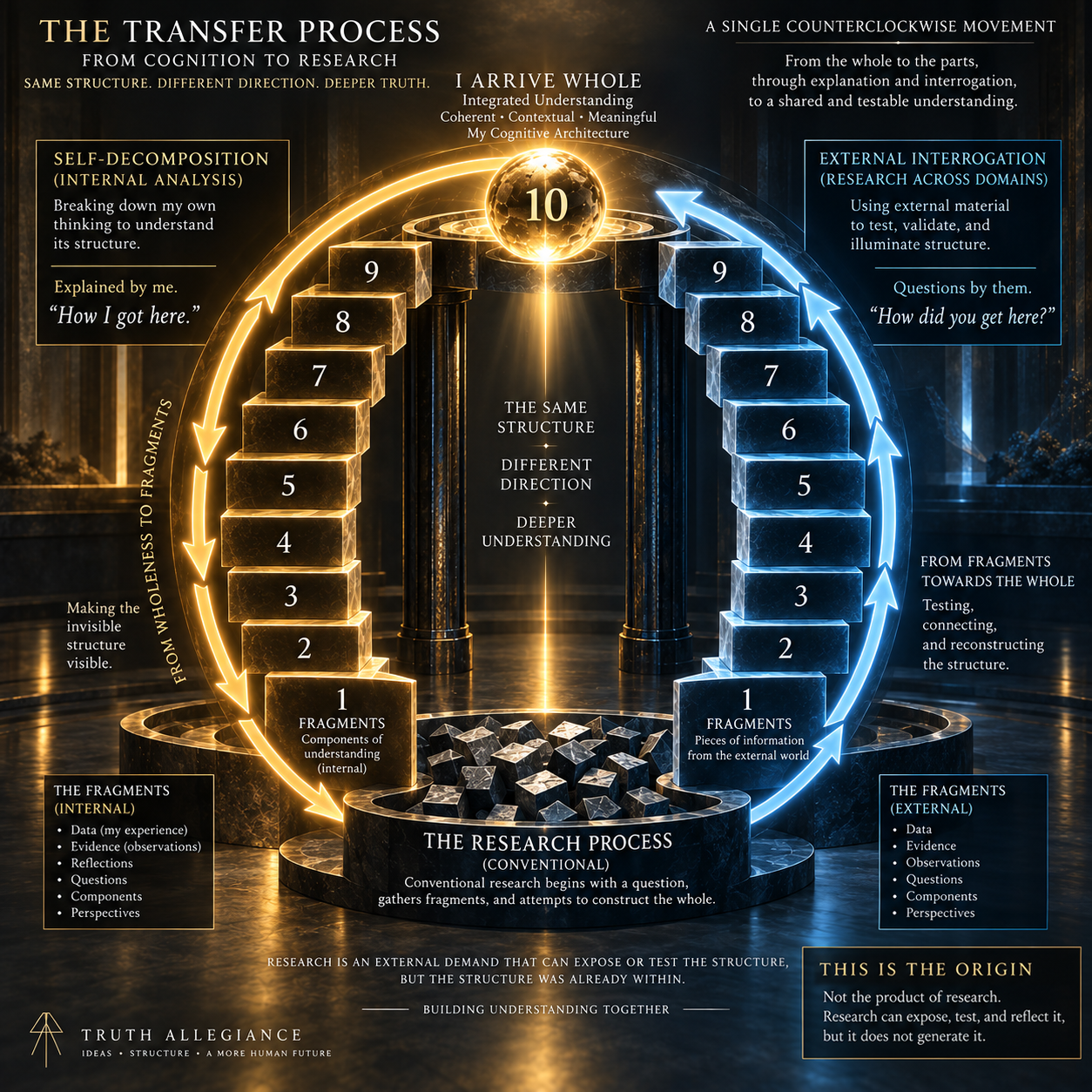
As this process was reviewed, another recognition began to emerge.
This was not merely the birth of Metacon Research.
It was the discovery of something beneath it.
Across inquiries, scrolls, pages of writing, books, investigations, revisions, questions, observations and moments of apparent departure from the original path, the same architectural movement appeared again and again.
And again.
And again.
The recurrence was no longer confined to a single inquiry. It was not simply a feature of one research method, one subject, or one period of investigation.
The same underlying movement could be witnessed across different domains, different questions, different forms of work and different points in time.
The investigator was beginning to observe not only what she thought, but how her cognition moved.
What had initially appeared to be methodology began to reveal itself as something more fundamental.
Metacon Research may have been one expression of this process.
The deeper discovery was the cognitive architecture that repeatedly generated it.
The object beneath the object
This distinction matters.
The question was no longer only:
How was Metacon Research formed?
It became:
What cognitive process repeatedly produces this way of seeing, questioning, testing, revising and restructuring?
The record provides an unusual opportunity to examine that question because the process was not reconstructed only after the fact. It was also witnessed while it was happening.
- The questions changed.
- The direction changed.
- Intuitions appeared.
- Warnings were recorded.
- Assumptions were exposed.
- Models were revised.
- Contradictions were retained.
- The investigator became part of the object of investigation.
Through this accumulation, a recurring sequence began to become visible.
Not as a theory imposed upon the earlier work.
As a pattern emerging from the work itself.
Ten observable movements
A provisional architecture
These ten movements are not presented as a finished cognitive theory.
They are a provisional description of a repeatedly witnessed process.
They are not yet claimed to be universal, exclusive, strictly linear, or unique to this investigator.
The movements may overlap. They may recur. They may occur in a different order. Several may be operating simultaneously. Further examination may divide, combine, rename, revise, or remove them.
That distinction must remain intact.
The discovery is not that the investigator has proven herself to possess a particular kind of cognition. The discovery is that, across a substantial body of recorded work, a recurring architecture of cognition appears to be operating.
And that architecture was operating before it had a name.
The architecture was not created by the description.
The description emerged because the architecture kept reappearing.
Metacon as visibility event
Metacon was not necessarily the beginning.
It may have been the moment the cognition became visible enough to be named.
The birth of Metacon Research and the discovery beneath Metacon are therefore related, but they are not the same event.
The first concerns the conscious articulation of a research object. The second concerns the recognition that the research object may itself have emerged from a recurring cognitive architecture already visible across earlier work.
Metacon may be one expression of that architecture.
It must not yet be treated as proof of it.
The risk of recognising the pattern too late
Because this architecture has now been named, later observations may be interpreted through it too easily.
The investigator may begin to find the ten movements because she expects to find them. Earlier work may be selectively reread to support the emerging structure. Differences between inquiries may be reduced in order to preserve the appearance of recurrence. The sequence may be reconstructed more cleanly than it actually occurred.
For that reason, the architecture must be tested against the record, not merely illustrated by it.
The search must include:
- Instances in which the sequence does not appear.
- Inquiries that developed through a different movement.
- Evidence that the ten movements are too broad to be meaningfully distinctive.
- Existing cognitive or methodological models that already describe the same architecture.
- Moments where retrospective interpretation has imposed order upon a less coherent process.
- Alternative explanations for the apparent recurrence.
Repeated recognition is not yet substantiation.
The pattern must still withstand the record that revealed it.
The research turns again
The object is no longer only the methodology that emerged.
It is the cognition from which the methodology emerged.
This does not remove Metacon Research from examination. It places Metacon inside a larger investigation.
The question now becomes:
What happens when cognition becomes capable of witnessing its own architecture while that architecture is still forming?
And beneath that question, another:
Can the architecture be examined without being protected by the very cognition that recognised it?
Discovery Beneath Metacon Record · Status
Metacon made the method visible.
The method made the cognition visible.
Now the cognition itself enters the record.
What may change?
This page is not static. The following may change:
- Definitions.
- Boundaries.
- Terminology.
- Procedures.
- Comparative claims.
- Implementation mechanisms.
- The interpretation of earlier observations.
- The name itself.
Substantive earlier positions should not simply disappear. They are versioned.
Position within the Truth Allegiance research architecture
Conceptual / philosophical architecture
Metacon Research
Research methodology
ConMetAI
Applied human–AI contribution methodology / implementation environment
These are presented as parts of an evolving research architecture, not as finished or universally validated systems.
Live application · the first instrument
The record is not only describing itself. It has already produced a working instrument: The Metrics of the Human System : a framework for observing Spirit, Mind, Heart and Behaviour as four nested layers of one human system.
The framework was formed inside the collaborative environment this record describes: human reasoning and AI contribution in sustained interaction, with disagreement, revision and adaptation preserved rather than cleaned away. It is presented here not as proof of the method, but as its first testable output: an instrument the non-protection principle applies to like everything else. If it stands, we learn something. If it breaks, we learn something more important.
The instrument remains a separate, working surface. It is linked to this record, not absorbed into it.
Version history
The cognitive architecture beneath Metacon enters the record as a provisional research object.
What changed in this version
- Section 10.10, The Discovery Beneath Metacon, added from the live research record.
- Ten observable cognitive movements entered as a provisional architecture.
- The record's object expands from the methodology to the cognition from which the methodology emerged.
- Seventh part of the River narration recorded, covering the discovery beneath Metacon.
Introduced
- the discovery beneath Metacon
- the distinction between Metacon and the cognition that generated it
- ten observable movements of the provisional cognitive architecture
- Metacon as a possible visibility event
- retrospective patterning and confirmation bias as explicit risks
- the cognition itself as a research object
The word “Alleged” is removed. The record becomes The Birth of Metacon Research.
What changed in this version
- Title transitioned from The Alleged Birth of Metacon Research to The Birth of Metacon Research, recorded verbatim as Section 10.9.
- Title Transition Record status panel opened; the change is bounded to the occurrence of the methodological formation.
- Status panel and live-record stamps updated to v0.5.
- Sixth part of the River narration recorded, covering the birth of the record.
Introduced
- the birth of Metacon Research as a consciously articulated research object
- the distinction between birth and validation, novelty, usefulness and survival
- birth establishes origin
- the object of the record changed: from “is this thing actually forming?” to “this thing has formed sufficiently to become the object of its own investigation”
- the question made more precise, not closed
The repeated absence enters the record as Section 10.8.
What changed in this version
- Section 10.8, The Repeated Absence, added verbatim from the live research record.
- Repeated Absence Record status panel opened; trace integrity named as the next review object.
- Fifth part of the River narration recorded, covering the repeated absence.
Introduced
- the repeated absence
- the introspective trace (provisional term)
- the researcher as object of methodological observation
- the bounded claim and the deliberate counterexample search
- the ethical consequence of a visible trace
- trace integrity: temporal, provenance, revision, omission, representational, AI trace, participant, correction
- preservation versus publication
- the problem of the false trace
- trace integrity as the next object of review
Whole-form recognition enters the record as Section 10.7.
What changed in this version
- Section 10.7, Whole-Form Recognition: Retrospective Structural Resolution, added verbatim from the live research record.
- Section 10.6 revised: the causal reading of the scan's finding replaced with disciplinary specialisation, recorded as a hypothesis rather than a finding of the present scan.
- Fourth part of the River narration recorded, covering whole-form recognition.
Introduced
- whole-form recognition
- reverse resolution (provisional term)
- the directional difference: one to ten, two through nine resolved retrospectively
- the external mirror: whole to fragments, fragments to possible whole
- the tapestry hypothesis
- retrofitting as an explicit risk
- the provenance advantage of the earlier dated trace
- the third question entered into the record
- the convergence of the internal and external traces, under investigation
The Review Process enters the record as Section 10.5.
What changed in this version
- Section 10.5, The Review Process, added verbatim from the live research record.
- Review Process Record status panel opened; model status recorded as Not Yet Formalised.
- Third part of the River narration recorded, covering the review process.
Introduced
- the review process
- the review event (provisional fields)
- reviewer provenance
- the boundaries of reviewer authority
- the review is also reviewed
- review authority must also be earned
- the originating AI problem
- independence as a variable
- internal pressure and external pressure
- possible review instruments: claim map, provenance map, version trace, contradiction register, failure register, review trace
- no-erasure applied to review
- the Metacon Review Model (provisional title)
Initial formal articulation of Metacon Research.
What changed in this version
- Title fixed to The Alleged Birth of Metacon Research.
- Neural Blueprint Hybrid visual direction applied to the hero.
- Full-page River narration added; script split across two TTS requests.
- Metrics of the Human System linked as the record's first live instrument.
- Live record stamp and version history made visible.
Introduced
- intentional use of “alleged”
- transparency
- precision
- the non-protection principle
- researcher nature, adaptation and productive conflict
- adaptive emergence
- inclusive research environment
- no-erasure principle
- irrelevance-as-data
- provisional considerations
- human/AI provenance
- reflexive entries
- planned global methodology scan
Record open · v0.6 · trace continuing