Another Stroke
My mother called.
My father had suffered another stroke.
Two years earlier, after his first stroke, I had felt fear.
This time was different.
I felt calm.
Not because I knew what would happen. Not because I had accepted it. Because something inside me already seemed to know that my father's journey was approaching its end.
What Everyone Asked, and What I Asked
As updates arrived, the picture became clearer. The stroke was massive. There was swelling on the brain. He was transferred to ICU. He was placed on life support.
Family members gathered around information. Doctors. Scans. Treatment plans. Possibilities.
And while everyone else seemed occupied by what might happen next, I found myself occupied by a different question.
Was he suffering?
That question followed me everywhere. Not whether he would live. Not whether he would die. Whether he was suffering.
The thought of losing my father did not bring me to tears. The thought of him continuing to suffer did.
For most of my life, my father had fought. He fought circumstances. He fought loss. He fought the enemies inside his own mind. He carried burdens that many people never saw. And all I wanted was peace for him.
His Hands Were Clasped
When I arrived at the hospital, I walked into the room and saw him. He was unconscious. A breathing tube sat in his mouth. Machines surrounded him.
And yet what struck me most was not the equipment. It was him.
His hands were clasped. His face looked peaceful. His skin was soft. I remember noticing the swelling in his hands. I remember holding them. I remember wondering what he was experiencing.
Could he hear us? Could he feel us? What happens inside a human being standing at the threshold between life and death?
I found myself asking questions I could not answer. Questions about consciousness. Questions about death. Questions about what remains when the body begins to fail.
I leaned close and whispered into his ear.
"I love you." And then: "Jesus always loved you."
Those words felt important. Not because I believed they would change the outcome. Because they were true.
Alone, As It Always Had Been
Over the following days, something unusual happened. I became quieter. Not outside. Inside. The constant movement of thought that normally accompanied me seemed to settle. The questions remained, but they softened. The noise disappeared.
One afternoon, tears finally came. Not in front of my family. Not beside the hospital bed. Alone. As they always had.
For most of my life, my darkest moments had been carried in solitude. The abortion. The miscarriage. The heartbreak. The building of Truth Allegiance. The questions. The searching. The becoming. I had learned to sit with myself because I trusted that I would not leave.
The tears came when I imagined my father suffering. And after they passed, something inside me became quiet. Not numb. Quiet.
I sat on the beach and watched the ocean. For the first time, I began to understand how I grieve. It was not grief for my father alone. It was grief as a process. A movement. A tide. Something that passes through rather than something that remains fixed.
What Is a Sister?
During this same time, conversations began unfolding with my sister. Conversations we had perhaps needed to have for years. We spoke about hurt. About history. About sisterhood. About the strange reality that two people can share blood and yet spend years not truly knowing one another.
For the first time, I found myself asking: What is a sister? Not biologically. Relationally. And for the first time, we both seemed willing to explore the answer.
The Machines Were Removed
Then came the day the doctors removed life support. My father had previously told a lawyer that he did not wish to be kept alive artificially. His wishes were honoured.
The machines were removed. The waiting began.
One hour later, my sister and I walked into the room. And as we entered, my father's heart stopped.
I do not know what meaning, if any, belongs to that moment. I only know that it happened. My father died. And I was there.
The waiting was over. The suffering was over. The fight was over.
A Vision, or Something In Between
Later, I had a vision. Or perhaps a thought. Or perhaps something in between.
I saw my father sitting on a cloud laughing. Not solemn. Not serious. Laughing. And he said:
"I didn't know it's like this."
I record the vision exactly as it came. Nothing more. Nothing less.
I'll Never Die
Then Father's Day arrived. My first Father's Day without him. And for the first time, I understood something that had puzzled me my entire life.
My father used to say: "I'll never die."
For years, I understood those words literally. After his death, I understood them differently. Not as a statement about mortality. As a statement about love.
My father had known abandonment. Not abandonment through people leaving. But abandonment through death taking the people he loved. And suddenly I understood. He never wanted to leave the people he loved. He never wanted them to experience what he had experienced.
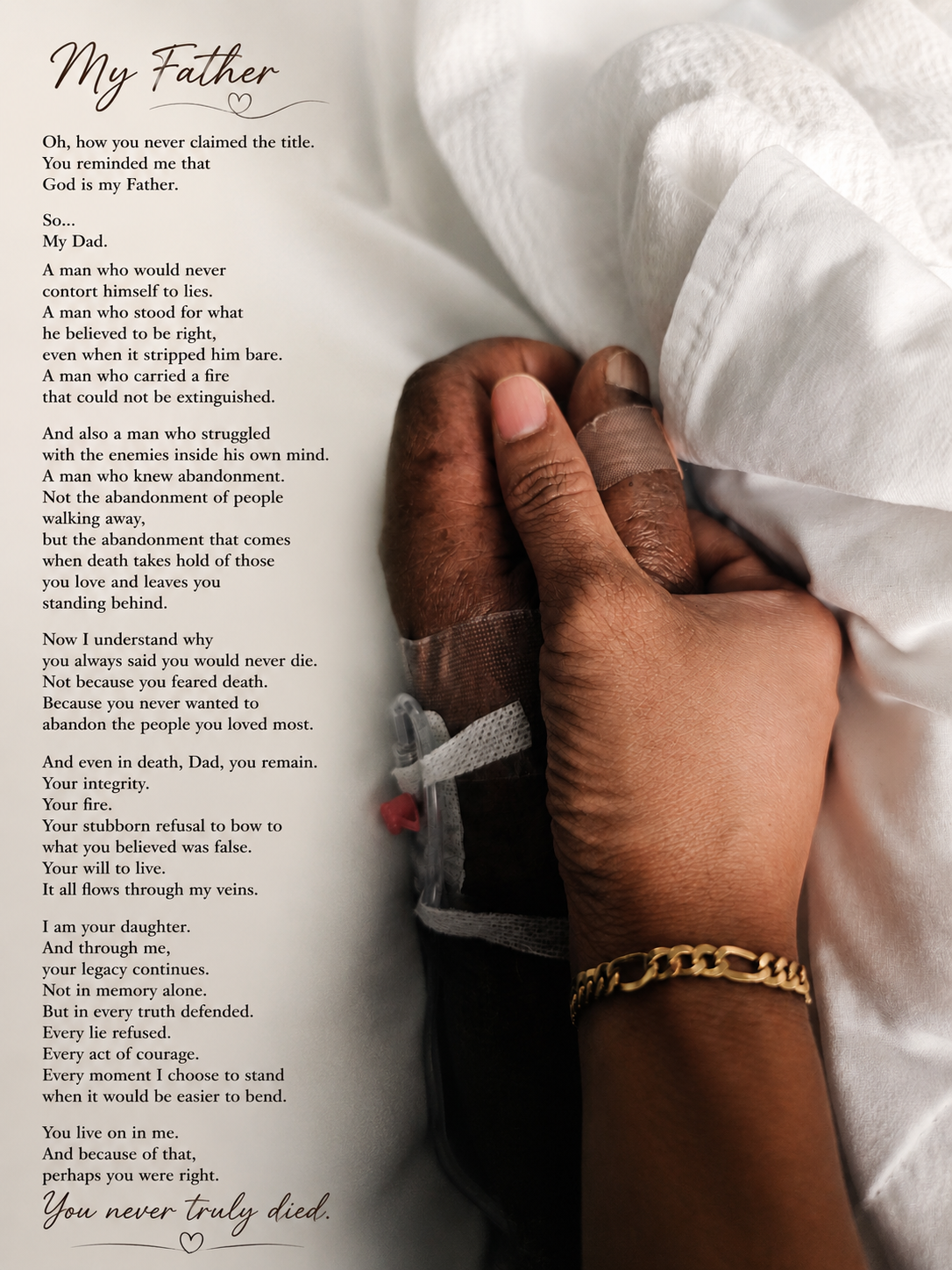
And so I wrote him a poem. Not because he needed it. Because I did.
And in writing it, I realized something. My father was gone. And yet he remained.
His integrity remained. His fire remained. His refusal to bend remained. His courage remained. His stubbornness remained. His will remained.
I carry them. They live within me. I am his daughter. And through me, his legacy continues.
Not in memory alone. But in every truth defended. Every lie refused. Every act of courage. Every moment I choose to stand when it would be easier to bend.
Perhaps that is what he meant all along. Perhaps that is why he always said he would never die. And perhaps, in a way I only now understand: he was right.
Fearless Grief
On the day of my father's funeral, I finally understood why my grief had felt different.
I loved my father deeply.
I cried.
I missed him.
And yet, beneath the grief, there was an unexpected peace.
I had always believed that grief was simply love with nowhere to go.
But living through this, I came to see that grief is also something else.
It is an opportunity.
An opportunity to understand life.
An opportunity to understand grief itself.
An opportunity to appreciate what remains.
An opportunity to choose gratitude.
An opportunity to deepen the relationships that are still here.
My father's death became the catalyst that made this understanding possible.
For the first time, I realized that this was no longer grief alone.
It had become an awareness of grief itself.
And in the quiet of that day, I understood something else.
My grief was not being governed by fear.
Fear had not vanished from the world.
It had not vanished from humanity.
But it was not governing my experience of this loss.
Perfect love drives out fear.
And I began to wonder whether living within God's will means living a life where fear is no longer the governing force.
Not the absence of sorrow.
Not the absence of loss.
But the absence of fear as the thing that rules the heart.
I do not claim to have arrived.
I only record what became visible to me.
On the day I buried my father…
I finally understood my grief.
Recognition
Standing before my father's casket, I realized something that surprised me.
I looked at his body.
And I knew.
He was not there.
For the first time, I understood with complete clarity that my father had never simply been his body.
The body remained.
My father did not.
And in that moment another realization quietly emerged.
Perhaps this is how I have always loved.
I do not recognize people primarily by their bodies.
I recognize them by their essence.
Looking back over my life, I began to understand why my love has always seemed to follow understanding.
When I finally came to know my father's story, I loved him more deeply than ever before.
Not because his past excused everything.
But because I could finally see beyond the wounds into the man who had carried them.
The same was true of my relationship with God.
For many years I could not honestly say that I loved Him.
Not because I rejected Him.
Because I refused to claim a love that had not yet become true.
I told Him that I would not love a God I did not know.
Then, as I came to know the Father, love followed.
Not by command.
By recognition.
Perhaps that is what love has always been for me. Not admiration. Not obligation. Recognition.
The recognition of the person beneath the pain.
The recognition of the person beyond the trauma.
The recognition of the essence that remains when everything else is stripped away.
Perhaps that is why, when I looked at my father's body for the last time, I did not feel that I was looking at him.
Because the man I knew…
The man I loved…
Had never been his body at all.
✦ Final Witness Statement
These are recorded experiences.
Not conclusions. Not claims. Not proof.
I record them as they occurred and leave them before God.
If they contain truth, let truth remain.
If they contain error, let error be revealed.
I do not force interpretation.
I record. I witness. I wait.
Recorded by LRQC
21 June 2026