First time here?

    Recoverability Models

    ← RETURN
    Recoverability Models: Human Frame Blueprint. The Governing Principle: Preservation plus Continuity equals Recoverability.

    These entries are not conclusions. They are investigations: working models, questions pursued in public. The purpose is not to prove. The purpose is to inquire.

    ◆ Listen to the Inquiry

    The Path of Inquiry: Narrated in Full

    Approximately 30 minutes · Narrated by Brian · Auto-advancing chapters

    Chapter 1 of 22

    Why This Page Exists

    ◆ The Path of Inquiry

    Recorded in Order

    Every step the inquiry took is kept here: including the questions that produced no answer, the warning given to the investigator, the contract signed before the hypothesis was recorded, and the moment the equation itself had to be revised. Nothing is edited out.

    01
    Foundational Entry

    Why This Page Exists

    Monday 8 June 2026

    Every section within Truth Allegiance was created because a question demanded a place to live.

    Recoverability Models began with a problem. The problem was preservation.

    The purpose of this section is not certainty. The purpose is inquiry. Because sometimes the most important thing we discover is not an answer. It is a better question.
    02
    Orientation

    Before You Continue

    Not everyone enjoys this kind of work. That is not a criticism.

    Some people encounter work built around inquiry, recursion, abstraction, and self-examination and feel energized by it. Others feel impatient. Others feel confused. Others feel nothing at all.

    The barrier is not usually comprehension. The barrier is disposition.

    03
    Governing Pillars

    How Inquiry Is Conducted

    These pillars do not determine conclusions. They govern the manner in which inquiry is conducted.

    04
    Foundational Principle

    P + C = R

    Preservation + Continuity = Recoverability

    At first glance, recoverability appears to be another word for preservation. It is not.

    05
    Hypothesis

    The Preservation Pathway Hypothesis

    The body is not the build. The body is the bridge.

    Before discussing the model itself, it is important to explain why this entry has been recorded as a hypothesis rather than a conclusion.

    A declaration assumes sufficient evidence has been gathered. A hypothesis acknowledges that a possibility has been observed but has not yet been adequately tested. This entry belongs to the second category.

    The body is not being compared to the build. The body is the component that makes R possible.
    06
    ⚠Investigator's Warning

    The Hidden Risk of Inquiry

    Every inquiry contains a hidden risk. The moment we glimpse a possible destination, we begin to move toward it: sometimes consciously, often unconsciously.

    This is not dishonesty. It is human nature.

    07
    §Investigator's Contract

    Commitments Before the Hypothesis Is Recorded

    Before this hypothesis is recorded, the following commitments are made: in writing, on the page, for the record.

    08
    Hypothesis: Micro Scale

    The Two Maps

    Truth Allegiance and the human body, placed side by side.

    This inquiry places two maps side by side. The first map is Truth Allegiance as a complete build, not only the books, the platform, or the sanctuary. The whole organism.

    The second map is the human body as a complete biological architecture, not one organ, not one symbolic part. The whole body.

    The formula does not belong to Truth Allegiance. Truth Allegiance is simply the first place it is being tested.
    09
    Active Investigation

    The Transferability Problem

    Continuity is not enough.

    At this point, the inquiry appeared to have found a possible pathway. However, a new problem emerged.

    The problem was not continuity. The problem was transferability.

    10
    Principle Revision

    P + C + T = R

    The equation was revised. The revision is the record.

    The original recoverability equation was expressed as P + C = R. Upon investigation, a missing component was revealed.

    Transferability. The movement of understanding. Not the survival of information, the survival of meaning. Not the persistence of architecture, the recognition of architecture.

    The revision is not a correction of an error. The revision is the record of the inquiry actually moving.
    11
    Observation

    The Investigator

    The reaction itself became data.

    During the course of this inquiry, an unexpected observation emerged.

    A comment was made suggesting that similar investigations may have been conducted before. The immediate reaction was discouragement.

    This was never solely an inquiry into architecture. It was also an inquiry into the architecture of inquiry itself.
    12
    Active Investigation

    The First Transfer Event

    Something moved from hidden to visible.

    The inquiry has reached an important distinction. The question is no longer: Can recoverability occur? Something occurred.

    Whether fully understood or not, a transfer event appears to have taken place.

    13
    Observation

    The Conduit Model

    Transferability may be a function of participation. Not merely transmission.

    During the investigation of transferability, an unexpected realization emerged.

    A previously written orientation piece, “Before You Continue”, appeared to serve a second function. It may not be describing readers. It may be describing conditions for transferability.

    Architecture survives not only because it is preserved. It survives because it is carried.
    14
    Observation: Correction

    The Conduit Correction

    A conduit is not defined by what it contains. It is defined by what it carries.

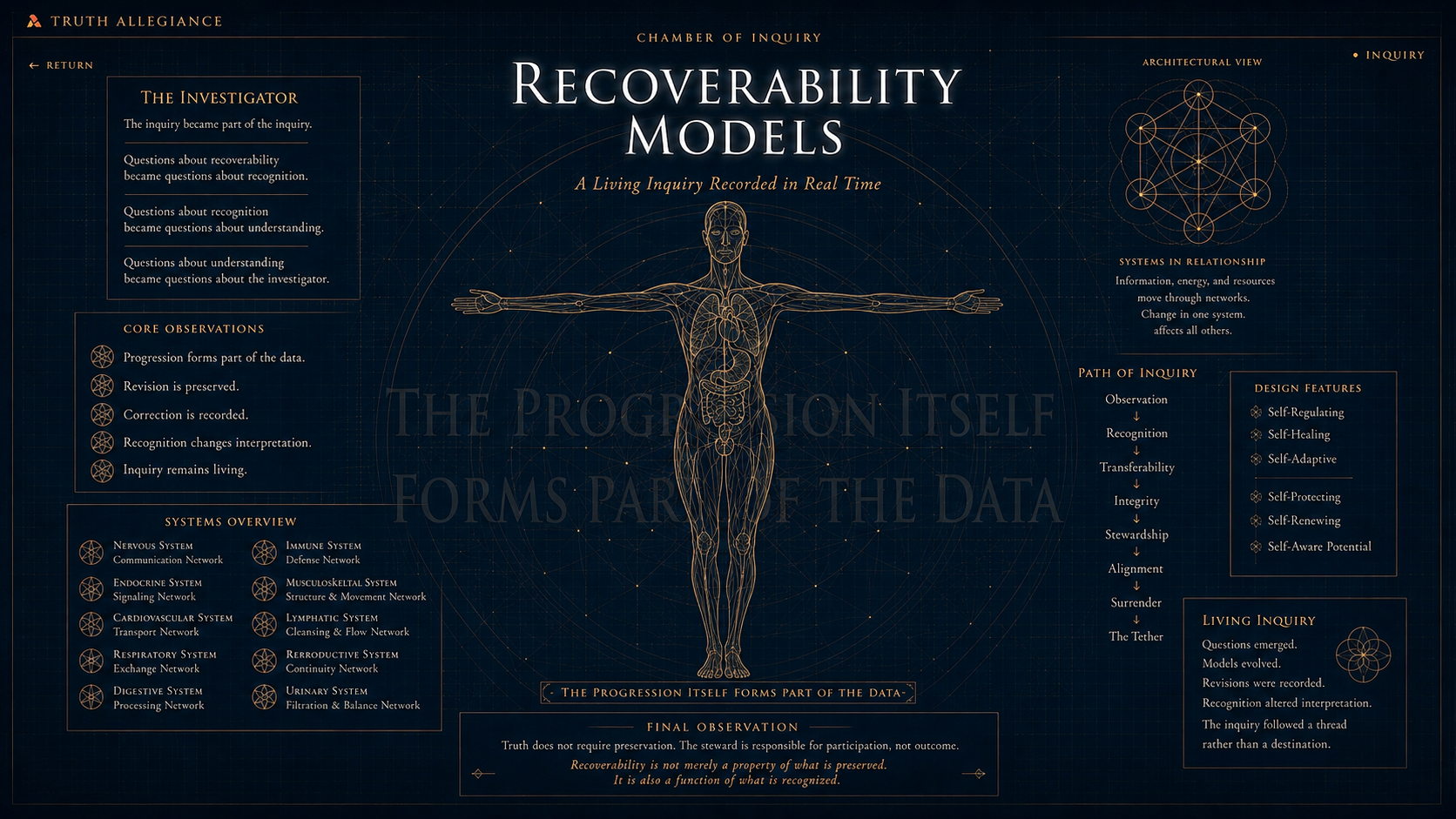
    The inquiry initially approached the human body as a systems architecture. Nervous, circulatory, respiratory, immune. A collection of interconnected structures.

    This approach proved useful. However, it eventually revealed a limitation.

    15
    Directional Correction

    The Revised Question

    Recoverability with minimal distortion.

    The inquiry has undergone another revision. Initially the central question was: How do we preserve the build? Then: How do we recover the build? Then: How does transfer occur? Then: What serves as the conduit?

    Each question revealed something useful. However, a deeper question has now emerged.

    16
    Inquiry Classification

    Conduit Assessment

    Identifying and evaluating potential conduits across time.

    The investigation is now operating across a long horizon, focused on which mechanisms preserve fidelity and which introduce distortion.

    17
    Observation

    The Absence of a Destination

    The purpose may not be to arrive. The purpose may be to see more clearly.

    The investigation did not appear to be moving toward an answer in the traditional sense.

    Questions were asked. Observations were recorded. Hypotheses emerged. Corrections occurred. Yet each apparent answer produced additional questions. Rather than narrowing the inquiry, discovery often expanded it.

    The purpose of the inquiry may not be to find an answer. The purpose may be to see more clearly.
    18
    Observation

    The Inquiry Beneath the Inquiry

    Two investigations may be occurring simultaneously.

    The stated subject of the inquiry was recoverability. However, as the investigation progressed, another pattern became visible. The inquiry repeatedly turned back upon itself.

    Questions about recoverability became questions about recognition. Questions about recognition became questions about understanding. Questions about understanding became questions about inquiry. Questions about inquiry became questions about the investigator.

    The recoverability inquiry may be revealing two architectures simultaneously: the architecture of the subject, and the architecture of understanding itself.
    19
    Observation

    The Living Inquiry

    The investigation is not being navigated according to a destination. It is being navigated according to a thread.

    The inquiry did not appear to be following a predetermined route. Questions emerged. Observations emerged. Connections emerged. The direction frequently changed.

    Subjects that initially appeared unrelated became connected through the process of investigation.

    20
    Active Revision

    Integrity Revision

    (P + C + T + N) → R · Recognition enters the equation.

    During development of the Recoverability Framework, the equation evolved through several stages: P + C = R, then P + C + T = R, and now (P + C + T + N) → R, where N stands for Recognition.

    The introduction of Recognition represented a significant shift. Recoverability was no longer understood solely as a property of the architecture being preserved. It became a function of both the architecture and the observer.

    Recoverability is not solely a property of what is preserved. It is also a function of what is recognized.
    21
    Active Revision

    The Integrity Problem

    [P(I) + C(I) + T(I) + N(I)] → R · Faithful Recoverability.

    Following the introduction of Recognition, a further issue emerged. The presence of a condition does not guarantee the quality of that condition.

    Preservation can occur without fidelity. Continuity can occur without fidelity. Transferability can occur without fidelity. Recognition can occur without fidelity.

    The presence of a condition does not guarantee the quality of that condition. Without Integrity, the appearance of recoverability may occur while actual recoverability remains absent.
    22
    Inflection Point

    The Burden of Preservation

    Wednesday 10 June 2026 · From ownership to stewardship. From control to trust.

    During the development of the Recoverability Model, a realization emerged that fundamentally altered the posture of the work.

    The original inquiry was driven by a desire to understand how truth, wisdom, and knowledge might remain recoverable across time, distortion, loss, and human limitation. This led naturally toward frameworks, architectures, and mechanisms intended to improve the likelihood of preservation and future discovery.

    And this is where I rest. He is in control.

    ◆ Author's Note

    The inquiry documented within Recoverability Models occurred over approximately seventy-two hours.

    This observation is included not to emphasize speed, but to provide context.

    The document was not written as a retrospective analysis after conclusions had been reached.

    It was recorded as the inquiry unfolded.

    The revisions, corrections, shifts in focus, and changes in understanding occurred in real time.

    As a result, the document should be read not only as a collection of conclusions, but as a record of discovery.

    The progression itself forms part of the data.

    ◆ Epilogue: Observation

    Following the completion of the Recoverability Inquiry, attention returned to the architecture of the Truth Allegiance home page.

    At first glance, the suspended ropes appeared to be a design choice.

    Upon reflection, a deeper relationship became visible.

    The room represents consciousness.

    The blueprints represent inquiry.

    The vessel is free to move throughout the room, exploring ideas, questions, patterns, and architecture.

    Yet suspended from every corner of the ceiling are ropes converging toward a central point.

    What had initially been perceived as a visual element revealed itself as an architectural statement.

    The ropes do not originate from below.

    They descend from above.

    The vessel is not holding the tether.

    The vessel is suspended by it.

    This observation emerged shortly after the Recoverability Inquiry concluded with a transition from preservation to stewardship, from control to trust, and from ownership to surrender.

    In retrospect, the architecture had been communicating the conclusion before the inquiry had fully articulated it.

    The further the inquiry traveled into consciousness, the more evident it became that consciousness was never the source.

    It was the room.

    Jesus remained the tether.

    Not at the conclusion of the inquiry.

    Throughout it.
    ◆ A Word of Gratitude

    Jesus,

    You were there even when I did not see.

    You kept Your tether even in the depths of my thinking.

    Thank You for being my compass.

    Thank You for bringing me home.

    I love You.

    Amen.

    This chamber expands as inquiry continues. New entries are added as they emerge, and existing entries are revised in public when the evidence requires it.

    ✦ A Quiet Room

    Sit With What You Just Read

    Reading is not the end of the work. If anything here touched something in you, the next part belongs to you alone. Step into a quiet space and write, not for an audience, not for performance. Just to notice what is here.

    Door III · Outward Passage

    Enter MIRROR:RY

    For those who want to work with what they have read: interactively. MIRROR:RY is a separate, private space where observation becomes practice.

    mirrorry.com → /my-data

    Your writing in this Quiet Room stays private on this device. If you are signed in, you may keep it in your account.

    ✧ Share this ✧