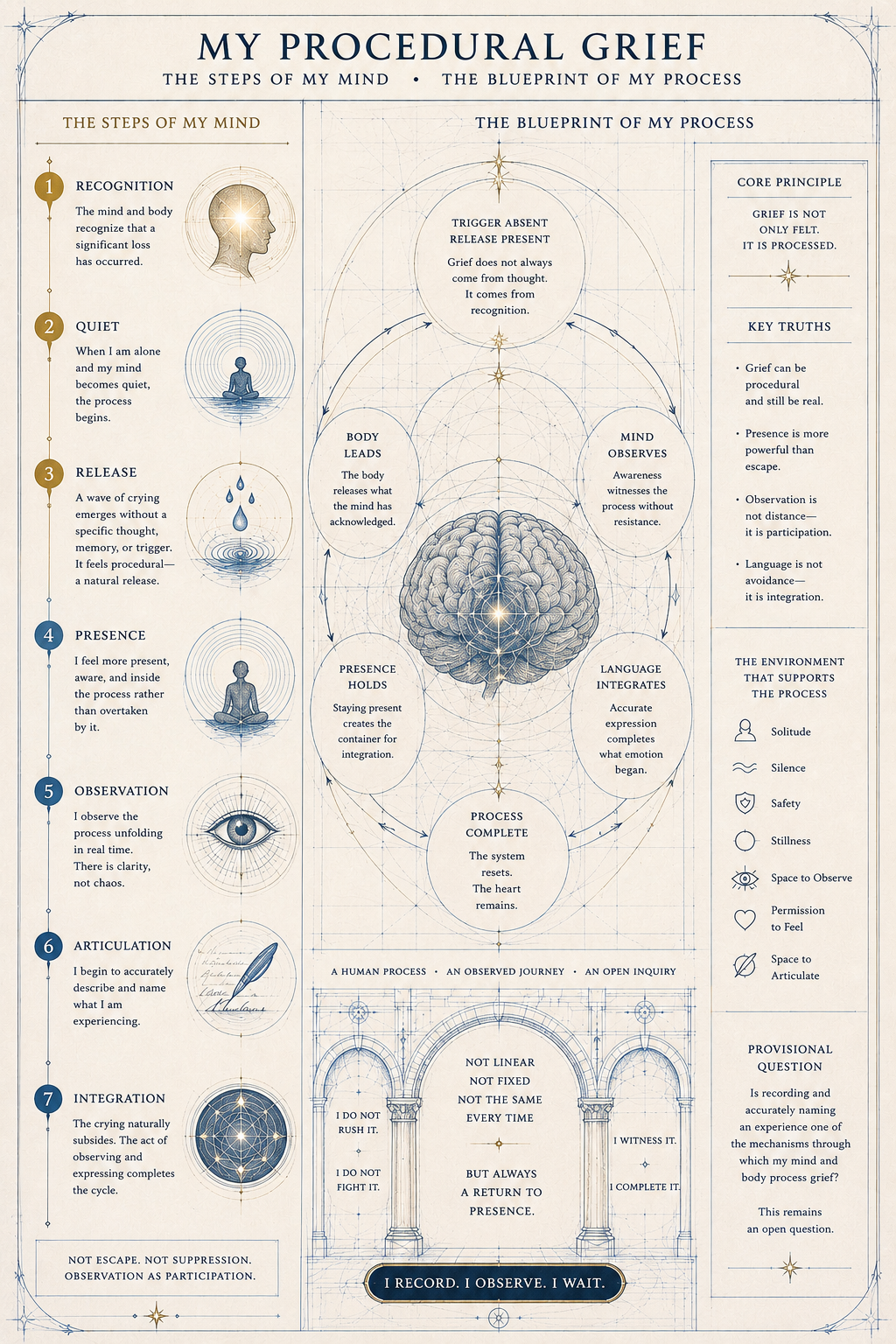
A Personal Observation
This is not an attempt to explain grief for others.
It is an observation of one human being attempting to understand her own process.
After the death of my father, I expected grief to feel primarily emotional.
Instead, I found myself observing something different.
The experience felt procedural.
Not detached. Not absent of love. Not unemotional.
Procedural.
Almost as though my mind and body had initiated a sequence designed to integrate significant loss.
The Nature of the Process
The tears would emerge without warning.
Often there would be no conscious memory preceding them.
No deliberate recollection. No identifiable emotional trigger.
Simply… release.
During these moments, I did not experience myself as overwhelmed.
Instead, I became increasingly aware of the process itself.
I observed it while participating in it.
Curiously, something else began to happen.
As I accurately described what I was experiencing, the crying naturally subsided.
Not because I distracted myself. Not because I suppressed it.
Because something appeared to complete.
A Question Emerges
This has led me to a provisional question.
I wonder whether, for some people, grief is processed not only through emotion… but also through observation.
Perhaps language is not simply a way of describing the experience.
Perhaps, for certain minds, accurate description is one of the mechanisms through which the experience becomes integrated.
I do not know whether this is true.
I only know that it appears to be true for me.
So I record. I observe. And I wait.
A Recorded Firing
Context: Alone in the morning.
A wave of crying emerged without a specific thought, memory, or emotionally distressing trigger.
The experience did not feel like emotional sadness in the conventional sense.
It felt procedural, as though the mind and body recognized that a significant loss had occurred and were carrying out an internal process.
When alone and the mind becomes quiet, the crying begins.
During the experience, I feel more present, more aware, and more inside the process rather than overtaken by it.
There is no sense of drowning in emotion or losing control.
Instead, there is an awareness of the process unfolding in real time.
As I begin to articulate and accurately describe the experience, the crying naturally subsides.
It does not feel interrupted. It does not feel suppressed.
Rather, observation itself appears to form part of the process.
A variation in the expected shape of grief
Today did not feel like grief in the way I previously understood it.
There was no rupture. No emotional collapse. No felt sense of something missing inside the ordinary structure of the day.
Life continued as normal. The internal world stayed coherent. Nothing felt broken or displaced.
And yet, in moments of quiet, something would begin without warning.
Tears arriving without narrative. Without memory. Without emotional escalation I could point to and name.
Not intense. Not overwhelming. Just… happening.
While it occurred, I remained aware. Not distant from it, but inside it and noticing it at the same time.
There was no strong feeling of sadness sitting underneath it. Only the process itself, moving through.
This creates a strange kind of mismatch in perception:
What I know intellectually has changed, and what I feel experientially do not align in any obvious emotional way.
And yet nothing about this feels wrong while it is happening.
It simply feels like this is how it is occurring in me.
Life remains normal.
Nothing feels absent.
And still:quietly, intermittently:the process continues.
Integration Through Description
I wonder whether, for some people, grief is processed not only through emotion…
but also through observation.
Perhaps language is not simply a way of describing the experience.
Perhaps, for certain minds, accurate description is one of the mechanisms through which the experience becomes integrated.
I do not know whether this is true.
I only know that it appears to be true for me.
So I record. I observe. And I wait.
Is recording and accurately naming an experience one of the mechanisms through which my mind and body process grief?
This remains an open question.
This is a process record.
Not a claim. Not a theory. Not advice.
I record what I observe and leave it before God.
If it contains truth, let truth remain.
If it contains error, let error be revealed.
Recorded by LRQC
29 June 2026